
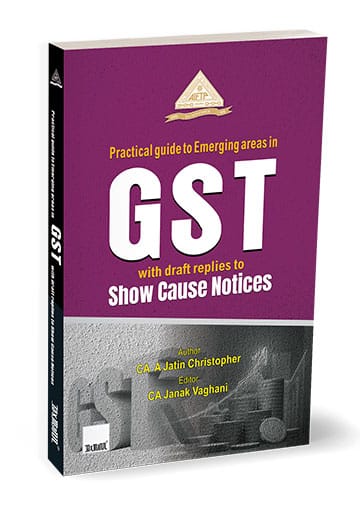

Taxmann’s Practical Guide to Emerging Areas in GST with Draft Replies to Show Cause Notices by AIFTP
₹745.00
Taxmann’s Practical Guide to Emerging Areas in GST with Draft Replies to Show Cause Notices by AIFTP – Edition 2026. Practical Guide to Emerging Areas in GST with Draft Replies to Show Cause Notices is a litigation-focused and practice-driven GST publication addressing the most contentious issues arising in audits, scrutiny, investigations, and adjudications. Structured into two parts, it combines rigorous legal analysis of substantive and procedural GST law with meticulously drafted replies to commonly issued show-cause notices. Commissioned by the All-India Federation of Tax Practitioners (AIFTP) and published by Taxmann, the book covers high-risk dispute areas such as ITC denial, return mismatches, valuation, cross-charge/ISD, penalties, interest, and confiscation. It equips practitioners, corporates, litigators, administrators, and advanced students with a clear, authoritative, and procedurally sound framework for handling GST disputes.
9 in stock
Taxmann’s Practical Guide to Emerging Areas in GST with Draft Replies to Show Cause Notices by AIFTP – Edition 2026.
Taxmann’s Practical Guide to Emerging Areas in GST with Draft Replies to Show Cause Notices by AIFTP – Edition 2026.
Description
Practical Guide to Emerging Areas in GST with Draft Replies to Show Cause Notices is one of the most strategic, litigation-ready, and conceptually advanced GST publications. It is not a routine commentary on the Act. Instead, it identifies the precise areas where GST disputes are intensifying nationwide, in audits, scrutiny, investigations, and adjudications. It provides a principled, evidence-backed, draft-ready framework to defend taxpayers. The book is organised in two integrated parts:
- Part I decodes the law through first principles, case law, inter-statute comparison, and administrative law doctrines. It explains not only what the law is, but why certain departmental approaches are erroneous or ultra vires
- Part II operationalises these principles by meticulously drafting replies to the very SCNs that taxpayers are currently receiving, making this the first book to bridge high-level legal analysis with practical drafting templates.
The result is a publication that redefines how GST disputes are understood and handled, equipping readers to respond with clarity, authority, and procedural precision.
This book is intended for the following audience:
- GST & Indirect Tax Practitioners – Professionals who advise, represent, or defend clients in audits, investigations, adjudications, and appeals, including those appearing before GSTAT
- Corporate Tax, Finance & Compliance Leaders – CFOs, tax heads, controllers, and compliance teams dealing with complex valuation, ITC, cross-charge, contract interpretation, and credit distribution issues
- Litigators & Dispute-resolution Specialists – Advocates needing a statute-backed, case-law-supported, and ready-to-adapt drafting resource
- GST Officers & Administrators – Officers (Central and State) seeking doctrinal clarity on jurisdiction, proper officer roles, audit vs investigation boundaries, confiscation prerequisites, and due-process limitations
- Scholars & Advanced Students of Taxation – Researchers studying GST’s structural architecture, interplay with allied laws, and modern principles of tax administration
The Present Publication is the Latest Edition, commissioned by the All-India Federation of Tax Practitioners (AIFTP) and published exclusively by Taxmann. It is authored by CA. A Jatin Christopher and edited by CA. Janak Vaghani, with the following noteworthy features:
- [Advanced Treatment of GST’s Most Litigated Areas] The book identifies and analyses the ‘pressure-point issues’ that consistently appear in SCNs, audit objections, and adjudication orders. These include:
- Deemed supplies and free-issue material
- Discounts & pricing structures
- Cross-charge vs ISD (post-2025 amendments)
- Corporate guarantees (post Rule 28(2))
- ESOPs & cross-border employee cost allocations
- Section 194R perquisites & barter structures
- Non-genuine suppliers & ‘fake ITC’ disputes
- Section 16(4) time-barred credits
- Confiscation vs seizure, interest computation, and jurisdictional lapses
- The author provides not only the statutory interpretation but also the logical, contractual, and evidentiary framework that determines the GST consequence
- [Most Complete Exposition of Departmental Powers & Limitations] It thoroughly explains:
- What scrutiny can and cannot examine
- How audit differs from investigation
- Why Section 67 powers cannot be used for routine verification
- What constitutes ‘reasons to believe’
- How the jurisdiction of the ‘Proper Officer’ is established
- Why linear comparisons (GSTR-1 vs 3B; 2A/2B vs 3B; EWB vs 3B) are jurisprudentially unsound
- How to challenge invalid authorisations, defective SCNs, incorrect service, and overreach
- Each chapter functions as a practical defence manual for disputes
- [Draft Replies that Practitioners can Deploy Immediately] Every reply is:
- Richly reasoned
- Statutorily anchored
- Supported by CBIC circulars, instructions, and press releases
- Aligned with evidence, law and administrative law doctrines
- Structured exactly as adjudicating authorities expect replies to be structured
- Templates cover 15+ scenarios, including mismatches, ITC objections, e-way bill disputes, late fee/penalty, interest-only demands, RCM alleged short payments, ‘other income’ disputes, SPL-1 to SPL-4 amnesty replies, and non-genuine supplier allegations
- [Litigation Strategy Woven into Every Chapter] The book explains to the reader:
- When not to reveal facts prematurely
- How ‘without prejudice’ is misused and how to avoid self-damage
- How to shift the burden of proof back to the department
- Why SCN defects are fatal and cannot be cured in adjudication (Section 75(7))
- How to prepare strategically for Tribunal, keeping in mind the limitations, interest cost, and probability analysis
- Why remand, revision, and enhancement require strict statutory compliance
- [Robust Case-law Integration] Includes an extensive catalogue of landmark decisions such as:
- Govind Saran, Oryx Fisheries, Nazir Ahmad, Brindavan Beverages, Binapani, Menaka Gandhi, Mafatlal, Ramlal, KM Cheria Abdulla, Gannon Dunkerley, Bhayana Builders, NM Goel, etc.
- These are embedded in reasoning and drafting
The coverage of the book is as follows:
- Part I – Essential Aspects of GST Law | A doctrinal, example-rich, litigation-oriented analysis covering:
- Contractual Architecture of GST Liability
- Why GST disputes must begin by reading the commercial contract; how to detect sham contracts; interaction with RERA, NHAI, Stamp Act, Legal Metrology rules, and accounting disclosures
- Classification of Supplies, Fiction & Non-fiction
- Clarifies misunderstood concepts of ‘deemed supply’, ‘deeming fiction’, ‘distinct persons’, and the limits of Schedule I
- Valuation Challenges – Discounts, FIM, Guarantees, ESOPs
- Each area is analysed with illustrations, court precedents, and statutory logic, resolving common misconceptions that lead to flawed SCNs
- Powers of the State vs. Rights of the Taxpayer
- A tour of Sections 59, 61, 62, 63, 65, 67, 69, meticulously explaining their boundaries, preconditions, procedural safeguards, and consequences of breach
- Interest, Confiscation, Remand & Revision
- Demystifies interest computation under Rule 88B, establishes the ‘seizure → custody → confiscation’ chain, clarifies when remand is appropriate, and warns against revision being misused as a second adjudication
- GSTAT Procedures & Future of GST Litigation
- A deep review of the new GSTAT Procedure Rules 2025, hybrid hearings, registry powers, filing defects, and how litigation strategy must evolve
- Death of the Taxpayer
- A sophisticated discussion on abatement of proceedings when a taxpayer (individual or company via merger) ‘dies,’ and the limits of recovery from legal heirs or successors
- Contractual Architecture of GST Liability
- Part II – Draft Replies to Emerging Issues | A complete ready-to-use drafting suite covering:
- GSTR-1 vs 3B
- GSTR-2A vs 3B
- GSTR-2B vs 3B
- GSTR-7 (TDS) mismatches
- Section 16(4) denial of ITC
- Fake ITC/non-genuine supplier allegations
- Free-of-cost supplies, expenditure-based supply allegations
- E-way bill mismatches
- RCM disputes
- Interest-only demands
- Late fee & general penalty
- Mandatory CGST-SGST issues (Section 77)
- SPL-1, SPL-2, SPL-3, SPL-4 replies under Amnesty Scheme
- Each draft contains robust statutory argumentation, procedural objections, and a legally sound ‘Relief Sought’ section
The structure of the book is intentionally problem-solution oriented:
- Problem – What kinds of SCNs are being issued?
- Principles – Which legal doctrines apply (contract law, evidence law, administrative law, allied laws)?
- Process – Which statutory procedures must Revenue follow, and where is overreach occurring?
- Protection – Which rights, safeguards and jurisprudential tools does the taxpayer have?
- Practice – A ready-to-deploy reply draft structured as per real adjudication expectations.
Details :
- Publisher : Taxmann
- Author : All India Federation of Tax Practitioners
- Edition : 2026
- ISBN-13 : 9789375618492
- ISBN-10 : 9789375618492
- Language : English
- Binding : Paperback
| Publisher | Taxmann |
|---|---|
| Author | All India Federation of Tax Practitioners |
| Language | English |
Only logged in customers who have purchased this product may leave a review.
Related products
Bharat’s Income Tax Act, 2025 (Pocket Edn.) – 39th Edition 2026
Bharat's Income Tax Act, 2025 (Pocket Edn.) - 39th Edition 2026. First, this Bharat publication provides the exact pocket-sized legal text on direct tax laws for professionals in India. Specifically, compiled by Bharat Law House, this compact reference book details the statutory rules of the newly active Income Tax Act, 2025. Furthermore, this 39th edition includes highly useful comments and cross-reference tables updated for easy use on the go.
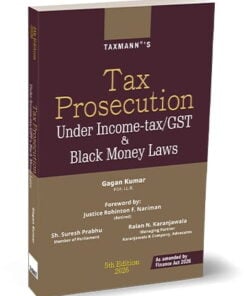
Taxmann’s Tax Prosecution under Income-tax/GST & Black Money Laws by Gagan Kumar
Taxmann's Tax Prosecution under Income-tax/GST & Black Money Laws by Gagan Kumar - 5th Edition 2026. First, this Taxmann publication provides the exact text on criminal tax liabilities. Specifically, author Gagan Kumar details the strict rules for tax prosecution. Furthermore, this fifth edition covers all fundamental 2026 statutory frameworks perfectly.
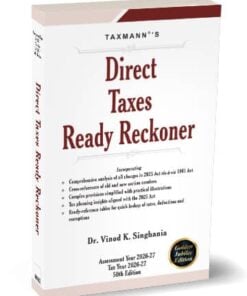
Taxmann’s Direct Taxes Ready Reckoner by Vinod K Singhania
Taxmann's Direct Taxes Ready Reckoner by Vinod K Singhania - 50th Edition March 2026 (A.Y. 2026-27) & (Tax Year 2026-27). First, this Taxmann publication provides the exact tax rates. Specifically, author Vinod K Singhania details strict tax planning. Furthermore, this 50th Edition covers all fundamental assessment year updates perfectly.

Taxmann’s Business Analytics by H.K. Dangi – 1st Edition 2024
Taxmann's Business Analytics by H.K. Dangi - 1st Edition 2024. This book underscores the pivotal role of data in the contemporary business landscape, blending theoretical knowledge with practical application to prepare students and professionals for data analysis and strategic implementation. It aligns with the UGCF 2022 syllabus under the National Education Policy of the University of Delhi. Covering a wide array of topics from data preparation to ethics in business analytics, it integrates tools like MS Excel, Tableau, and R for comprehensive learning in business analytics.

Reviews
There are no reviews yet.