

DLH’s Law on Contempt of Courts by Iyer – 7th Edition Reprint 2024
Original price was: ₹4,195.00.₹3,146.00Current price is: ₹3,146.00.
DLH’s Law on Contempt of Courts by Iyer – 7th Edition Reprint 2024.
10 in stock
DLH’s Law on Contempt of Courts by Iyer – 7th Edition Reprint 2024.
DLH’s Law on Contempt of Courts by Iyer – 7th Edition Reprint 2024.
Description :
Anything that curtails or impairs the freedom of limits of judicial proceedings must of necessity result in hampering of the administration of Law and in interfering with the due course of justice. This necessarily constitutes “Contempt of Court” Oswald defines contempt to be constituted by any conduct that tends to bring the authority and administration of Law into disrespect or disregard or to interfere with or prejudice parties or their witnesses during litigation. Halsbury defines contempt as consisting of words spoken or written which obstruct or tend to obstruct the administration of justice. Black Odgers enunciates that it is contempt of Court to publish words which tend to bring the administration of Justice into contempt to prejudice the free trial of any cause or matter which is the subject of civil or criminal proceeding or in any way to obstruct the cause of justice
Article 19(1)(a) of the Constitution gives the right of freedom of speech and expression to all citizens and this freedom of speech can legitimately be subjected to reasonable restriction on the ground of contempt of Court But Articles and 215 gives the power of contempt of Court to the higher judiciary, and this power limits the freedom granted by Article 19(1)(a). The definition of contempt is elastic, open to subjective interpretation and the process is complex with the Court acting as the complainant, prosecutor and Judge rolled into one.
The Contempt of Courts Act, 1971 prohibits any reporting or comment which would prejudice or interfere with the course of the judicial process, Another type of criminal contempt involves scandalising the Court by remark that tends to lower the authority of the Court. It is fair to criticise any order, direction or judgment even in harsh words. However, allegation of corruption, bias, nepotism or any statement relating to non-legal reasons including ideological orientation invites the wrath of contempt jurisdiction.
Section 2(a) of the Contempt of Courts Act, 1971, defines contempt of Court as civil or criminal contempt. It is generally felt that the existing law relating to contempt of courts is some what uncertain, undefined and unsatisfactory. The jurisdiction to punish for contempt touches upon two important fundamental rights of the citizens, namely, the right to personal liberty and the right to freedom of expression.
In a latest case which made headlines-In re Prashant Bhushan and Anr., Suo motu Contempt Petition (Cri.) No.1 of 2020 decided on 31st August, 2020 (Popularly known as the Prashant Bhushan case) the Apex Court refused to consider the averments in the affidatin reply het by Mr. Prashant Bhushan The averments made several allestions both retired and sitting Judges. Court held that freedom of youth ores freedom to make fair criticism but some cannot be stretches on scandalous and malicious attack made by Mt Bhushan on judges judiciary. It held that pendency of other content proceedings had to bearing on the question of sentence in the presente Coordineren on to hold that criticism in the media could not influence is de making process. It was open for the Court to debar M. Bhushan from practicing. Lately, it had not coerced Mr Bhushan to tender to He was advised by the attorney to express regret and withdraw the allegation made in the affidavit in reply which was Rally the time However showing magnanimity Court sentence Mt Bhushan * nominal fine Rs. One.
Iyer’s “Law on Contempt of Courts” needs no prior introductions is considered as a welcome source of dependable and exhaustive treatise on the subject by the Bench, Bar and the public alike.
The present revised edition is being presented to our stores and learned readers with the objective of reviewing the changes introduced in the topic as a result of digitalization, online proceedings, social networking sites and the pandemic Covid-19. Every effort has been made to bring the subject made upto date without disturbing the basic layout of the booklet which the book has won allocates. The case law has been brought up date and obsolete and redundant subject matter has been called to provide case to the busy renders.
To err is human. In spite of best care and caution there is always & chance that errors or omissions may have crept in for which the readers would kindly bear with us. In case of any discrepancy noticed they can be brought to our knowledge which would be rectified in the next edition On a parting note it is hoped that the book would be found useful by the Bench, Bar and all those who are concerned with this Branch of law.
Details
- Binding : Hardbound
- Publisher : Delhi Law House
- Author : Iyer
- Edition : 7th Edition Reprint 2024
- Language : English
- ISBN-10 : 9789388918107
- ISBN-13 : 9789388918107
| Publisher | Delhi Law House |
|---|---|
| Language | English |
| Author | IYER |
Only logged in customers who have purchased this product may leave a review.
Related products
VP’s Cyber Law & Cyber Crimes by Dr. J. N. Barowalia
Equip your practice for India’s new era of digital jurisprudence. VP’s Cyber Law & Cyber Crimes (2nd Edition, August 2026), authored by Dr. J. N. Barowalia and Dr. Aarushi Jain, is a monumental 1,100-page desk reference published by Vinod Publications.
-
✔ The New Criminal Framework: Complete cross-analysis of cyber offenses with the Bharatiya Nyaya Sanhita (BNS) 2023 and procedural impacts under the Bharatiya Nagarik Suraksha Sanhita (BNSS) 2023.
-
✔ Electronic Evidence Mastery: Detailed, actionable guides on hash value validation and presenting digital evidence in court as per the Bharatiya Sakshya Adhiniyam (BSA) 2023.
-
✔ Data Privacy & Modern Threats: Section-by-section breakdown of the DPDP Act, 2023, plus judicial interpretations on digital arrests, crypto-crimes, and ransomware. Featuring a prestigious foreword by former CJI Hon’ble Dr. Justice D.Y. Chandrachud.
Introduction to the Constitution of India | DD Basu (28th Ed. 2026)
Master the foundational legal framework of the world's largest democracy with Introduction to the Constitution of India by legendary jurist Durga Das Basu. Published by LexisNexis, this 28th Edition (2026) remains the most incisive and pioneering work on the subject.
-
✔ Historical & Modern Context: Traces India’s constitutional evolution since the Government of India Act, 1858, right through to the latest legislative amendments.
-
✔ Recent Landmark Judgments: Fully updated with pivotal Supreme Court decisions, including Surendra Koli v State of Uttar Pradesh and Dr Tanvi Behl v Shrey Goel.
-
✔ Exam-Ready Structure: Features an analytical table of contents, marginal notes, and reference tables, making it indispensable for LL.B., LL.M., and UPSC/PSC candidates.
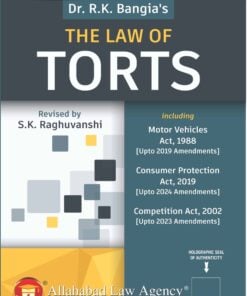
Law of Torts by R.K. Bangia (27th Edition, 2026) | ALA
Begin your legal journey with the most widely prescribed torts textbook in Indian legal education: The Law of Torts by Dr. R.K. Bangia. Published by the Allahabad Law Agency (ALA), this 27th Edition Reprint (2026) is revised by S.K. Raghuvanshi to meet modern syllabus demands.
-
✔ Updated Statutory Landscape: Integrates the Motor Vehicles Act, 1988 (amended up to 2019), Consumer Protection Act, 2019 (amended up to 2024), and Competition Act, 2002 (amended up to 2023).
-
✔ Classic Case Laws: Develops foundational concepts through landmark judgments from Rylands v. Fletcher to M.C. Mehta.
-
✔ Authentic Edition: Includes the ALA holographic authenticity seal on every genuine copy.

R. Cambray’s Land Laws of West Bengal by Babu Sarkar
R. Cambray's Land Laws of West Bengal by Babu Sarkar - 6th Edition 2024. First, this R. Cambray publication provides the exact text on regional property. Specifically, author Babu Sarkar details the strict West Bengal land rules. Furthermore, this sixth edition covers all fundamental 2024 statutory updates perfectly.
Lexis Nexis’s The Specific Relief Act, 1963 (Bare Act) by Universal
Lexis Nexis’s The Specific Relief Act, 1963 (Bare Act) by Universal - 2026 Edition. First, this LexisNexis publication provides the exact text of civil remedies. Specifically, it details the strict rules for enforcing contracts. Furthermore, this 2026 Edition covers all fundamental statutory updates perfectly.

Reviews
There are no reviews yet.