
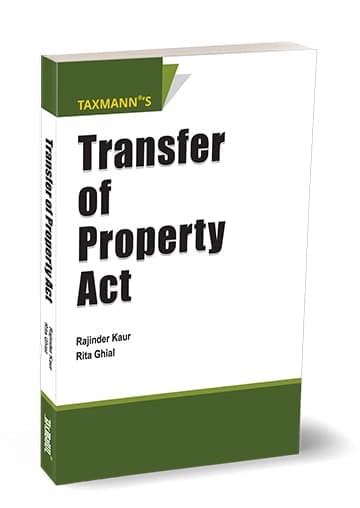

Taxmann’s Transfer of Property Act by Rajinder Kaur
Original price was: ₹575.00.₹489.00Current price is: ₹489.00.
Taxmann’s Transfer of Property Act by Rajinder Kaur – 1st Edition 2025. Transfer of Property Act is a student-focused, topic-wise textbook that simplifies complex property law concepts through contextual explanations and cross-references to allied statutes. It integrates landmark case law, practical examples, and background notes to demonstrate both the evolution and application of the law. Each chapter includes synopses, illustrations, and concise summaries for quick comprehension. Designed for law students, researchers, and practitioners, it bridges theory with practice through a clear, exam-oriented and application-driven approach.
10 in stock
Taxmann’s Transfer of Property Act by Rajinder Kaur – 1st Edition 2025.
Taxmann’s Transfer of Property Act by Rajinder Kaur – 1st Edition 2025.
Description
Transfer of Property Act is a student-centred textbook that follows a topic-wise architecture rather than a rigid section-by-section commentary. It explains each doctrine in context, cross-links relevant provisions from allied laws (such as Contract, Registration, Easements, CPC, and the Indian Succession Act), and embeds landmark case-law analyses into the narrative, allowing readers to see how courts interpret and apply the rules in practice. Background notes accompany major provisions to explain why the law evolved as it did, rather than merely what it states. Each chapter opens with a clear synopsis and closes with a concise ‘Summary’, with worked illustrations and case analyses embedded throughout for exam-ready understanding and practical application.
This book is intended for the following audience:
- LL.B./B.A., LL.B. Students seeking a concept-first, exam-ready resource mapped to university syllabi
- LL.M. Scholars & Researchers who need doctrinal depth with comparative notes (English/Indian positions) and legislative history
- Practitioners, Academicians & Judicial Aspirants requiring a concise, cross-referenced explainer with case-law integration and practical insights
The Present Publication is the Latest Edition, authored by Prof. (Dr) Rajinder Kaur and Dr Rita Ghial, with the following noteworthy features:
- [Topic-wise Pedagogy] Chapters cluster related concepts (e.g., conditional transfers, vested/contingent interests, notice, part performance), aiding intuitive learning and revision
- [Cross-referencing Across Statutes] Correlates TPA provisions with the Contract Act, Registration Act, Easements Act, CPC, Indian Succession Act, and personal laws—highlighting where general rules yield to special regimes (e.g., Muslim law & waqf).
- [Integrated Case-studies] Detailed, doctrine-wise discussion of seminal decisions (e.g., Duke of Norfolk, Whitby v. Mitchell, London & S.W. Ry v. Gomm, Jumma Masjid v. Deviah, Suraj Lamp) to illuminate principles and exam application
- [‘Why’ Behind the Law] Legislative background, policy rationale, and historical evolution precede black-letter exposition—bridging theory and application.
- [Practice Orientation] Clarifies registration/attestation requirements, notice doctrines, and consequences of invalid/void conditions with illustrations
- [Student-centric Tone] Emphasis on comprehension over rote, with clear illustrations and comparative notes (Indian vs. English law)
- [Scholarly Apparatus & Utility] Extensive case list, precise statutory extracts, and practical illustrations make it equally useful for classrooms, moots, and chambers
This book provides complete coverage of the Transfer of Property Act, 1882 (TPA), combining doctrinal clarity with practical illustrations and case-based analysis. The contents progress systematically from basic concepts to advanced doctrines governing the transfer of property in India. A brief overview of the major themes covered is as follows:
- Foundations (Sections 1–4)
- Explains the scope and structure of the Act, interpretation clauses, and its connection with the Contract Act and Registration Act. Clarifies what constitutes immovable property, the meaning of ‘attached to the earth,’ and key rules on attestation and registration
- Essentials of a Valid Transfer (Sections 5–9)
- Discusses the meaning of transfer, the competence of parties, and what can or cannot be transferred. Includes special discussions on spes successionis, actionable claims, oral transfers, and comparative perspectives with practical examples
- Transfer for the Benefit of Unborn Persons & the Rule against Perpetuity (Sections 13, 14, 15, 16 and 18)
- Covers how property can be transferred for the benefit of persons not yet born, the operation of trusts, and the limits imposed by the rule against perpetuity, with reference to Indian and English law
- Conditional Transfers (Sections 10–12, 17, 25–34)
- Explains transfers subject to conditions—such as restraints on alienation, conditions precedent and subsequent, and the doctrines of acceleration and conditional limitation
- Vested and Contingent Interests; Election and Apportionment (Sections 19–24, 35–37)
- Differentiates between vested and contingent interests, explores class gifts and uncertain events, and illustrates doctrines such as election and apportionment through clear examples
- Notice and Unconscionable Transfers (Section 3 & Sections 39–41, 43, 53, 53A)
- Explains actual and constructive notice, ostensible ownership, fraudulent transfers, and the celebrated doctrine of part-performance. Includes comparative commentary on English and Indian principles
- Priority, Co-ownership, and Lis Pendens (Sections 38, 42, 44–52)
- Examines the rights of co-owners, the effect of transfers made by them, and the priority of interests created by successive transfers, concluding with a detailed explanation of lis pendens
- Sale of Immovable Property (Sections 54–57)
- Discusses the essentials of a sale and contract for sale, along with the rights and liabilities of the buyer and seller, discharge of encumbrances, and the concept of marshalling
- Mortgages and Charges (Sections 58–73, 76, 81–82, 91–96, 100–104)
- Provides an in-depth treatment of the various kinds of mortgages, rights of redemption and foreclosure, duties of mortgagors and mortgagees, subrogation, and the creation and enforcement of charges—supported by key judicial decisions
- Leases (Sections 105–117)
- Clarifies the essentials of lease creation, the rights and duties of lessor and lessee, forfeiture and relief, holding over, and exemptions for agricultural leases
- Exchange, Gift, and Actionable Claims (Sections 118–137)
- Distinguishes between sale, exchange, and partition; discusses the essentials of a valid gift; and analyses how actionable claims are transferred under the Act
- The structure of the book is as follows:
- Concept → Background → Cross-links → Cases → Summary – Each topic follows a uniform didactic arc that begins with principle and ends in synthesis
- Comparative Inserts – Indian vs. English law notes (e.g., perpetuities, Whitby v. Mitchell line, conditional limitations)
- Boxed Illustrations & Step-wise Analyses – For doctrines like election, acceleration, notice, priorities, marshalling, subrogation, etc.
- End-caps – One-page ‘Summary’ snapshots per chapter help last-mile revision for viva/exams
the CAT, ITAT, NCLT/NCLAT, DRT, NGT, SAT, TDSAT, as well as labour and consumer fora. Extends the discussion to regulatory authorities, both statutory and self-regulatory, with examples like TRAI, CCI, SEBI, IRDAI, PNGRB, and CERC
- Chapter 7 – Liabilities of the State
- Analyses contractual liability (constitutional basis, state contracts, promissory estoppel, quasi-contracts, unjust enrichment, state largesse) and tortious liability (the UK’s move away from immunity, US legislative approaches, and India’s case law evolution). Highlights constitutional torts with leading cases such as Rudal Shah, Nilabati Behera, and D.K. Basu
- Chapter 8 – Transparency and Accountability in Governance
- Discusses the doctrine of public accountability and institutions designed to uphold it—Lokpal and Ombudsman (constitution, tenure, powers, and limits), the RTI Act, 2005 (objectives, overriding effect, jurisdictional bar, exclusions), the Commissions of Inquiry Act, 1952, and the CVC (strengthened after Vineet Narain). Also examines judicial accountability through reform proposals and codes of conduct
- Chapter 9 – Public Corporations
- Defines and explains the concept, characteristics, and types of public corporations (commercial, service-oriented, supervisory). Discusses control mechanisms—Parliamentary, public, governmental, central agency, and judicial—supported with a schematic representation. Notes their constitutional status and uses contemporary examples such as parliamentary scrutiny of LIC’s investments
The structure of the book is as follows:
- The work is organised into Nine Core Chapters, each broken down into multiple thematic units for systematic coverage
- Every chapter begins with a Synopsis, offering readers a pre-reading orientation and a roadmap of key issues
- Throughout the chapters, case References to Landmark and Recent Judgments—both Indian and comparative—are seamlessly integrated to illustrate principles in action
- At the end of each chapter, Summaries distil the essential points, helping with consolidation, revision, and exam readiness
- The overall progression of the book follows a Logical Sequence, moving step by step from:
- Concepts → Doctrines → Administrative Actions → Controls → Remedies → Institutions → State Liability → Transparency & Accountability.
Details
- Binding : Softcover
- Publisher : Taxmann
- Author : Rajinder Kaur, Rita Ghial
- Edition : 1st Edition 2025
- Language : English
- ISBN-10 : 9789371260022
- ISBN-13 : 9789371260022
| Publisher | Taxmann |
|---|---|
| Author | Rajinder Kaur |
| Language | English |
Only logged in customers who have purchased this product may leave a review.
Related products
Lexis Nexis’s Statement of Indian Law by Govind Goel
Master the absolute highest level of Indian jurisprudence. LexisNexis's Statement of Indian Law (2nd Edition, 2024) by Govind Goel is a monumental 3-volume compilation tracking every single decision delivered by the Constitution Benches of the Supreme Court of India since 1950.
-
✔ The Ultimate Constitutional Record: The only exhaustive running interpretative commentary on the evolution of law through the Constitutional Benches.
-
✔ Pioneering Judicial Analytics: Features a dedicated chapter mapping the productivity, spread of unanimity, and dissent of Supreme Court judges using graphs, pie charts, and data tables.
-
✔ Recent Historic Addendums: Fully updated with landmark 2023/2024 rulings, including In Re Article 370 of the Constitution of India, Vivek Narayan Sharma v Union of India, and Sita Soren v Union of India.
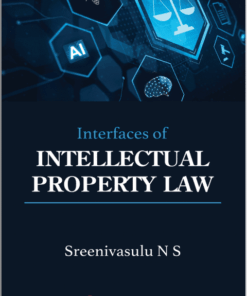
Lexis Nexis’s Interfaces of Intellectual Property Law by Sreenivasulu N S
Go beyond the basics with Interfaces of Intellectual Property Law. Authored by distinguished NUJS Professor Sreenivasulu N S and published by LexisNexis, this 1st Edition (2025) explores how IP rights intersect with today’s most critical legal domains.
-
✔ Cross-Disciplinary Approach: Delves into the coexistence of IP law with constitutional law, human rights, environmental law, and technology law.
-
✔ Comprehensive Scope: Reviews the evolution of IP laws from 19th-century conventions through to the complex post-TRIPS era.
-
✔ Latest Developments: Fully updated with important judicial developments and recent legislative changes shaping the public domain and competition law.

R. Cambray’s Land Laws of West Bengal by Babu Sarkar
R. Cambray's Land Laws of West Bengal by Babu Sarkar - 6th Edition 2024. First, this R. Cambray publication provides the exact text on regional property. Specifically, author Babu Sarkar details the strict West Bengal land rules. Furthermore, this sixth edition covers all fundamental 2024 statutory updates perfectly.
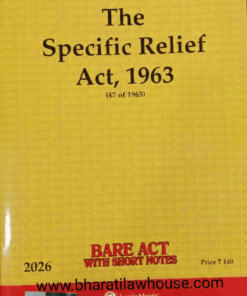
Lexis Nexis’s The Specific Relief Act, 1963 (Bare Act) by Universal
Lexis Nexis’s The Specific Relief Act, 1963 (Bare Act) by Universal - 2026 Edition. First, this LexisNexis publication provides the exact text of civil remedies. Specifically, it details the strict rules for enforcing contracts. Furthermore, this 2026 Edition covers all fundamental statutory updates perfectly.


Reviews
There are no reviews yet.