
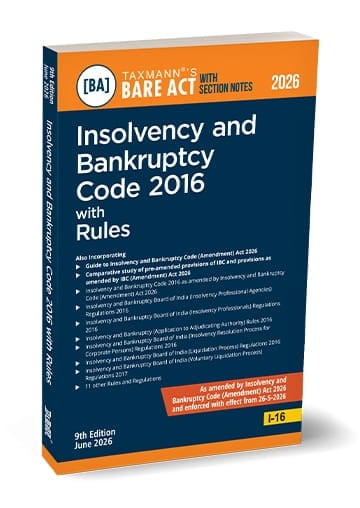

Taxmann’s Insolvency and Bankruptcy Code 2016 with Rules – Bare Act with Section Notes
Original price was: ₹1,695.00.₹1,356.00Current price is: ₹1,356.00.
Taxmann’s Insolvency and Bankruptcy Code 2016 with Rules – Bare Act with Section Notes – 9th Edition June 2026. First, this Taxmann publication provides the exact consolidated text of India’s unified corporate insolvency architecture. Specifically, compiled by Taxmann’s Editorial Board, it details the strict rules of the master insolvency code alongside its corresponding procedural regulations and corporate liquidation schedules. Furthermore, this ninth edition fully incorporates all statutory amendments and notified changes updated up to June 2026.
99 in stock
Taxmann’s Insolvency and Bankruptcy Code 2016 with Rules – Bare Act with Section Notes – 9th Edition June 2026.
Main Description / Overview
Undeniably, this comprehensive single-volume Bare Act compendium makes complex restructuring and insolvency processes very clear. For instance, the book features a highly disciplined Section Notes layout where primary legislative provisions are seamlessly paired with exhaustive legal annotations, enforcement timelines, and critical regulatory cross-references.
Consequently, readers easily grasp the exact statutory modes of confirming default thresholds and initiating corporate rescue procedures without checking multiple separate gazette sheets. Ultimately, it logically organizes the massive insolvency framework into a highly practical, streamlined reference tool for everyday use.
Furthermore, it covers everything from the statutory timelines of the Corporate Insolvency Resolution Process (CIRP) to the administrative powers of liquidators. Therefore, it acts as an essential daily desk reference for handling routine compliance mappings and minimizing procedural legal liabilities.
Target Audience
Clearly, this practice-oriented reference volume serves insolvency practitioners and corporate financial advisors directly. Therefore, it gives direct help to these specific users.
-
First, it supports insolvency professionals (IPs) executing strict statutory resolutions, asset pooling, and corporate liquidations.
-
Second, it helps practicing chartered accountants and company secretaries conducting strict corporate compliance audits during stress conditions.
-
Third, it guides legal advocates and corporate counsels cross-checking exact statutory section text during NCLT or NCLAT filings.
Key Features of the 9th Edition June 2026
Significantly, the research team updated this foundational insolvency resource perfectly. As a result, it offers several highly useful tools for readers.
-
First, it integrates the full, unedited statutory text of the Insolvency and Bankruptcy Code 2016 seamlessly.
-
Furthermore, it incorporates the complete text of all corresponding IBBI rules, operational regulations, and forms completely.
-
Specifically, it provides detailed, paragraph-by-paragraph Section Notes to clarify hidden statutory layers and structural legal shifts.
-
Moreover, it tracks all central notification milestones, threshold parameters, and amendment notes updated up to June 2026 clearly.
-
Additionally, it incorporates standard, ready-to-use compliance forms, electronic filing guidelines, and reporting templates cleanly.
Detailed Chapter Breakdown
Structurally, the work covers the complete corporate and individual insolvency spectrum across clear, navigable statutory parts. Initially, it maps the foundational legal framework of primary insolvency definitions perfectly.
-
First, it clearly outlines the core principles of the Corporate Insolvency Resolution Process (CIRP), tracking the revised application thresholds and admission rules.
-
Next, it fully details the exact duties of the Interim Resolution Professional (IRP) and the formation parameters of the Committee of Creditors (CoC).
-
Furthermore, it perfectly outlines the strict regulations defining the Fast Track Corporate Insolvency Resolution Process and Pre-packaged Insolvency Resolution Processes (PPIRP).
-
Moreover, it tackles the complex operational rules governing the liquidation process, asset distribution waterfalls, and the voluntary liquidation framework.
-
Finally, it details the strict statutory approaches towards individual and partnership insolvency, alongside administrative guidelines for cross-border insolvency frameworks.
Details
Only logged in customers who have purchased this product may leave a review.
Related products
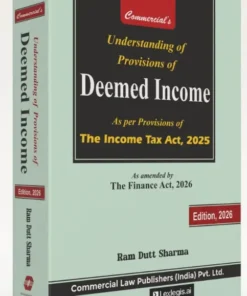
Commercial’s Understanding of Provisions of Deemed Income by Ram Dutt Sharma
Master the complex legal fictions that turn undisclosed financial transactions into massive tax liabilities. Commercial's Understanding of Provisions of Deemed Income (1st Edition, 2026) is a highly focused reference manual authored by former Income Tax Officer Ram Dutt Sharma.
-
✔ The Finance Act 2026 Updates: Fully aligned with the Income Tax Act 2025, detailing the latest statutory treatments of income deemed to accrue or arise in India.
-
✔ Unexplained Wealth: Deep, operational analysis of deemed income arising from unexplained cash, investments, expenditure, and assets (Sections 68, 69, 69A-D).
-
✔ Insider Strategy: Written by a 35-year veteran of the Income Tax Department, providing unparalleled clarity for defending against scrutiny assessments and reassessments.
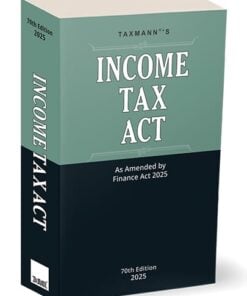
Taxmann’s Income Tax Act – As Amended by Finance Act 2025
Taxmann's Income Tax Act - As Amended by Finance Act 2025 - 70th Edition 2025. This book seamlessly integrates all amendments from the Finance Act 2025 into a single authoritative text. It offers extensive annotations, cross-references, and legislative history, catering to practitioners, academics, and libraries. Separate divisions also cover the Finance Act 2025, STT, CTT, and the now-ended Equalisation Levy, ensuring a holistic overview of direct tax laws. A user-friendly layout—with marginal notes, footnotes, and a comprehensive subject index—enables efficient navigation. Backed by meticulous editorial accuracy, this volume remains a definitive guide to direct tax legislation.

Reviews
There are no reviews yet.