
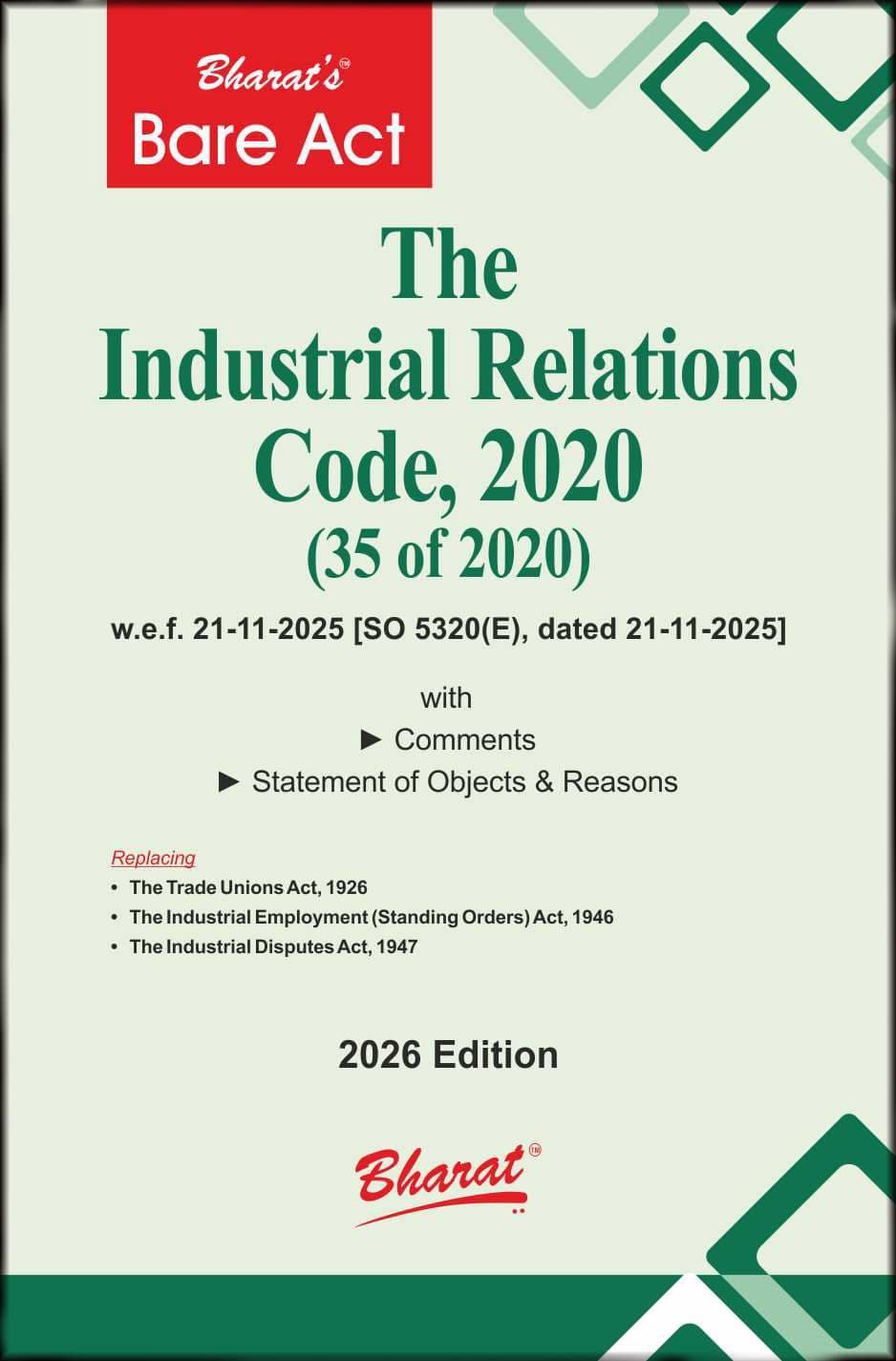


Bharat’s The Industrial Relations Code, 2020 (35 of 2020)
Original price was: ₹150.00.₹120.00Current price is: ₹120.00.
Bharat’s The Industrial Relations Code, 2020 (35 of 2020) – 1st Edition 2026.
10 in stock
Bharat’s The Industrial Relations Code, 2020 (35 of 2020) – 1st Edition 2026.
Bharat’s The Industrial Relations Code, 2020 (35 of 2020) – 1st Edition 2026.
About The Industrial Relations Code, 2020
The Industrial Relations Code, 2020 (Act No. 35 of 2020) is an Indian labour law that consolidates and amends existing laws related to trade unions, conditions of employment, and the investigation and settlement of industrial disputes.
The Code received presidential assent on September 28, 2020, and all its provisions came into force on November 21, 2025. It subsumes and replaces three previous Acts: the Trade Unions Act, 1926; the Industrial Employment (Standing Orders) Act, 1946; and the Industrial Disputes Act, 1947.
Key Provisions
- Consolidation of Laws: The Code amalgamates three central labour acts into a single framework to simplify compliance and promote industrial harmony.
- Increased Thresholds: The applicability threshold for standing orders (rules on working conditions, etc.) and the requirement for government permission for lay-offs, retrenchment, and closure have been increased to industrial establishments with 300 or more workers(previously 100). This provides employers with greater operational flexibility.
- Fixed-Term Employment: The Code formally introduces fixed-term employment, ensuring that workers engaged on a written contract for a fixed period receive all statutory benefits (wages, allowances, gratuity, etc.) on par with permanent workers, proportionate to their service period.
- Trade Union Recognition: It provides for statutory recognition of a “negotiating union” with at least 51% of worker support for collective bargaining. If no single union meets this threshold, a negotiating council will be formed with representatives from unions having at least 20% membership.
- Dispute Resolution: The process for resolving industrial disputes has been streamlined. Individual workers can now directly approach an Industrial Tribunal for adjudication of disputes related to dismissal or termination after 45 days of conciliation proceedings, without requiring government approval.
- Regulation of Strikes and Lockouts: The definition of “strike” is expanded to include “mass casual leave” by 50% or more workers. All persons in industrial establishments must give a 60-day advance notice before a strike or lockout, with a mandatory 14-day gap before the specified strike date.
- Worker Re-skilling Fund: A dedicated fund is to be created, with employer contributions equivalent to 15 days’ last drawn wages for every retrenched worker, to help them re-skill and secure new employment.
- Penalties: The Code introduces stricter penalties for offenses and allows for the compounding (settling) of certain offenses to reduce litigation.
Details
- Binding : Softcover
- Publisher : Bharat Law House Pvt. Ltd.
- Author : Bharat
- Edition : 1st Edition 2026
- Language : English
- ISBN-10 : 9788199364110
- ISBN-13 : 9788199364110
| Publisher | Bharat Law House Pvt. Ltd. |
|---|---|
| Author | Bharat |
| Language | English |
Only logged in customers who have purchased this product may leave a review.
Related products
VP’s Cyber Law & Cyber Crimes by Dr. J. N. Barowalia
Equip your practice for India’s new era of digital jurisprudence. VP’s Cyber Law & Cyber Crimes (2nd Edition, August 2026), authored by Dr. J. N. Barowalia and Dr. Aarushi Jain, is a monumental 1,100-page desk reference published by Vinod Publications.
-
✔ The New Criminal Framework: Complete cross-analysis of cyber offenses with the Bharatiya Nyaya Sanhita (BNS) 2023 and procedural impacts under the Bharatiya Nagarik Suraksha Sanhita (BNSS) 2023.
-
✔ Electronic Evidence Mastery: Detailed, actionable guides on hash value validation and presenting digital evidence in court as per the Bharatiya Sakshya Adhiniyam (BSA) 2023.
-
✔ Data Privacy & Modern Threats: Section-by-section breakdown of the DPDP Act, 2023, plus judicial interpretations on digital arrests, crypto-crimes, and ransomware. Featuring a prestigious foreword by former CJI Hon’ble Dr. Justice D.Y. Chandrachud.
Lexis Nexis’s Commentary on Trade Marks Act by T.R.S. Iyengar
Navigate the complex intersection of intellectual property law and commercial strategy with Iyengar's Commentary on The Trade Marks Act. Published by LexisNexis, this comprehensively updated 6th Edition (2025) remains the ultimate courtroom and boardroom authority on brand protection.
-
✔ Integrated Business Approach: Approaches trademark law not just as a rigid statute, but as an active tool for business trading, brand protection, and corporate strategy.
-
✔ Global & Domestic Jurisprudence: Features an exhaustive compilation of landmark and recent case laws from both Indian courts and international jurisdictions.
-
✔ Complete Statutory Framework: Incorporates all recent legislative developments, Rules, Notifications, and critical international Treaties (including the Madrid Protocol).
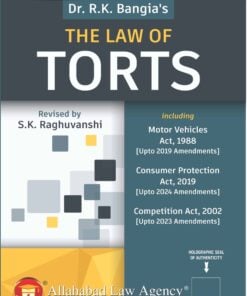
Law of Torts by R.K. Bangia (27th Edition, 2026) | ALA
Begin your legal journey with the most widely prescribed torts textbook in Indian legal education: The Law of Torts by Dr. R.K. Bangia. Published by the Allahabad Law Agency (ALA), this 27th Edition Reprint (2026) is revised by S.K. Raghuvanshi to meet modern syllabus demands.
-
✔ Updated Statutory Landscape: Integrates the Motor Vehicles Act, 1988 (amended up to 2019), Consumer Protection Act, 2019 (amended up to 2024), and Competition Act, 2002 (amended up to 2023).
-
✔ Classic Case Laws: Develops foundational concepts through landmark judgments from Rylands v. Fletcher to M.C. Mehta.
-
✔ Authentic Edition: Includes the ALA holographic authenticity seal on every genuine copy.

Reviews
There are no reviews yet.