
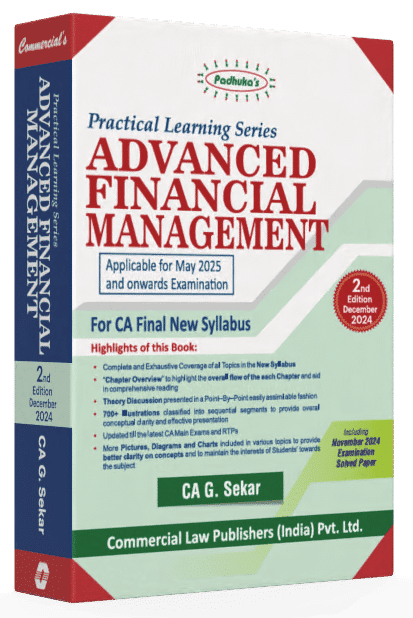
Commercial’s Practical Learning Series – Advanced Financial Management by G. Sekar for Nov 2025
Original price was: ₹1,359.00.₹1,155.00Current price is: ₹1,155.00.
Commercial’s Practical Learning Series – Advanced Financial Management (CA Final) – (New Syllabus) by G. Sekar for Nov 2025 Exam – 2nd Edition December 2024.
10 in stock
Commercial’s Practical Learning Series – Advanced Financial Management (CA Final) – (New Syllabus) by G. Sekar for Nov 2025 Exam – 2nd Edition December 2024.
Commercial’s Practical Learning Series – Advanced Financial Management (CA Final) – (New Syllabus) by G. Sekar for Nov 2025 Exam – 2nd Edition December 2024.
CONTENTS:
Commercial’s Practical Learning Series – Advanced Financial Management (CA Final) – (New Syllabus) by G. Sekar for Nov 2025 Exam – 2nd Edition December 2024.
Advanced Financial Management (AFM) is a crucial and challenging paper (Paper 2) in the ICAI CA Final examination. It is considered one of the most critical papers that tests a candidate’s practical knowledge and decision-making abilities in finance.
Here’s a breakdown of key aspects of CA Final AFM:
- Syllabus
The AFM syllabus has undergone recent revisions under the new scheme of education and training. It now comprises the following chapters:
- Financial Policy and Corporate Strategy
- Risk Management
- Advanced Capital Budgeting Decisions
- Security Analysis
- Security Valuation
- Portfolio Management
- Securitization
- Mutual Funds
- Derivatives Analysis and Valuation
- Foreign Exchange Exposure and Risk Management
- International Financial Management
- Interest Rate Risk Management
- Business Valuation
- Mergers, Acquisitions and Corporate Restructuring
- Startup Finance
- Appendix
- Exam pattern and marking scheme
- Mode: Pen and paper-based (offline).
- Duration: 3 hours.
- Questions:
- 30% multiple-choice questions (MCQs).
- 70% descriptive (practical and theory-based application questions).
- Marking: Each paper carries 100 marks.
- Passing Criteria: 40% in each paper and 50% in aggregate for each group (Group I and Group II).
- Negative Marking: No negative marking for wrong answers.
- Chapter-wise weightage (Based on past exams and the new syllabus)
- Capital Budgeting: 15–20 Marks
- Risk Analysis in Capital Budgeting: 5–10 Marks
- Dividend Policy Decisions: 4–6 Marks
- Capital Structure Theories: 5–8 Marks
- Portfolio Management & Security Valuation: 10–12 Marks
- Corporate Valuation: 8–10 Marks
- Leasing: 4–6 Marks
- Mergers, Acquisitions & Restructuring: 10–12 Marks
- Derivatives & Risk Management: 12–16 Marks
- Forex Management: 10–14 Marks
- International Financial Management: 6–8 Marks
- Startup Finance & PE/VC: 2–4 Marks
- Mutual Funds: 2–4 Marks
- Security Analysis (Beta, CAPM, APT): 6–8 Marks
- Case Scenario-Based MCQs: 20 Marks (Fixed)
- Key preparation tips
- Understanding Concepts: The derivation and application of financial concepts and formulas should be emphasized rather than rote memorization.
- Practice, Practice, Practice: Practice questions from sources like ICAI modules, mock test papers (MTPs), revision test papers (RTPs), previous year papers, and reference books.
- Mock Exams: Real exam conditions should be simulated to evaluate speed, accuracy, and time allocation across sections.
- Time Management: A time management strategy should be developed to attempt all questions within the allotted time.
- Stay Updated: Stay updated with current events to strengthen conceptual clarity, as AFM topics are linked to real-world financial events.
- Utilize Resources: Leverage ICAI study materials, reference books, and online lectures for comprehensive preparation.
- Strategic Planning: Use the chapter-wise weightage to prioritize topics and dedicate adequate time to high-scoring areas, such as Case Scenario-Based MCQs.
- Integrate Theory and Practice: Do not skip theory questions, even in numerically heavy chapters, as they offer easy scoring opportunities.
In conclusion, success in CA Final AFM requires a strong understanding of concepts, extensive practice, effective time management, and a strategic approach to cover the vast syllabus effectively.
Details :
- Publisher : Commercial Law Publishers (India) Pvt. Ltd.
- Author : G. Sekar
- Edition : 2nd Edition December 2024
- ISBN-13 : 9789356036796
- ISBN-10 : 9789356036796
- Binding: Paperback
- Language : English
| Author | G Sekar |
|---|---|
| Language | English |
| Publisher | Commercial Law Publishers (India) Pvt. Ltd. |
Only logged in customers who have purchased this product may leave a review.
Related products
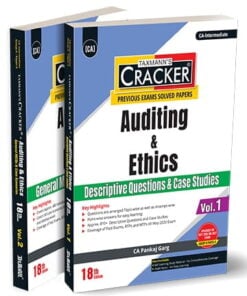
Taxmann’s Cracker – Auditing & Ethics (Auditing) by Pankaj Garg for Sept 2026 Exams
Taxmann's Cracker - Auditing & Ethics (Auditing) (CA Intermediate) (New Syllabus) by Pankaj Garg for Sept 2026 Exams - 18th Edition June 2026. First, this Taxmann publication provides the exact practice-ready text on verification standards and professional ethics for Chartered Accountancy candidates. Specifically, authored by CA Pankaj Garg, this two-volume question bank details the strict rules of audit execution under tight timing constraints. Furthermore, this 18th edition covers all mandatory ICAI New Scheme testing parameters for the September 2026 exams perfectly.



Reviews
There are no reviews yet.