

Taxmann’s Cost Accounting by Sneh Lata Gupta – 1st Edition Reprint February 2024
Original price was: ₹795.00.₹676.00Current price is: ₹676.00.
Taxmann’s Cost Accounting by Sneh Lata Gupta – 1st Edition Reprint February 2024. This book takes a comprehensive approach to explain the principles of cost accounting, emphasizing accuracy in cost ascertainment and efficiency in cost control within a competitive landscape. It’s structured to offer a balanced exposition of theoretical concepts and practical applications, ensuring a deep understanding of each aspect of cost accounting. Each chapter ensures clarity and accessibility for first-time learners, with practical problems included to facilitate the application of theoretical knowledge.
10 in stock
Taxmann’s Cost Accounting by Sneh Lata Gupta – 1st Edition Reprint February 2024.
Taxmann’s Cost Accounting by Sneh Lata Gupta – 1st Edition Reprint February 2024.
Description
This comprehensive guide to Cost Accounting is designed to introduce readers to the fundamental principles and practical applications of cost accounting, catering specifically to the syllabus requirements of B.Com. (Hons) under the National Education Policy (NEP) at the University of Delhi. The book aims to foster cost awareness among manufacturing enterprises to optimize profits through precise cost ascertainment and efficiency in cost control within a competitive landscape.
This book is a valuable resource for commerce and accounting students, including the following:
- B.Com. (Hons.) under the New Education Policy (NEP) for the University of Delhi
- B.Com. | Paper DSC 4.2 under NEP for the University of Delhi
- Non-Collegiate Women’s Education Board (NCWEB)
- School of Open Learning (SOL)
- Various Universities Throughout India
This book aims to provide a solid foundation in cost accounting principles while bridging theoretical knowledge with practical problem-solving skills.
The Present Publication is the Latest 2024 Edition, authored by Dr Sneh Lata Gupta, with the following noteworthy features:
- [Comprehensive Topics Covered as Per NEP] The book discusses a wide range of topics, which include:
- Basic Cost Accounting Concepts
- Limitations of Financial Accounting
- Objectives
- Differences Between Cost and Financial Accounting
- Advanced Topics
- Activity-Based Costing
- Single or Output Costing
- Job Costing, etc.
- Basic Cost Accounting Concepts
- [Clear Explanations and Practical Examples] This book aims to ease the complexities of cost accounting in a systematic and coherent manner
- [Latest Developments in Various Cost Accounting Standards (CAS)] is included in this book regarding the treatment of cost items and their presentation in the statement of cost
- [Practical Approach] With an emphasis on real-world applications, the book includes discussions on material control, inventory systems, labour cost accounting, overhead classification and absorption, and specifics of service costing, among others
- [Specialized Topics] including the reconciliation of cost and financial accounts and the nuances of integral and non-integral accounting systems, offering the readers a nuanced analysis of the intricacies of cost accounting frameworks
- [Learning Objectives] at the beginning of each chapter to give a broad framework about the topic given in this book
- [Charts & Graphs] along with diagrammatic presentations of certain concepts is included in this book to make it more understandable
- [Illustrations and Solved Problems] at the end of each chapter is included in this book
The detailed contents of the book are as follows:
- [Introduction to Cost Accounting] This chapter begins with an overview of basic concepts and terms, contrasting financial accounting with cost accounting to highlight the latter’s significance and development due to the limitations of financial accounting. It outlines the objectives, advantages, and drawbacks of cost accounting, differentiating it from financial accounting and discussing methods, techniques, and the design of cost accounting systems
- [Material Cost] This chapter discusses materials control, stages of material control, inventory systems, and techniques for effective inventory control. It covers methods for pricing the issue of materials to production and addresses material losses, offering strategies for managing and controlling material costs
- [Employee Cost] This chapter examines the accounting and control of labour costs, detailing the roles of different departments such as personnel, engineering, time-keeping, payroll, and cost accounting. It also covers the treatment of special labour items and various methods of wage payment
- [Overheads] This chapter focuses on classifying, segregating, distributing, and absorbing overhead costs. It explains the computation of machine hour rates and the distribution of factory, office, and selling and distribution overheads, along with dealing with under or over-absorption of overheads and capacity levels
- [Activity-Based Costing (ABC)] This chapter introduces the features, key terms, and steps of ABC. It discusses the benefits and weaknesses of this costing method, which aims to provide more accurate cost information by assigning costs to activities based on their use of resources
- [Single or Output Costing] This chapter covers the procedures and types of cost sheets, objectives, treatment of stocks and scrap, and the production account, providing insights into the costing techniques for single or mass production scenarios
- [Job Costing] This chapter details the features and procedures of job costing, including simultaneous recording in cost or integrated ledgers, catering to the costing needs of jobs or batches that require unique cost-tracking
- [Contract Costing] This chapter explores the specifics of contract costing, distinguishing it from job costing and outlining the procedure and specific concepts used, suitable for long-term projects with distinct stages
- [Process Costing] This chapter discusses the comparative aspects of job and process costing, procedures, handling of work-in-progress (WIP), and the preparation of process accounts, addressing manufacturing processes with continuous production
- [Operating Costing (Service Costing)] This chapter examines the characteristics, determination of cost units, and transport costing within the context of service industries or organizations where services, rather than goods, are produced
- [Non-Integral and Integral Accounting Systems] This chapter presents features of both non-integrated (interlocking) and integrated accounting systems, including cost control accounts, reconciliation of cost and financial accounts, and the requirements for introducing an integrated system
- [Reconciliation of Cost and Financial Accounts] This chapter introduces the necessity of reconciling cost and financial accounts, attributing the differences to factors such as stock valuation, overheads, and accounting periods. It proceeds to explain the methods of reconciliation, presenting a structured approach for aligning the figures reported in cost accounting with those in financial accounting
- [Integral Accounting System] This chapter transitions into the concept of an integral accounting system. This segment starts with an overview of what constitutes an integrated system and its pivotal role in streamlining accounting processes. It highlights the features of such a system, including the seamless integration of cost and financial accounting functions, which eliminates the need for separate books and reconciliation processes. The ‘third entry method’ is discussed to facilitate this integration, emphasizing its utility in maintaining comprehensive and consistent financial records. The discussion further elaborates on the advantages of adopting an integrated accounting system, such as improved efficiency, reduced errors, and enhanced decision-making capabilities by providing timely and accurate financial information. It concludes by outlining the basic requirements or prerequisites for introducing an integral accounting system within an organization, offering guidance on the foundational steps necessary to transition towards a more cohesive and efficient accounting framework.
Details
- Pages : 788 Pages
- Publisher : Taxmann
- Author : Sneh Lata Gupta
- Edition : 1st Edition January 2024
- Language : English
- ISBN-10 : 9789357784238
- ISBN-13 : 9789357784238
| Author | Sneh Lata Gupta |
|---|---|
| Language | English |
| Publisher | Taxmann |
Only logged in customers who have purchased this product may leave a review.
Related products
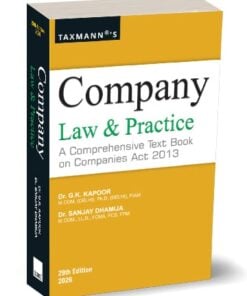
Taxmann’s Company Law and Practice by G K Kapoor
Taxmann's Company Law and Practice - A Comprehensive Text Book on Companies Act 2013 by G K Kapoor - 29th Edition January 2026. Company Law & Practice – A Comprehensive Textbook on the Companies Act 2013 (29th Edition | 2026) is a definitive and practice-oriented work that presents Indian company law as an integrated statutory, governance, and compliance framework. Updated with all legislative amendments, rules, regulatory developments, and judicial pronouncements, it reflects the contemporary, enforcement-driven, and governance-focused corporate law regime. The book combines doctrinal clarity with applied learning through contextual case law, procedural guidance, and specimen drafting tools. With comprehensive coverage of the entire corporate lifecycle, it functions both as a core academic textbook and a dependable professional reference.
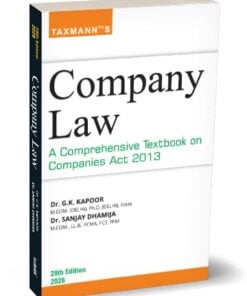
Taxmann’s Company Law (University Edition) by G K Kapoor
Taxmann's Company Law (University Edition) - A Comprehensive Text Book on Companies Act 2013 by G K Kapoor - 28th Edition 2026. Company Law – A Comprehensive Textbook on the Companies Act 2013 is an authoritative, concept-driven textbook that explains Indian company law as an integrated legal system governing the entire corporate lifecycle—from incorporation and governance to regulation, restructuring, and dissolution. This Edition seamlessly blends statutory provisions with judicial interpretation, regulatory developments, and practical application. The book is structured for effective learning and examination readiness, with chapter summaries, review questions, practical problem guidance, and specimen drafting support. It serves as a reliable, syllabus-aligned resource for UG/PG students, CA/CS/CMA aspirants, law students, and academicians seeking clarity, depth, and contemporary relevance in Company Law.
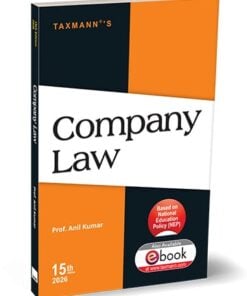
Taxmann’s Company Law | UGCF by Anil Kumar
Taxmann's Company Law | UGCF by Anil Kumar - 15th Edition 2026. Company Law is a thoroughly updated and academically robust textbook that presents the law governing companies in India with clarity, structure, and a strong student-centric approach. Anchored in the Companies Act 2013, the 15th Edition (2026) incorporates all major legislative amendments, allied Rules, and relevant provisions of the Insolvency and Bankruptcy Code 2016. Going beyond a mere reproduction of statutory text, the book explains core concepts, procedures, and practical implications through judicial reasoning, illustrations, and flowcharts. Designed in line with the National Education Policy (NEP), it emphasises outcome-based learning, analytical understanding, and exam preparedness. The book is ideally suited for undergraduate commerce and management students, professional learners, and academic institutions seeking a reliable and comprehensive Company Law resource.
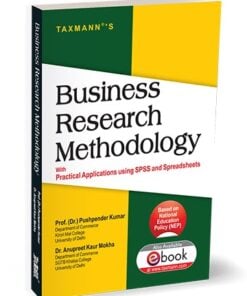
Taxmann’s Business Research Methodology with Practical Applications using SPSS and Spreadsheets by Pushpender Kumar
Taxmann's Business Research Methodology with Practical Applications using SPSS and Spreadsheets by Pushpender Kumar - 1st Edition 2025. Business Research Methodology is a NEP-aligned, practice-oriented textbook that turns research learning into a clear, step-by-step process. It covers the whole research journey—from foundational concepts and philosophical approaches to data collection, SPSS/Excel-based analysis, report writing, and ethics—across five structured units. Supported by real datasets, case studies, visuals, solved examples, and practical tasks, the book blends conceptual clarity with hands-on application. It is an ideal resource for B.Com./B.Com. (Hons.) students, research beginners, and learners preparing for dissertations, exams, internships, and early research roles.
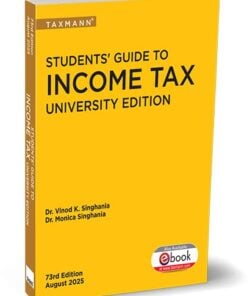
Taxmann’s Students Guide To Income Tax (University Edition) by Vinod K Singhania
Taxmann's Students Guide To Income Tax (University Edition) by Vinod K Singhania - 73rd Edition August 2025. Students' Guide to Income Tax—University Edition is the definitive textbook on Indian income tax law for Assessment Year 2025-26, authored by Dr Vinod K. Singhania and Dr Monica Singhania. This 73rd Edition offers a thorough, practice-oriented approach—combining the latest legislative amendments with clear explanations, stepwise solutions, and extensive illustrations. Covering all key topics, including exemptions, heads of income, deductions, compliance, and practical case studies, it is tailored for university students, professional aspirants, and educators. The book's lucid, exam-focused structure makes even the most complex provisions easy to grasp and apply.
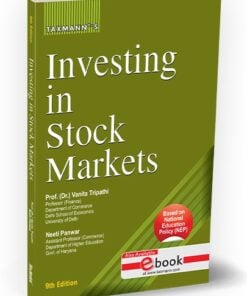
Taxmann’s Investing in Stock Markets by Vanita Tripathi – 9th Edition 2025
Taxmann's Investing in Stock Markets by Vanita Tripathi - 9th Edition 2025. Investing in Stock Markets by Prof. (Dr) Vanita Tripathi & Neeti Panwar is a comprehensive, NEP-aligned resource covering everything from basic concepts to advanced analytical tools. It merges theory with application through a project-based approach, making complex financial topics accessible to students, educators, and enthusiasts. Updated data, new technical indicators, and a clear chapter structure with learning outcomes guide effective learning. Hands-on assignments, illustrations, and references to recent university question papers enhance practical understanding and exam readiness.
Taxmann’s Business Statistics By Gurmeet Kaur
Taxmann's Business Statistics By Gurmeet Kaur - 2nd Edition June 2025. Business Statistics, authored by Dr Gurmeet Kaur, Soumya Sharma, and Dr Rachan Sareen, is a comprehensive textbook introducing undergraduate students to core statistical concepts and real-world applications. Aligned with UGCF-NEP 2020 guidelines, it strikes an ideal balance between theoretical rigour and practical relevance, covering Descriptive Statistics, Probability & Distributions, Correlation & Regression, Time Series Analysis, and Index Numbers. The text features step-by-step examples, practice problems, formula summaries, and Excel-based exercises, ensuring a robust learning experience. Its structured approach and student-centric design make it an invaluable resource for classroom teaching, self-study, and research.
Reviews
There are no reviews yet.