
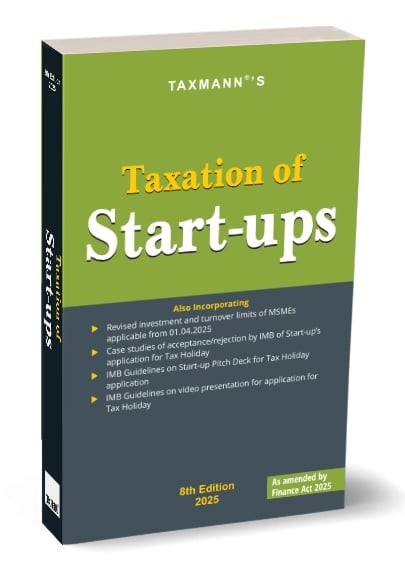
Taxmann’s Taxation of Start-ups & Investors – 8th Edition 2025
Original price was: ₹1,595.00.₹1,276.00Current price is: ₹1,276.00.
Taxmann’s Taxation of Start-ups & Investors – As Amended by Finance Act, 2025 – 8th Edition 2025. This updated 8th Edition is a one-stop resource for navigating India’s start-up ecosystem under the Finance Act 2025. It simplifies eligibility norms, revised MSME criteria, and entity structures while offering practical insights into IMB approvals and rejections. From Section 80-IAC incentives and angel tax to ESOP deferrals, comprehensive tax considerations are illustrated via practical case studies. Step-by-step procedures, checklists, and official references make it invaluable for entrepreneurs, tax professionals, and investors. By merging foundational concepts with hands-on guidance, this book provides a 360° view of forming, financing, and operating a start-up in India.
10 in stock
Taxmann’s Taxation of Start-ups & Investors – As Amended by Finance Act, 2025 – 8th Edition 2025.
Taxmann’s Taxation of Start-ups & Investors – As Amended by Finance Act, 2025 – 8th Edition 2025.
Description
This book is a comprehensive guide that simplifies the complex landscape of India’s start-up ecosystem and its tax implications. Updated to incorporate the latest provisions from the Finance Act 2025, this book provides practical insights into eligibility criteria, legal structures, and tax benefits specifically tailored to start-ups. Combining foundational concepts with in-depth case studies and practical examples of Inter-Ministerial Board (IMB) approvals and rejections offers a 360-degree perspective on forming, financing, and operating a start-up in India.
This book is intended for the following audience:
- Tax & Legal Professionals – Chartered accountants, company secretaries, and legal advisors who guide start-ups through tax planning, compliance, and structuring decisions
- Entrepreneurs & Founders – Aspiring and early-stage entrepreneurs seeking clarity on recognition, eligibility, and tax holidays
- Investors & Incubators – Angel investors, venture capitalists, and incubators looking to understand tax incentives and compliance requirements of the ventures they support
- Policy Enthusiasts & Academics – Researchers and students studying India’s start-up policies, especially those concerning direct taxes and MSME regulations
The Present Publication is the 8th Edition | 2025, amended by the Finance Act 2025. This book is authored by Taxmann’s Editorial Board with the following noteworthy features:
- [Revised MSME Criteria] Detailed coverage of the revised investment and turnover limits of Micro, Small & Medium Enterprises (MSMEs) effective from April 1, 2025, and what it means for start-ups
- [Case Studies] Practical IMB (Inter-Ministerial Board) decisions and precedents that illustrate successful and rejected applications for tax holidays under Section 80-IAC
- [IMB Guidelines & Best Practices] Step-by-step guidance on preparing start-up pitch decks and video presentations for tax holiday applications, ensuring compliance with the latest norms
- [Comprehensive Legal Analysis] Explores different entity structures—Proprietorship, Partnership, LLP, Private Limited Company, One Person Company—and their tax implications
- [Exhaustive Coverage of Section 80-IAC] Clarity on eligibility criteria, application procedures, common pitfalls leading to rejection, and the interplay with other tax provisions such as MAT (Minimum Alternate Tax) and AMT (Alternate Minimum Tax)
- [Angel Tax and Section 68] Detailed discussion of share premium taxation, the additional onus on start-ups to explain ‘source of the source,’ and compliance with sections 56(2)(viib) and 68
- [Carry Forward & Set Off of Losses] Special provisions for start-ups under Section 79 and how turnover thresholds impact these benefits
- [Practical Tools & Appendices] Includes relevant statutory references, rules, and sample documents for filings and registrations, plus official notifications and guidelines from DPIIT and MSME authorities
- [Illustrative Examples] Contains a wide range of exemplars—successful transformations from sole proprietorship to LLP or private limited, plus rejections by IMB for non-compliance
The coverage of the book is as follows:
- Foundational Concepts
- Definition and distinction between ‘entrepreneurship’ and ‘start-ups’
- Overview of the Start-up India Scheme and benefits for DPIIT-recognised start-ups
- MSME classification and registration under the MSMED Act 2006
- Start-ups vs. MSMEs
- Revised classification criteria effective April 1, 2025
- Legal distinctions and scenarios where an entity can be both a start-up and an MSME
- A step-by-step approach to Udyam Registration and the associated benefits
- Eligibility Criteria for DPIIT Recognition
- Detailed criteria for recognition (innovation, scalable business model, wealth/employment generation potential)
- Forms of entities recognised (Registered Partnership, LLP, Private Limited, OPC)
- Exclusions (foreign-incorporated entities, subsidiaries/holding companies, JVs, entities formed by mergers/demergers, etc.)
- One Person Company (OPC) as a Start-up
- Features of an OPC, conversion rules, and tax implications
- Discussion on foreign ownership, NRI incorporations, and the interplay with ‘angel tax’
- Innovation, Scalable Business Model & IMB Case Studies
- Illustrative examples of innovative start-ups approved or rejected by IMB
- Comprehensive insights into documentation, pitch decks, and the significance of improvement vs. innovation
- Splitting-up / Reconstruction Restrictions
- When an entity may lose DPIIT recognition due to re-structuring
- Practical rejection scenarios and best practices to avoid pitfalls
- Procedural Aspects & Compliance
- A step-by-step guide to filing for DPIIT recognition and IMB certification
- Name/CIN/LLPIN changes, conversions between different legal structures, and how they affect recognition
- Tax Holidays & Incentives
- Core provisions of Section 80-IAC, eligibility, conditions, and the interplay with MAT/AMT
- Common reasons for IMB rejections and how to address them
- Funding & Regulatory Challenges
- ‘Angel tax’ under Section 56(2)(viib) and additional onus under Section 68
- Explanation of ‘source of the source,’ debentures, loans, and how the Finance Act 2022 impacts start-ups
- Practical guidance on due diligence and e-verification of share capital
- Carry Forward & Set Off of Losses
- Relaxations provided to start-ups under Section 79
- Impact of turnover exceeding thresholds on tax benefits
- ESOP Taxation for Start-up Employees
- Special regime for deferral of TDS or tax payment for employees of recognised start-ups
- Frequently asked questions and clarifications for employees and start-up founders
- Appendices & Reference Materials
- Detailed Notifications, Circulars, and the New MSME Notification (NMN)
- ‘Step-by-step’ Guidelines for Recognition of Start-ups’
- Relevant sections of the Income-tax Act, 1961, and the text of ‘Start-up India’ rules/notifications
The structure of the book is as follows:
- Conceptual Modules – Each chapter addresses a core concept—like ‘What is a Start-up,’ ‘Distinction Between Start-ups and MSMEs,’ or ‘One Person Company (OPC).’ Sub-points break down definitions and examples in simple language
- Practical FAQs & Case Studies – Practical queries and official IMB outcomes are woven in, ensuring that readers see how rules apply on the ground
- Procedural Checklists – Various forms, filing details, and stepwise instructions guide readers through regulatory compliance—from DPIIT recognition to tax filing
- Appendices & Official References – The end sections compile new and old definitions of ‘start-ups,’ relevant Income-tax Act sections, and updated guidelines—so readers have a one-stop reference
- Cross-referencing & Flow – The book is designed to move logically from entity identification and registration to nuanced tax provisions, ensuring a smooth learning curve.
Details
Only logged in customers who have purchased this product may leave a review.
Related products
Bharat’s Financial Statements of Non-Corporate Entities by CA. Kamal Garg
Bharat's Financial Statements of Non-Corporate Entities by CA. Kamal Garg - 2nd Edition 2026. First, this Bharat publication provides the exact, practice-ready text on reporting guidelines, ledger disclosures, and accounting formats for un-incorporated setups in India. Specifically, written by CA. Kamal Garg, this manual outlines the strict rules of preparing books for non-corporate setups. Furthermore, this 2nd edition incorporates all active disclosure parameters and structural compliance revisions running flawlessly through 2026.
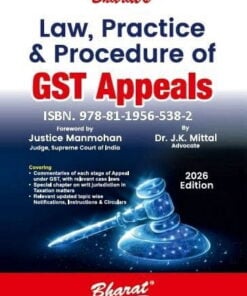
Bharat’s Law, Practice & Procedure of GST Appeals by Dr. J.K. Mittal
Bharat's Law, Practice & Procedure of GST Appeals by Dr. J.K. Mittal - 1st Edition 2026. First, this Bharat publication provides the exact, practice-ready text on indirect tax litigation and dispute resolution in India. Specifically, written by Dr. J.K. Mittal, this definitive legal reference manual details the strict rules of managing appeal files. Furthermore, this 1st edition completely incorporates all recent operational guidelines and structural tribunal mandates running smoothly through 2026.
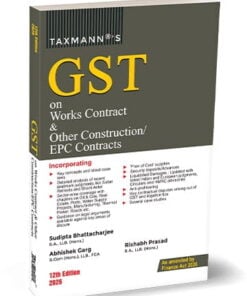
Taxmann’s GST on Works Contract & Other Construction/EPC Contracts by Sudipta Bhattacharjee
Taxmann's GST on Works Contract & Other Construction/EPC Contracts by Sudipta Bhattacharjee, Rishabh Prasad, Abhishek Garg - 12th Edition 2026. First, this Taxmann publication provides the exact text on engineering agreements. Specifically, the authors detail the strict rules for infrastructure taxation. Furthermore, this twelfth edition covers all fundamental 2026 legal updates perfectly.

Taxmann’s Income Tax Act – As Amended by Finance Act 2025
Taxmann's Income Tax Act - As Amended by Finance Act 2025 - 70th Edition 2025. This book seamlessly integrates all amendments from the Finance Act 2025 into a single authoritative text. It offers extensive annotations, cross-references, and legislative history, catering to practitioners, academics, and libraries. Separate divisions also cover the Finance Act 2025, STT, CTT, and the now-ended Equalisation Levy, ensuring a holistic overview of direct tax laws. A user-friendly layout—with marginal notes, footnotes, and a comprehensive subject index—enables efficient navigation. Backed by meticulous editorial accuracy, this volume remains a definitive guide to direct tax legislation.

Reviews
There are no reviews yet.