
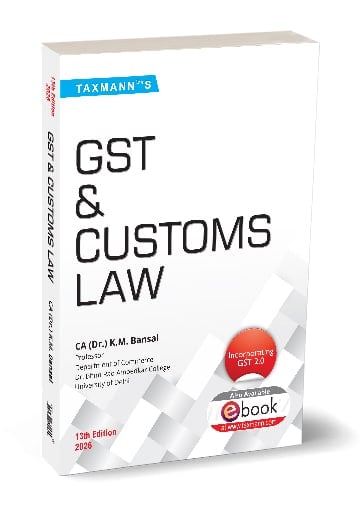

Taxmann’s GST & Customs Law (University Edition) by K.M Bansal
Original price was: ₹795.00.₹676.00Current price is: ₹676.00.
Taxmann’s GST & Customs Law (University Edition) by K.M Bansal – 13th Edition January 2026. GST & Customs Law (Incorporating GST 2.0) is a comprehensive, statute-based textbook that presents GST and Customs Law as a unified indirect tax and compliance framework. Fully updated with amendments up to 31st December 2025, the 13th Edition integrates the GST 2.0 reforms (September 2025), capturing the shift towards structural correction, rate rationalisation, and simplified, trust-based compliance. The book follows a concept-first, illustration-driven pedagogy, explaining each topic through statutory provisions, rule mechanics, numerical illustrations, and exam-oriented practice. Designed for commerce students, CA aspirants, faculty, and tax professionals, it serves as both a strong foundational text and a practical reference for execution.
10 in stock
Taxmann’s GST & Customs Law (University Edition) by K.M Bansal – 13th Edition January 2026.
Taxmann’s GST & Customs Law (University Edition) by K.M Bansal – 13th Edition January 2026.
Description :-
GST & Customs Law (Incorporating GST 2.0) is a comprehensive, statute-driven, and student-oriented exposition of India’s indirect tax framework, presenting Goods and Services Tax (GST) and Customs Law as an integrated fiscal, compliance, and governance system. The book does not approach GST as a mere collection of provisions; instead, it explains GST as a living legal architecture—rooted in constitutional design, implemented through technology-driven compliance mechanisms, and continuously refined through GST Council decisions, notifications, circulars, and judicial and administrative developments. This Edition fully incorporates the GST 2.0 reform framework approved in September 2025, marking a decisive transition of GST from its initial expansion phase to a phase of structural correction, rate rationalisation, simplification, predictability, and trust-based compliance. It reflects the most current statutory position while simultaneously providing forward-looking insight into the evolving direction of GST administration and policy. A defining strength of this book lies in its pedagogical design. Each concept is explained through a structured progression—legal principle → statutory provision → rule mechanics → numerical illustration → compliance application → self-assessment and exam questions.
This book aims to fulfil the requirements of students of undergraduate courses in commerce and management, particularly the following:
- B.Com., B.Com. (Hons.), and M.Com. Students under CBCS/NEP-aligned curricula
- Faculty Members & Academicians teaching indirect taxation
- Chartered Accountancy Students studying GST and Customs Law
- Chartered Accountants, GST Practitioners, & Tax Consultants
- Students & Professionals preparing for competitive and professional examinations involving indirect tax laws
- The book caters effectively to both first-time learners seeking conceptual clarity and advanced readers requiring execution-level understanding
The Present Publication is the 13th Edition, amended up to 31st December 2025. It is authored by CA. (Dr) K.M. Bansal, with the following noteworthy features:
- [GST 2.0 Reform Integration] Provides a structured and analytical treatment of the September 2025 GST reforms, covering their background, objectives, and long-term impact. The reforms are explained through three core pillars—structural reforms, rate rationalisation, and ease of living/ease of doing business—highlighting their role in reducing litigation, correcting inverted duty structures, simplifying rate slabs, and improving refund efficiency
- [Concept-first, Statute-backed Approach] Each topic is introduced conceptually and firmly anchored in the provisions of the CGST Act, IGST Act, GST (Compensation to States) Act, and relevant Customs legislation, ensuring statutory accuracy without sacrificing clarity
- [Illustration-driven Learning Model] Extensive use of worked numerical illustrations, case-based scenarios, and step-by-step computations, particularly in critical areas such as Input Tax Credit (ITC), Reverse Charge Mechanism (RCM), valuation, tax computation, and Customs assessable value
- [Strong Compliance-system Orientation] Explains GST as a portal-driven compliance system, covering e-invoicing workflows, e-way bills, auto-populated returns, inward supply statements (GSTR-2A and GSTR-2B), electronic ledgers, and refund mechanisms
- [Integrated GST-Customs Perspective] Customs Law is explained not in isolation but in direct connection with GST on imports and exports, IGST on imports, valuation principles, and cross-border trade compliance
- [Exam-oriented Pedagogy] Chapters consistently include ‘Test Your Knowledge’ sections and Previous Examination Questions, making the book highly suitable for academic and professional examinations
The contents and the structure of the book are as follows:
- Part I – Goods and Services Tax (GST)
- Evolution of indirect taxes in India and the constitutional foundation of GST
- GST governance structure and legislative framework
- Meaning and scope of Supply, including composite and mixed supplies
- Levy and collection of GST
- Place of Supply, Time of Supply, and Value of Supply
- Input Tax Credit (ITC):
- Eligibility and ineligibility
- Blocked credits under section 17(5)
- Apportionment and reversals (including Rule 42 methodology)
- Capital goods and special circumstances
- Reverse Charge Mechanism (RCM) explained through statutory logic and practical illustrations
- Tax invoices, credit notes, debit notes, receipts and refund vouchers
- E-Way Bills and E-Invoicing, including IRN generation, QR codes, and portal integration
- Returns architecture and payment of tax, with an explanation of electronic ledgers
- GST implications for e-commerce and electronic commerce operators
- GST 2.0 Reforms:
- Structural corrections
- Rate rationalisation and notification-based implementation
- Ease-of-compliance measures, such as pre-filled returns and automated refunds
- Policy significance and future direction of GST
- Part II – Customs Law
- Fundamental concepts and scope of Customs Law
- Territorial waters, customs waters, and jurisdictional applicability
- Types of Customs Duties, including surcharge and IGST linkage
- Valuation under Customs, supported by step-by-step computational illustrations
- Practical relevance of Customs provisions in import/export transactions
The structure of the book is as follows:
- The book is organised into clearly demarcated units and chapters, enabling systematic and progressive learning.
- Each chapter follows a logical internal structure
- Statutory Framework → Explanation → Illustration → Application → Assessment
- Computational topics are taught using algorithmic, stepwise methods, particularly for ITC apportionment, RCM liability, returns, and Customs valuation
- A comprehensive list of abbreviations and technical terms supports ease of reference in an acronym-intensive GST environment.
K.M. Bansal
CA (Dr) K.M. Bansal is a Professor in the Department of Commerce at Dr B.R. Ambedkar College, University of Delhi. A Gold Medalist from Shri Ram College of Commerce and a University Rank Holder in M.Com., Dr Bansal also holds an M.Phil. in Accounting and Finance from the Delhi School of Economics, University of Delhi, and is a member of the Institute of Chartered Accountants of India (ICAI). He has guided M.Phil. students and brings more than two decades of professional teaching experience to his role.
Dr Bansal is closely associated with ICAI and the Institute of Company Secretaries of India (ICSI) as a visiting faculty and is a sought-after speaker at various conferences, seminars, and workshops. He stays current with the latest developments in accounting and law and is known for applying a systematic and uniform approach to solving practical problems.
In recognition of his contributions, Dr Bansal has been felicitated multiple times by the Northern India Regional Council (NIRC) of ICAI. He received Certificates of Appreciation during the Diamond Jubilee year of NIRC in 2011 and again on 24th February 2016 for his valuable services as a faculty member. On 20th February 2016, he was also honoured for his commendable contributions to the professional activities of the NIRC of ICAI.
Additionally, Dr Bansal has been a key speaker at Faculty Development Programmes organised by various colleges of the University of Delhi, sharing his expertise and insights with fellow educators and practitioners.
Details
- Binding : Softcover
- Publisher : Taxmann
- Author : K.M Bansal
- Edition : 13th Edition January 2026
- Language : English
- ISBN-10 : 9789375618720
- ISBN-13 : 9789375618720
| Publisher | Taxmann |
|---|---|
| Language | English |
| Author | K.M Bansal |
Only logged in customers who have purchased this product may leave a review.
Related products
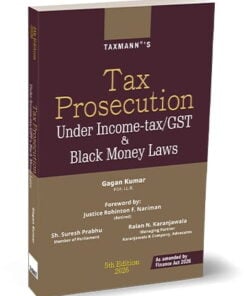
Taxmann’s Tax Prosecution under Income-tax/GST & Black Money Laws by Gagan Kumar
Taxmann's Tax Prosecution under Income-tax/GST & Black Money Laws by Gagan Kumar - 5th Edition 2026. First, this Taxmann publication provides the exact text on criminal tax liabilities. Specifically, author Gagan Kumar details the strict rules for tax prosecution. Furthermore, this fifth edition covers all fundamental 2026 statutory frameworks perfectly.


Taxmann’s GST Practical Guides | Unlocking Input Tax Credit – Navigating the GST Maze
Taxmann's GST Practical Guides | Unlocking Input Tax Credit – Navigating the GST Maze by Hiral Shah - 1st Edition 2024. This book provides insights into critical aspects of the Input Tax Credit (ITC) as per the GST Law, focusing on the CGST Act. This book will be helpful for tax practitioners and legal professionals. It is updated till 29th February 2024 and is developed by the Goods & Services Tax Practitioners' Association of Maharashtra.

Taxmann’s GST Appellate Mechanism | Key Aspects and Procedures by KSCAA – Edition March 2024
Taxmann's GST Appellate Mechanism | Key Aspects and Procedures by KSCAA - Edition March 2024. This comprehensive guide discusses the procedural and substantive aspects of GST appellate mechanisms in India, addressing the evolving challenges in GST litigation and the absence of a functional GST Appellate Tribunal. The book is structured to aid understanding from basic principles to complex procedures, enriched with real-world case studies and practical insights. It's updated with the latest legal provisions, making it a crucial resource for professionals and newcomers in GST litigation.
Reviews
There are no reviews yet.