


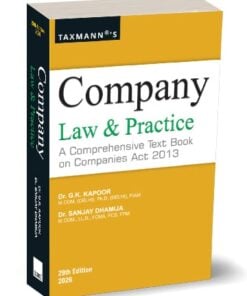
Taxmann’s Company Law and Practice by G K Kapoor
Taxmann's Company Law and Practice - A Comprehensive Text Book on Companies Act 2013 by G K Kapoor - 29th Edition January 2026. Company Law & Practice – A Comprehensive Textbook on the Companies Act 2013 (29th Edition | 2026) is a definitive and practice-oriented work that presents Indian company law as an integrated statutory, governance, and compliance framework. Updated with all legislative amendments, rules, regulatory developments, and judicial pronouncements, it reflects the contemporary, enforcement-driven, and governance-focused corporate law regime. The book combines doctrinal clarity with applied learning through contextual case law, procedural guidance, and specimen drafting tools. With comprehensive coverage of the entire corporate lifecycle, it functions both as a core academic textbook and a dependable professional reference.
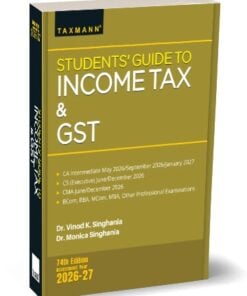
Taxmann’s Students Guide to Income Tax by V.K. Singhania
Taxmann's Students Guide to Income Tax Including GST (74th Edition 2026-27) (CA Inter) (New Syllabus) by Vinod K Singhania - January 2026. First, this Taxmann publication provides a complete guide to income tax and GST. Specifically, it details the exact rules for the 2026-2027 assessment year. Furthermore, this 74th Edition 2026 includes all CA Inter new syllabus updates perfectly.
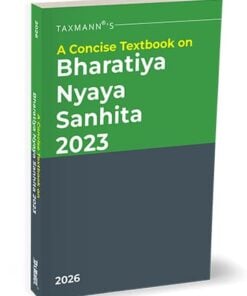
Taxmann’s A Concise Textbook on Bharatiya Nyaya Sanhita (BNS) 2023
Taxmann's A Concise Textbook on Bharatiya Nyaya Sanhita (BNS) 2023 - Edition 2026. A Concise Textbook on Bharatiya Nyaya Sanhita 2023 is a carefully structured, student-focused academic text that presents the complete framework of India's new substantive criminal law, replacing the Indian Penal Code, 1860. The 2026 Edition integrates the verbatim statutory provisions of the Bharatiya Nyaya Sanhita with clear, section-wise Comments and Analysis, enabling readers to understand the scope, ingredients, exceptions, and practical application of each provision. Designed as a learning tool rather than a mere statutory reproduction, the book facilitates a smooth transition from the IPC to the BNS regime while maintaining doctrinal continuity. It occupies a distinct position between a Bare Act and a full commentary, making it an essential foundational resource for academic study, classroom teaching, and examination preparation in the post-IPC era.
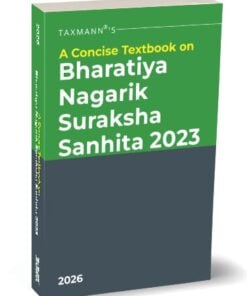
Taxmann’s A Concise Textbook on Bharatiya Nagarik Suraksha Sanhita (BNSS) 2023
Taxmann's A Concise Textbook on Bharatiya Nagarik Suraksha Sanhita (BNSS) 2023 - Edition 2026. A Concise Textbook on Bharatiya Nagarik Suraksha Sanhita 2023 is a carefully structured, student-oriented exposition of India's new criminal procedure law, replacing the Code of Criminal Procedure 1973. The 2026 Edition presents the BNSS as a coherent and functional procedural framework that systematically covers investigation, arrest, inquiry, trial, sentencing, and post-trial remedies. Positioned between a Bare Act and a full commentary, it combines the statutory text with clear section-wise analysis and comparative references to the CrPC, enabling practical and conceptual understanding. Reflecting the BNSS's technology-enabled, citizen-centric orientation, the book serves as a reliable academic and preparatory resource for students, judicial aspirants, educators, and early-stage legal professionals.
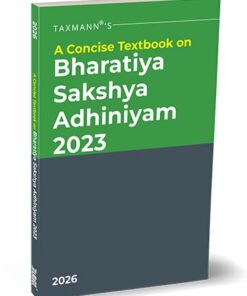
Taxmann’s A Concise Textbook on Bharatiya Sakshya Adhiniyam (BSA) 2023
Taxmann's A Concise Textbook on Bharatiya Sakshya Adhiniyam (BSA) 2023 - Edition 2026. A Concise Textbook on Bharatiya Sakshya Adhiniyam 2023 is a rigorously structured and student-focused exposition of India's new law of evidence, enacted to replace the Indian Evidence Act 1872. The 2026 Students' Edition is specifically designed for learners studying evidence law under the re-codified criminal law framework. Rather than treating the statute as a mere replacement, the book explains the Bharatiya Sakshya Adhiniyam as a functional evidentiary system governing proof, relevance, credibility, and judicial evaluation of facts. Positioned between a Bare Act and a professional commentary, it integrates the statutory text with concise, section-wise explanatory analysis aligned with classroom teaching and examination requirements. The work emphasises conceptual clarity, structured learning, and practical understanding of evidentiary principles.