
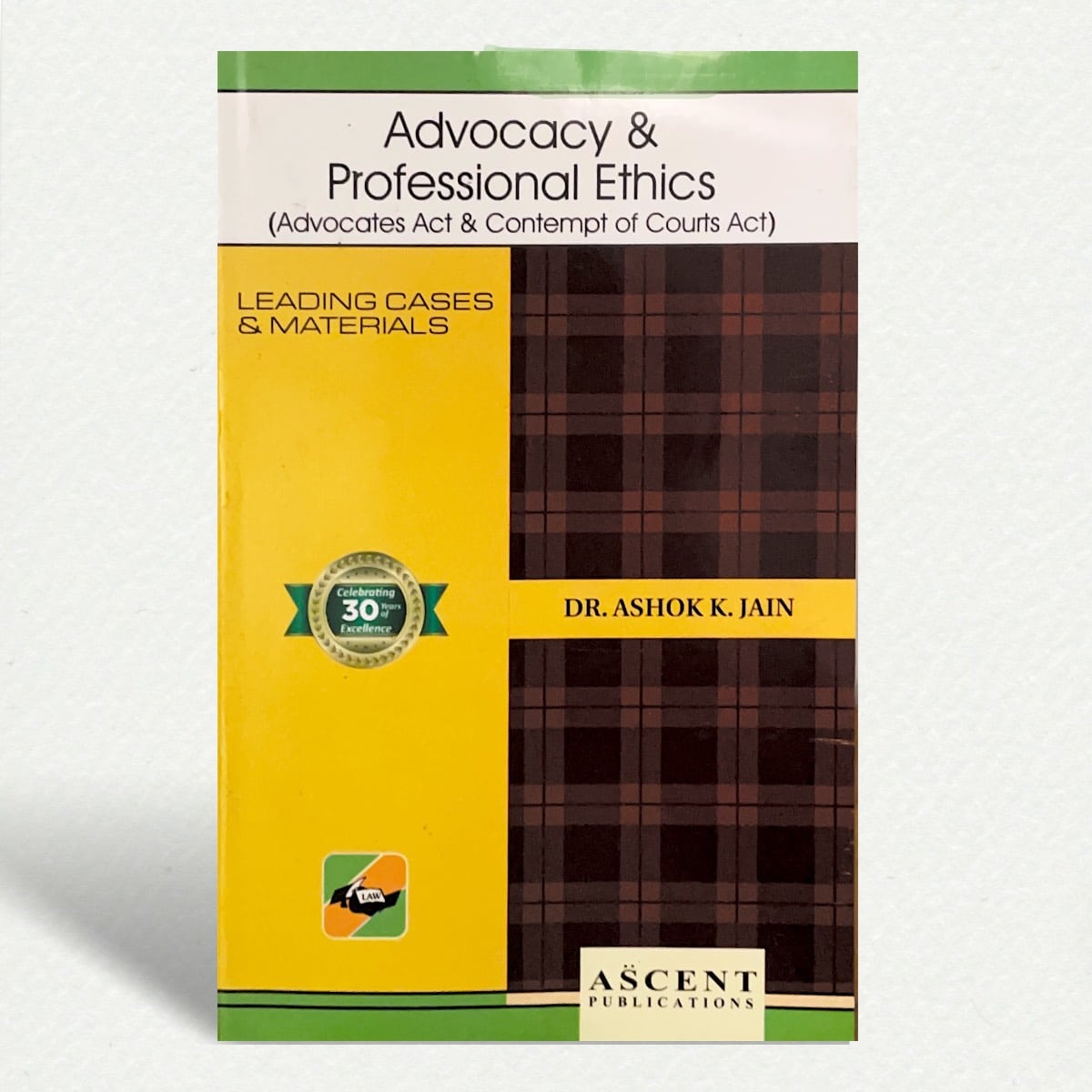


Ascent’s Advocacy & Professional Ethics by Dr. Ashok Kumar Jain
Original price was: ₹375.00.₹319.00Current price is: ₹319.00.
Ascent’s Advocacy & Professional Ethics (Advocates Act & Contempt of Courts Act) by Dr. Ashok Kumar Jain.
10 in stock
Ascent’s Advocacy & Professional Ethics (Advocates Act & Contempt of Courts Act) by Dr. Ashok Kumar Jain.
Ascent’s Advocacy & Professional Ethics (Advocates Act & Contempt of Courts Act) by Dr. Ashok Kumar Jain.
Description:
Advocacy & Professional Ethics is a field of study and practice, particularly in the legal profession, that explores the principles of effective representation while adhering to a strict moral and professional code of conduct. It encompasses the skills needed to advocate for a client’s interests and the ethical standards that govern the behavior of legal professionals towards the court, clients, opponents, and colleagues.
Key Components of Advocacy
Advocacy refers to the act of pleading or arguing in favor of a cause or a client. Effective advocacy requires specific skills and qualities, often summarized by the “Seven Lamps of Advocacy”:
- Honesty: Being straightforward and truthful in all dealings.
- Courage: Fearlessly upholding the interests of the client, even in the face of adverse consequences, while remaining within the bounds of the law.
- Industry: Involving hard work, diligence, and thorough preparation of cases.
- Wit: The ability to use intelligence and quickness of mind to navigate complex situations.
- Eloquence: Fluent and persuasive communication skills to present arguments effectively.
- Judgment: The ability to make sound decisions and choose the most effective course of action.
- Fellowship: Maintaining courtesy, respect, and good faith towards fellow advocates and the bench.
Key Principles of Professional Ethics
Professional ethics in the legal field refer to the set of moral principles and standards that guide the conduct of legal professionals, ensuring integrity, fairness, and the upholding of the rule of law. Core principles include:
- Integrity: Acting with honesty and moral uprightness in all professional and business relationships.
- Confidentiality: Respecting and protecting private information acquired from clients, subject to legal obligations.
- Objectivity/Impartiality: Making decisions based on facts and evidence, free from personal bias or conflicts of interest.
- Competence and Due Care: Maintaining the necessary knowledge and skill to provide competent legal services and acting with diligence.
- Accountability: Taking responsibility for one’s actions and decisions.
- Professional Behavior: Complying with relevant laws and regulations and avoiding conduct that might discredit the profession.
Core Duties of an Advocate
The Bar Council of India (BCI) has established a detailed code of conduct under the Advocates Act, 1961, which outlines specific duties:
- Duty towards the Court: Advocates must act in a dignified manner, show respect to the court, not communicate privately with judges, appear in a prescribed dress, and refuse to use unfair or illegal means.
- Duty towards the Client: Advocates are generally bound to accept briefs (cases), must not withdraw without reasonable cause and notice, must disclose all relevant information, fearlessly uphold the client’s interests by all fair means, and maintain client confidentiality. They cannot charge fees contingent on the outcome of the case.
- Duty towards the Opponent: Advocates should not negotiate directly with the opposing party (only through their counsel) and must carry out all legitimate promises made.
- Duty towards Fellow Advocates: Advocates must act with courtesy and good faith, must not solicit work or advertise, and must obtain the consent of an already engaged advocate before appearing in the same case.
Importance
Adherence to professional ethics in advocacy is crucial for:
- Maintaining public trust and confidence in the legal system and the administration of justice.
- Ensuring fairness and impartiality in legal proceedings.
- Upholding the dignity and integrity of the legal profession.
- Guiding legal professionals through complex ethical dilemmas and conflicts of interest.
Violations of these ethical standards can lead to disciplinary actions by regulatory bodies, including suspension or removal from practicing law.
Details :
- Publisher : Ascent publications
- Author : Dr. Ashok Kumar Jain
- Edition : 2nd Edition
- ISBN-13 : 9789387286443
- ISBN-10 : 9789387286443
- Language : English
- Binding : Paperback
| Author | Dr. Ashok Kumar Jain |
|---|---|
| Language | English |
| Publisher | Ascent Publication |
Only logged in customers who have purchased this product may leave a review.
Related products

VP’s Cyber Law & Cyber Crimes by Dr. J. N. Barowalia
Equip your practice for India’s new era of digital jurisprudence. VP’s Cyber Law & Cyber Crimes (2nd Edition, August 2026), authored by Dr. J. N. Barowalia and Dr. Aarushi Jain, is a monumental 1,100-page desk reference published by Vinod Publications.
-
✔ The New Criminal Framework: Complete cross-analysis of cyber offenses with the Bharatiya Nyaya Sanhita (BNS) 2023 and procedural impacts under the Bharatiya Nagarik Suraksha Sanhita (BNSS) 2023.
-
✔ Electronic Evidence Mastery: Detailed, actionable guides on hash value validation and presenting digital evidence in court as per the Bharatiya Sakshya Adhiniyam (BSA) 2023.
-
✔ Data Privacy & Modern Threats: Section-by-section breakdown of the DPDP Act, 2023, plus judicial interpretations on digital arrests, crypto-crimes, and ransomware. Featuring a prestigious foreword by former CJI Hon’ble Dr. Justice D.Y. Chandrachud.
Lexis Nexis’s The Specific Relief Act, 1963 (Bare Act) by Universal
Lexis Nexis’s The Specific Relief Act, 1963 (Bare Act) by Universal - 2026 Edition. First, this LexisNexis publication provides the exact text of civil remedies. Specifically, it details the strict rules for enforcing contracts. Furthermore, this 2026 Edition covers all fundamental statutory updates perfectly.



Reviews
There are no reviews yet.