
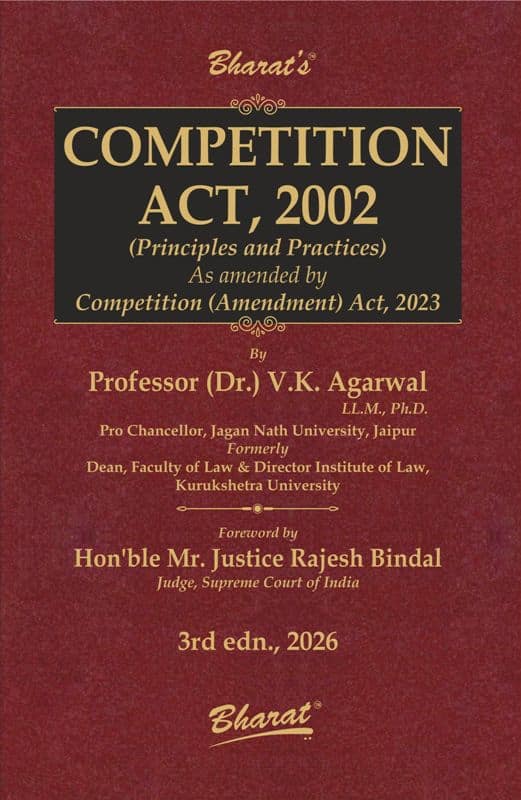



Bharat’s Competition Act, 2002 (Principles and Practices) by (Dr.) V.K. Agarwal
Original price was: ₹2,495.00.₹1,871.00Current price is: ₹1,871.00.
Bharat’s Competition Act, 2002 (Principles and Practices) by (Dr.) V.K. Agarwal – 3rd Edition 2026.
10 in stock
Bharat’s Competition Act, 2002 (Principles and Practices) by (Dr.) V.K. Agarwal – 3rd Edition 2026.
Bharat’s Competition Act, 2002 (Principles and Practices) by (Dr.) V.K. Agarwal – 3rd Edition 2026.
About Competition Act, 2002 (Principles and Practices)
The Competition Act, 2002 is the primary legislation in India that governs modern competition law. It aims to prevent anti-competitive practices, promote and sustain competition in markets, protect consumer interests, and ensure freedom of trade. The Act replaced the outdated Monopolies and Restrictive Trade Practices Act, 1969 (MRTP Act) to align Indian law with global economic changes following the liberalization in the 1990s.
Core Objectives
The Act’s main objectives are to prevent practices that harm competition, promote a competitive environment, protect consumers, and ensure freedom of trade.
Key Provisions
The Act addresses anti-competitive behavior through three main areas:
- Anti-Competitive Agreements (Section 3):Prohibits agreements, formal or informal, that negatively impact competition in India. These include agreements between competitors (horizontal) like price-fixing and market allocation, which are presumed anti-competitive, and agreements between entities at different supply chain levels (vertical), assessed based on their potential harm.
- Abuse of Dominant Position (Section 4):Prevents companies in a dominant market position from engaging in abusive practices like unfair pricing, limiting production or market access, or using dominance in one market to gain an advantage in another.
- Regulation of Combinations (Sections 5 & 6):Regulates mergers, acquisitions, and amalgamations that meet certain thresholds and could harm competition. Such combinations require notification to the Competition Commission of India (CCI) for review. Recent amendments introduced a “deal value threshold” requiring notification for transactions over ₹2,000 Crore.
Enforcement and Regulatory Body
The Competition Commission of India (CCI) enforces the Act, investigating anti-competitive practices, reviewing combinations, imposing penalties (up to 10% of average turnover, higher for cartels), and promoting competition awareness. Appeals can be made to the National Company Law Appellate Tribunal (NCLAT).
Recent Amendments
The Competition (Amendment) Act, 2023 brought changes such as introducing the deal value threshold, reducing review timelines for combinations, allowing settlements and commitments for violations, and enabling the CCI to base penalties on a company’s global turnover.
Details
- Binding : Hardcover
- Publisher : Bharat Law House Pvt. Ltd.
- Author : (Dr.) V.K. Agarwal
- Edition : 3rd Edition 2026
- Language : English
- ISBN-10 : 9788119565344
- ISBN-13 : 9788119565344
| Language | English |
|---|---|
| Publisher | Bharat Law House Pvt. Ltd. |
| Author | Dr. V.K. Agarwal |
Only logged in customers who have purchased this product may leave a review.
Related products

R. Cambray’s Land Laws of West Bengal by Babu Sarkar
R. Cambray's Land Laws of West Bengal by Babu Sarkar - 6th Edition 2024. First, this R. Cambray publication provides the exact text on regional property. Specifically, author Babu Sarkar details the strict West Bengal land rules. Furthermore, this sixth edition covers all fundamental 2024 statutory updates perfectly.
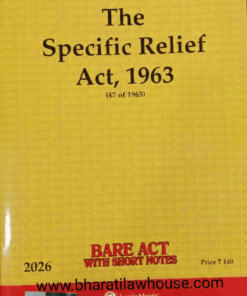
Lexis Nexis’s The Specific Relief Act, 1963 (Bare Act) by Universal
Lexis Nexis’s The Specific Relief Act, 1963 (Bare Act) by Universal - 2026 Edition. First, this LexisNexis publication provides the exact text of civil remedies. Specifically, it details the strict rules for enforcing contracts. Furthermore, this 2026 Edition covers all fundamental statutory updates perfectly.




Reviews
There are no reviews yet.