
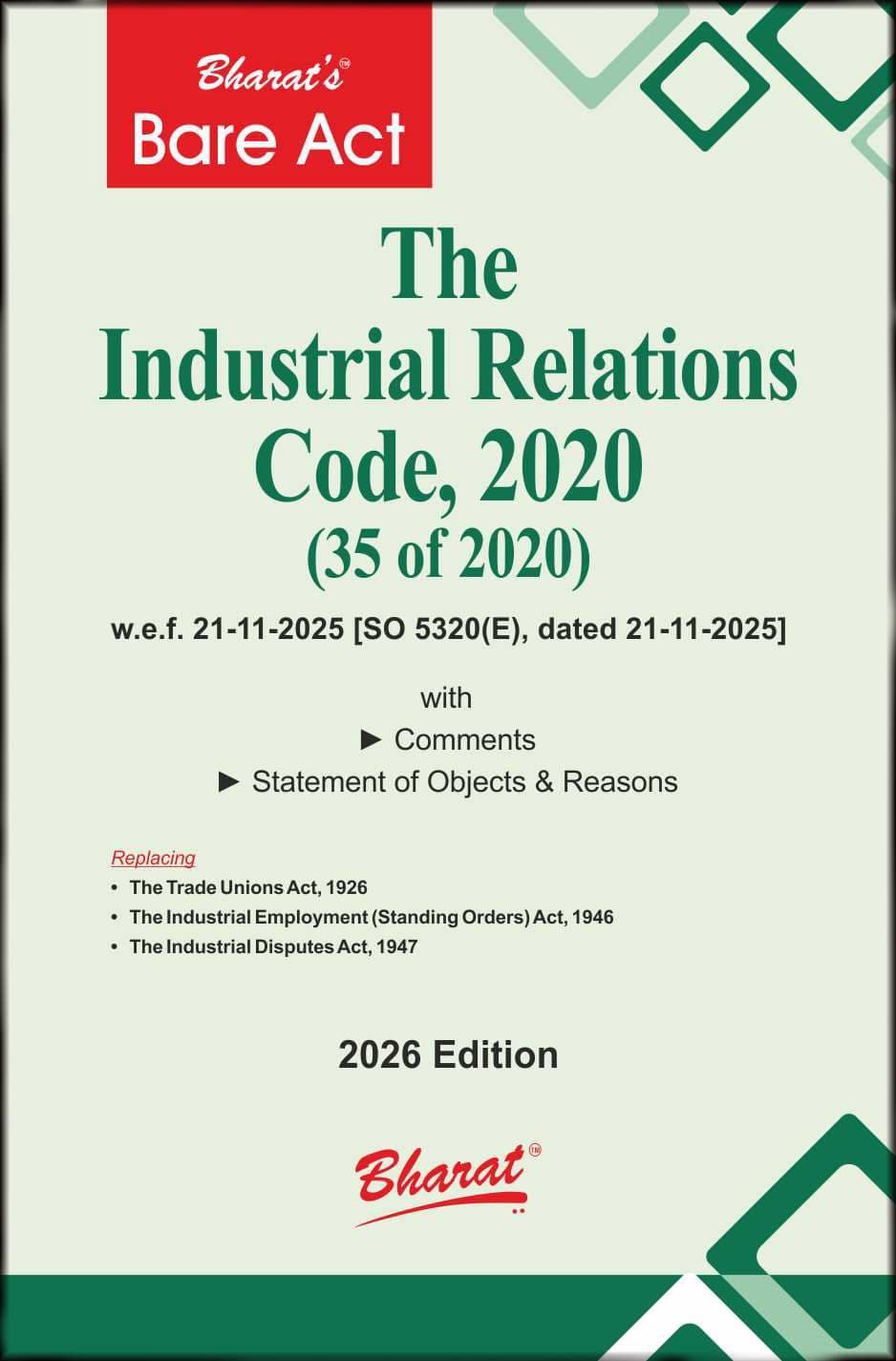


Bharat’s The Industrial Relations Code, 2020 (35 of 2020)
Original price was: ₹150.00.₹120.00Current price is: ₹120.00.
Bharat’s The Industrial Relations Code, 2020 (35 of 2020) – 1st Edition 2026.
10 in stock
Bharat’s The Industrial Relations Code, 2020 (35 of 2020) – 1st Edition 2026.
Bharat’s The Industrial Relations Code, 2020 (35 of 2020) – 1st Edition 2026.
About The Industrial Relations Code, 2020
The Industrial Relations Code, 2020 (Act No. 35 of 2020) is an Indian labour law that consolidates and amends existing laws related to trade unions, conditions of employment, and the investigation and settlement of industrial disputes.
The Code received presidential assent on September 28, 2020, and all its provisions came into force on November 21, 2025. It subsumes and replaces three previous Acts: the Trade Unions Act, 1926; the Industrial Employment (Standing Orders) Act, 1946; and the Industrial Disputes Act, 1947.
Key Provisions
- Consolidation of Laws: The Code amalgamates three central labour acts into a single framework to simplify compliance and promote industrial harmony.
- Increased Thresholds: The applicability threshold for standing orders (rules on working conditions, etc.) and the requirement for government permission for lay-offs, retrenchment, and closure have been increased to industrial establishments with 300 or more workers(previously 100). This provides employers with greater operational flexibility.
- Fixed-Term Employment: The Code formally introduces fixed-term employment, ensuring that workers engaged on a written contract for a fixed period receive all statutory benefits (wages, allowances, gratuity, etc.) on par with permanent workers, proportionate to their service period.
- Trade Union Recognition: It provides for statutory recognition of a “negotiating union” with at least 51% of worker support for collective bargaining. If no single union meets this threshold, a negotiating council will be formed with representatives from unions having at least 20% membership.
- Dispute Resolution: The process for resolving industrial disputes has been streamlined. Individual workers can now directly approach an Industrial Tribunal for adjudication of disputes related to dismissal or termination after 45 days of conciliation proceedings, without requiring government approval.
- Regulation of Strikes and Lockouts: The definition of “strike” is expanded to include “mass casual leave” by 50% or more workers. All persons in industrial establishments must give a 60-day advance notice before a strike or lockout, with a mandatory 14-day gap before the specified strike date.
- Worker Re-skilling Fund: A dedicated fund is to be created, with employer contributions equivalent to 15 days’ last drawn wages for every retrenched worker, to help them re-skill and secure new employment.
- Penalties: The Code introduces stricter penalties for offenses and allows for the compounding (settling) of certain offenses to reduce litigation.
Details
- Binding : Softcover
- Publisher : Bharat Law House Pvt. Ltd.
- Author : Bharat
- Edition : 1st Edition 2026
- Language : English
- ISBN-10 : 9788199364110
- ISBN-13 : 9788199364110
| Publisher | Bharat Law House Pvt. Ltd. |
|---|---|
| Author | Bharat |
| Language | English |
Only logged in customers who have purchased this product may leave a review.
Related products
Introduction to the Constitution of India | DD Basu (28th Ed. 2026)
Master the foundational legal framework of the world's largest democracy with Introduction to the Constitution of India by legendary jurist Durga Das Basu. Published by LexisNexis, this 28th Edition (2026) remains the most incisive and pioneering work on the subject.
-
✔ Historical & Modern Context: Traces India’s constitutional evolution since the Government of India Act, 1858, right through to the latest legislative amendments.
-
✔ Recent Landmark Judgments: Fully updated with pivotal Supreme Court decisions, including Surendra Koli v State of Uttar Pradesh and Dr Tanvi Behl v Shrey Goel.
-
✔ Exam-Ready Structure: Features an analytical table of contents, marginal notes, and reference tables, making it indispensable for LL.B., LL.M., and UPSC/PSC candidates.

Reviews
There are no reviews yet.