
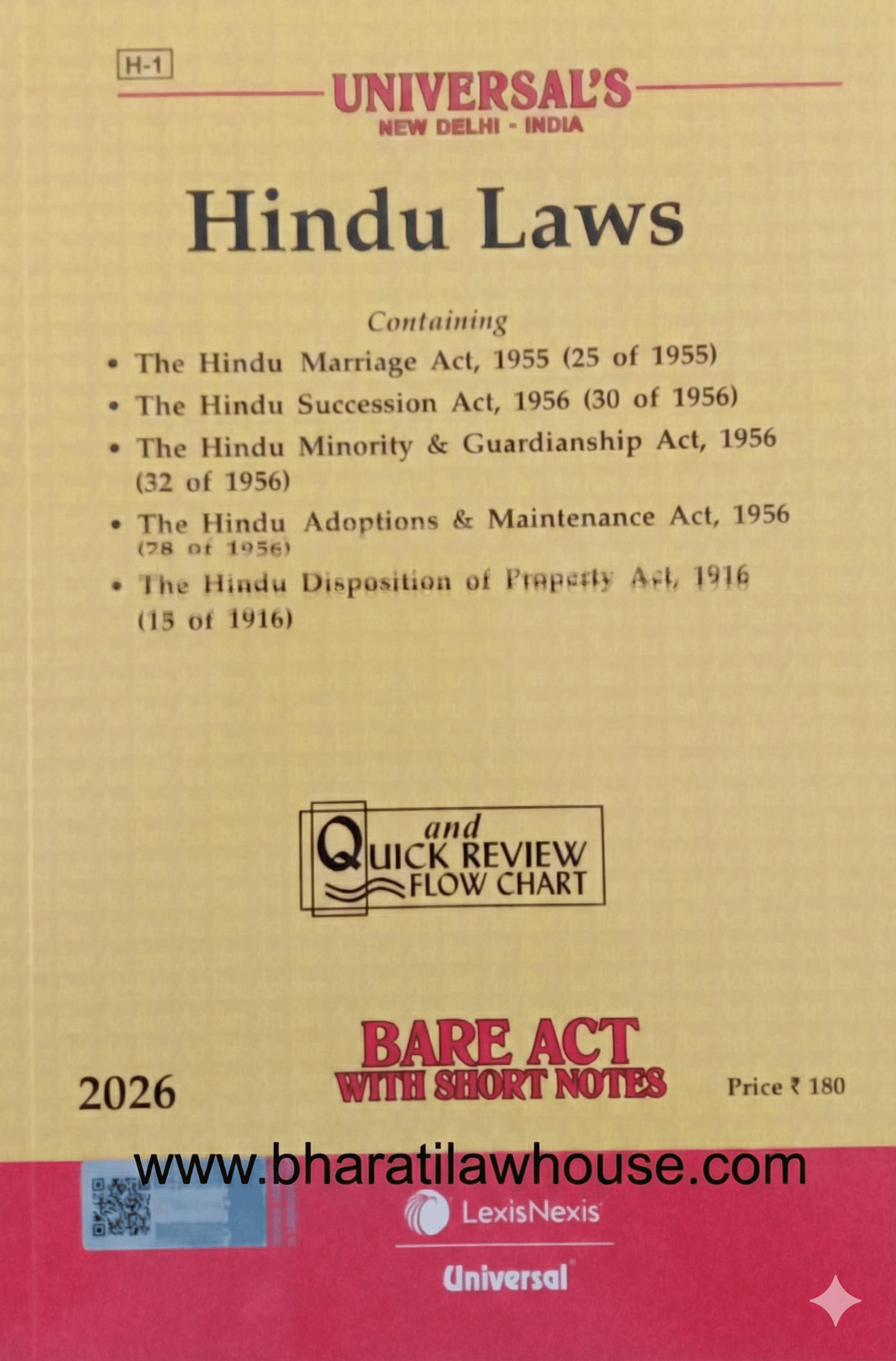

Hindu Laws (Containing 5 Acts) Bare Act | Universal Lexis Nexis 2026
₹180.00
Consolidate your family law practice with Lexis Nexis’s Hindu Laws (Containing 5 Acts) Bare Act. Published under the highly trusted Universal imprint, this 2026 Edition compiles all central statutes governing Hindu personal law into a single, comprehensive volume.
-
✔ 5 Core Statutes: Contains the Hindu Marriage Act (1955), Succession Act (1956), Minority & Guardianship Act (1956), Adoptions & Maintenance Act (1956), and Disposition of Property Act (1916).
-
✔ Complete Legislative Updates: Fully amended to reflect the latest statutory changes, including the Jammu and Kashmir Reorganisation Act impacts.
-
✔ Quick Review Features: Includes proprietary visual flow charts and short notes for rapid courtroom or exam revision.
100 in stock
Lexis Nexis’s Hindu Laws (Containing 5 Acts) (Bare Act) by Universal – 2026 Edition.
Hindu Laws (Containing 5 Acts) is the definitive statutory compilation for navigating Hindu personal jurisprudence in India. Published by Lexis Nexis under the Universal series, this 2026 Edition brings together the unabridged legislative texts of the five major acts regulating marriage, divorce, succession, adoption, and guardianship. It is meticulously designed for legal professionals, scholars, and students, integrating the bare texts with quick-reference visual aids and explanatory notes.
Key Statutes Included in this Compilation
This Bare Act provides the exact statutory text, updated with all relevant central and state amendments, for the following critical legislations:
-
The Hindu Marriage Act, 1955: The foundational statute governing the conditions for a valid Hindu marriage, restitution of conjugal rights, judicial separation, and the statutory grounds for divorce.
-
The Hindu Succession Act, 1956: Outlines the legal framework for intestate succession, coparcenary property rights, and the absolute property rights of Hindu females.
-
The Hindu Minority and Guardianship Act, 1956: Regulations defining natural guardians, their powers, and the welfare of the minor as the paramount consideration.
-
The Hindu Adoptions and Maintenance Act, 1956: The legal prerequisites for a valid adoption and the statutory obligations regarding the maintenance of wives, children, and aged parents.
-
The Hindu Disposition of Property Act, 1916: Governs dispositions of property by Hindus for the benefit of persons not in existence at the date of the disposition.
Value-Added Features for Practitioners
-
Quick Review Flow Chart: Features proprietary visual flow charts that map out complex statutory mechanisms (like the rules of succession and degrees of prohibited relationship), making it an excellent tool for last-minute exam preparation or quick in-court reference.
-
Short Notes: Annotated with concise explanatory notes to clarify complex doctrines and legislative history without cluttering the bare text.
Who Should Buy This Bare Act?
-
Family Law Litigators: A mandatory daily desk reference for advocates handling matrimonial disputes, maintenance claims, child custody, and property partition suits.
-
Law Students: The primary text for understanding Hindu jurisprudence in LL.B. curriculums, made accessible through short notes and flow charts.
-
Judiciary Aspirants: An indispensable, highly structured study tool for candidates preparing for state Judicial Service Examinations.
-
Legal Counselors & Mediators: Essential for professionals handling community mediation and pre-litigation family dispute resolution.
Details
- Binding : Softcover
- Publisher : Lexis Nexis
- Author : Universal
- Edition : 2026
- Language : English
- ISBN-10 : 9999999999H01
- ISBN-13 : 9999999999H01
| Publisher | Lexis Nexis |
|---|---|
| Language | English |
| Author | Universal |
Only logged in customers who have purchased this product may leave a review.
Related products
Lexis Nexis’s Commentary on Trade Marks Act by T.R.S. Iyengar
Navigate the complex intersection of intellectual property law and commercial strategy with Iyengar's Commentary on The Trade Marks Act. Published by LexisNexis, this comprehensively updated 6th Edition (2025) remains the ultimate courtroom and boardroom authority on brand protection.
-
✔ Integrated Business Approach: Approaches trademark law not just as a rigid statute, but as an active tool for business trading, brand protection, and corporate strategy.
-
✔ Global & Domestic Jurisprudence: Features an exhaustive compilation of landmark and recent case laws from both Indian courts and international jurisdictions.
-
✔ Complete Statutory Framework: Incorporates all recent legislative developments, Rules, Notifications, and critical international Treaties (including the Madrid Protocol).
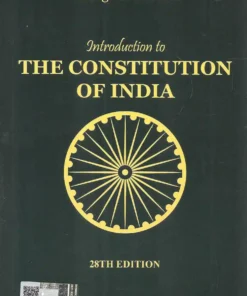
Introduction to the Constitution of India | DD Basu (28th Ed. 2026)
Master the foundational legal framework of the world's largest democracy with Introduction to the Constitution of India by legendary jurist Durga Das Basu. Published by LexisNexis, this 28th Edition (2026) remains the most incisive and pioneering work on the subject.
-
✔ Historical & Modern Context: Traces India’s constitutional evolution since the Government of India Act, 1858, right through to the latest legislative amendments.
-
✔ Recent Landmark Judgments: Fully updated with pivotal Supreme Court decisions, including Surendra Koli v State of Uttar Pradesh and Dr Tanvi Behl v Shrey Goel.
-
✔ Exam-Ready Structure: Features an analytical table of contents, marginal notes, and reference tables, making it indispensable for LL.B., LL.M., and UPSC/PSC candidates.

R. Cambray’s Land Laws of West Bengal by Babu Sarkar
R. Cambray's Land Laws of West Bengal by Babu Sarkar - 6th Edition 2024. First, this R. Cambray publication provides the exact text on regional property. Specifically, author Babu Sarkar details the strict West Bengal land rules. Furthermore, this sixth edition covers all fundamental 2024 statutory updates perfectly.
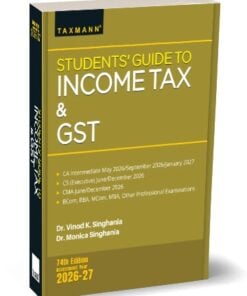
Taxmann’s Students Guide to Income Tax by V.K. Singhania
Taxmann's Students Guide to Income Tax Including GST (74th Edition 2026-27) (CA Inter) (New Syllabus) by Vinod K Singhania - January 2026. First, this Taxmann publication provides a complete guide to income tax and GST. Specifically, it details the exact rules for the 2026-2027 assessment year. Furthermore, this 74th Edition 2026 includes all CA Inter new syllabus updates perfectly.


Reviews
There are no reviews yet.