
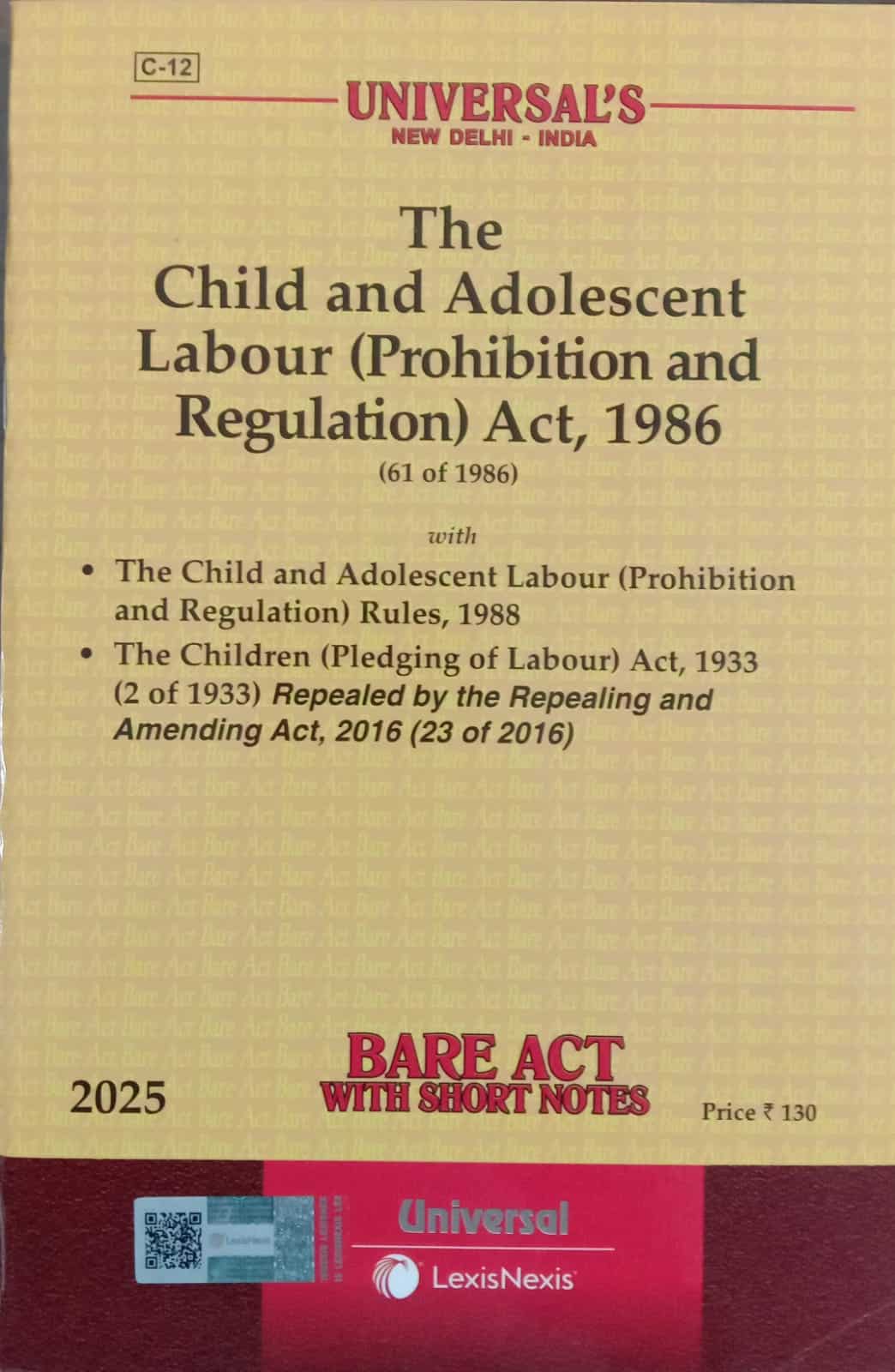

Lexis Nexis’s The Child and Adolescent Labour (Prohibition and Regulation) Act, 1986 (Bare Act) – 2025 Edition
₹130.00
Lexis Nexis’s The Child and Adolescent Labour (Prohibition and Regulation) Act, 1986 (Bare Act) – 2025 Edition.
29 in stock
Lexis Nexis’s The Child and Adolescent Labour (Prohibition and Regulation) Act, 1986 (Bare Act) – 2025 Edition.
Lexis Nexis’s The Child and Adolescent Labour (Prohibition and Regulation) Act, 1986 (Bare Act) – 2025 Edition.
Description:
The Child and Adolescent Labour (Prohibition and Regulation) Act, 1986, is an Indian law that prohibits the employment of children under 14 and regulates the working conditions of adolescents (ages 14–18). The Act was significantly amended in 2016 to increase penalties, clarify definitions, and provide stronger enforcement mechanisms.
Key provisions of the Act
Prohibition on child labour
- Complete ban: The Act completely prohibits the employment of children under 14 in any occupation or process.
- Exceptions: There are two exceptions to this ban:
- Children can help in a family enterprise or in their family’s business, provided it is not a hazardous occupation and the work is done after school hours or during vacations.
- Children can work as artists in the audio-visual entertainment industry (excluding circuses), so long as their health, safety, and education are not compromised.
Regulation of adolescent labour
The Act regulates the working conditions of adolescents (14 to 18 years old) in non-hazardous occupations, with the following rules:
- Hazardous occupations: Adolescents are prohibited from working in hazardous occupations and processes listed in the Act’s schedules.
- Working hours: An adolescent cannot work for more than 6 hours per day, including a rest interval of at least one hour.
- Night work and overtime: Working between 7 p.m. and 8 a.m. is prohibited, and overtime work is not permitted.
- Weekly holiday: A full-day holiday every week is mandatory.
- Double employment: Adolescents cannot be employed in more than one establishment on the same day.
Enforcement and penalties
The Act makes the contravention of its provisions a cognizable offense, which means a police officer can make an arrest without a warrant.
- Penalties for employers:
- First offense: Imprisonment for 6 months to 2 years, or a fine of ₹20,000 to ₹50,000, or both.
- Repeated offense: Imprisonment for 1 to 3 years.
- Penalties for parents/guardians:
- First offense: No punishment.
- Repeated offense: A fine of up to ₹10,000.
- Other violations: Violations of rules regarding working conditions for adolescents are punishable with simple imprisonment of up to one month or a fine of up to ₹10,000, or both.
Rehabilitation of rescued children
The Act mandates the establishment of a Child and Adolescent Labour Rehabilitation Fund in each district. When a child or adolescent is rescued, the government credits ₹15,000 to this fund for the individual. The amount, including interest, is paid to them when they turn 18 to support their education and welfare.
Importance of the 2016 amendment
The 2016 amendment was a crucial update that brought India’s laws into alignment with international standards, particularly the International Labour Organization (ILO) conventions. Before the amendment, children under 14 were only prohibited from working in a limited list of occupations. The 2016 changes expanded this ban to all forms of child labour, with the specified exceptions. It also explicitly created the legal category of “adolescents” and regulated their work, extending protection to a larger age group.
Details
- Binding : Softcover
- Publisher : Lexis Nexis
- Author : Universal
- Edition : 2025
- Language : English
- ISBN-10 : 9999999999C12
- ISBN-13 : 9999999999C12
| Publisher | Lexis Nexis |
|---|---|
| Language | English |
| Author | Universal |
Only logged in customers who have purchased this product may leave a review.
Related products
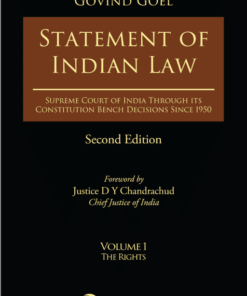
Lexis Nexis’s Statement of Indian Law by Govind Goel
Master the absolute highest level of Indian jurisprudence. LexisNexis's Statement of Indian Law (2nd Edition, 2024) by Govind Goel is a monumental 3-volume compilation tracking every single decision delivered by the Constitution Benches of the Supreme Court of India since 1950.
-
✔ The Ultimate Constitutional Record: The only exhaustive running interpretative commentary on the evolution of law through the Constitutional Benches.
-
✔ Pioneering Judicial Analytics: Features a dedicated chapter mapping the productivity, spread of unanimity, and dissent of Supreme Court judges using graphs, pie charts, and data tables.
-
✔ Recent Historic Addendums: Fully updated with landmark 2023/2024 rulings, including In Re Article 370 of the Constitution of India, Vivek Narayan Sharma v Union of India, and Sita Soren v Union of India.
Lexis Nexis’s Interfaces of Intellectual Property Law by Sreenivasulu N S
Go beyond the basics with Interfaces of Intellectual Property Law. Authored by distinguished NUJS Professor Sreenivasulu N S and published by LexisNexis, this 1st Edition (2025) explores how IP rights intersect with today’s most critical legal domains.
-
✔ Cross-Disciplinary Approach: Delves into the coexistence of IP law with constitutional law, human rights, environmental law, and technology law.
-
✔ Comprehensive Scope: Reviews the evolution of IP laws from 19th-century conventions through to the complex post-TRIPS era.
-
✔ Latest Developments: Fully updated with important judicial developments and recent legislative changes shaping the public domain and competition law.
Law of Torts by R.K. Bangia (27th Edition, 2026) | ALA
Begin your legal journey with the most widely prescribed torts textbook in Indian legal education: The Law of Torts by Dr. R.K. Bangia. Published by the Allahabad Law Agency (ALA), this 27th Edition Reprint (2026) is revised by S.K. Raghuvanshi to meet modern syllabus demands.
-
✔ Updated Statutory Landscape: Integrates the Motor Vehicles Act, 1988 (amended up to 2019), Consumer Protection Act, 2019 (amended up to 2024), and Competition Act, 2002 (amended up to 2023).
-
✔ Classic Case Laws: Develops foundational concepts through landmark judgments from Rylands v. Fletcher to M.C. Mehta.
-
✔ Authentic Edition: Includes the ALA holographic authenticity seal on every genuine copy.
Taxmann’s Students Guide to Income Tax by V.K. Singhania
Taxmann's Students Guide to Income Tax Including GST (74th Edition 2026-27) (CA Inter) (New Syllabus) by Vinod K Singhania - January 2026. First, this Taxmann publication provides a complete guide to income tax and GST. Specifically, it details the exact rules for the 2026-2027 assessment year. Furthermore, this 74th Edition 2026 includes all CA Inter new syllabus updates perfectly.


Reviews
There are no reviews yet.