
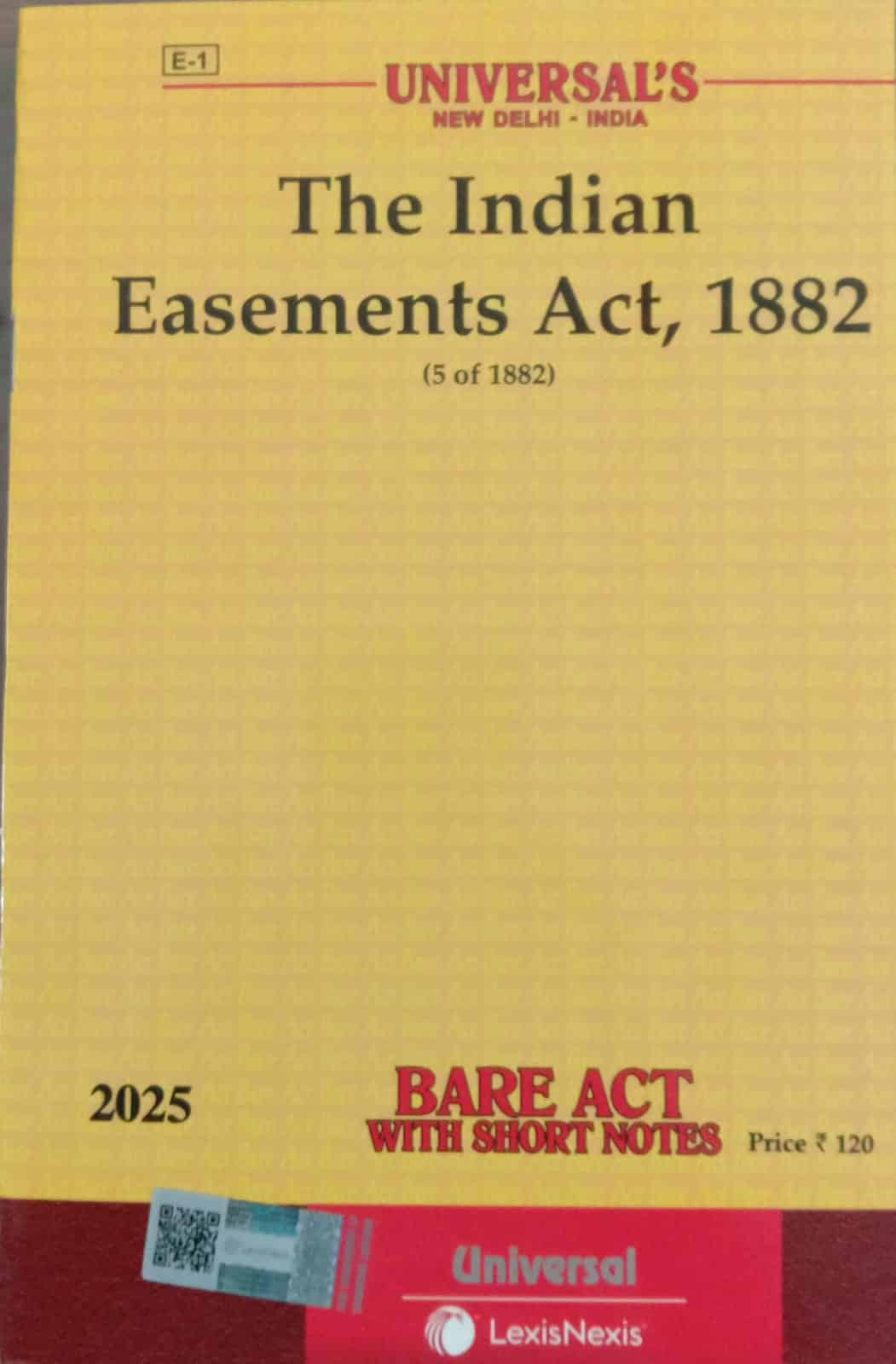

Lexis Nexis’s The Indian Easements Act, 1882 (Bare Act) – 2025 Edition
₹120.00
Lexis Nexis’s The Indian Easements Act, 1882 (Bare Act) – 2025 Edition.
30 in stock
Lexis Nexis’s The Indian Easements Act, 1882 (Bare Act) – 2025 Edition.
Lexis Nexis’s The Indian Easements Act, 1882 (Bare Act) – 2025 Edition.
Description:
The Indian Easements Act, 1882 (Act No. 5 of 1882) is the central legislation that defines and amends the law relating to easements and licenses in India. An easement is a right that the owner or occupier of a specific piece of land (the dominant heritage) has for its beneficial enjoyment over another piece of land that is not their own (the servient heritage). This includes the right to do something or to prevent something from being done on the other person’s land.
Key provisions of the Act
Chapter I: Of easements generally
- Definition of easement (Section 4): An easement is a right exercised by a dominant owner over a servient heritage for the beneficial enjoyment of their property. For an easement to exist, there must be a dominant and a servient heritage.
- Types of easements (Section 5): Easements can be continuous or discontinuous, and apparent or non-apparent.
- Continuous: Enjoyment of this type of easement does not require a human act (e.g., a right to light).
- Discontinuous: A human act is necessary for its enjoyment (e.g., a right of way).
- Apparent: The existence of the easement is visible through a permanent sign (e.g., a drain).
- Non-apparent: The easement has no visible, permanent sign (e.g., a right to privacy).
- Easements are restrictive rights (Section 7): The Act clarifies that easements are limitations on the exclusive right of a property owner to enjoy and dispose of their property.
Chapter II: The imposition, acquisition, and transfer of easements
- Acquisition of easements:
- Express grant: An easement can be acquired through an explicit grant by the servient owner.
- Necessity and quasi-easements (Section 13):
-
-
- Easements of necessity: Arise when a property owner cannot enjoy their property without exercising a right over an adjacent property, and it is a matter of absolute necessity, not just convenience.
-
-
-
- Quasi-easements: These are implied easements that arise when a common property is divided, and one part requires an apparent and continuous easement over the other for its continued enjoyment.
-
-
- Prescription (Section 15): An easement can be acquired by openly, peacefully, and continuously enjoying a right for a specified period without interruption. The period is 20 years for private land and 30 years for government land.
- Customary easements (Section 18): These rights are acquired by virtue of a local custom.
- Who can impose and acquire easements (Sections 8 and 12): The Act defines who can legally impose and acquire easements, including owners, co-owners, and those with limited interests.
Chapter III: The incidents of easements
- Rights and obligations of owners: This chapter details the rules for exercising an easement, such as the dominant owner’s right to repair and the servient owner’s right to impose an easement that does not lessen the utility of an existing one. The dominant owner is liable for damage caused during repairs.
Chapter IV: The disturbance of easements
- Right to enjoyment without disturbance (Section 32): The dominant owner has the right to enjoy their easement without interference.
- Remedies for disturbance (Sections 33 and 35): The Act allows for legal action, such as a suit for compensation or an injunction, to restrain the disturbance of an easement.
Chapter V: The extinction, suspension, and revival of easements
- Extinction of easements: An easement can be extinguished in various ways, including by release, by unity of ownership, by the expiration of a limited period, or by non-enjoyment for 20 years.
- Suspension and revival: The Act also covers the temporary suspension of an easement and the circumstances under which it can be revived.
Chapter VI: Licenses
- License defined (Section 52): A license is a right granted by one person to another to do something on the grantor’s immovable property, which would otherwise be unlawful, and does not create an interest in the property.
- Revocation of license (Sections 60–64): The Act specifies when a license is revocable and defines the rights of the licensee upon revocation or eviction. Certain licenses, particularly those coupled with a transfer of property or with a permanent work created at an expense, may be irrevocable.
Details
- Binding : Softcover
- Publisher : Lexis Nexis
- Author : Universal
- Edition : 2025
- Language : English
- ISBN-10 : 9999999999E01
- ISBN-13 : 9999999999E01
| Publisher | Lexis Nexis |
|---|---|
| Language | English |
| Author | Universal |
Only logged in customers who have purchased this product may leave a review.
Related products
Lexis Nexis’s Interfaces of Intellectual Property Law by Sreenivasulu N S
Go beyond the basics with Interfaces of Intellectual Property Law. Authored by distinguished NUJS Professor Sreenivasulu N S and published by LexisNexis, this 1st Edition (2025) explores how IP rights intersect with today’s most critical legal domains.
-
✔ Cross-Disciplinary Approach: Delves into the coexistence of IP law with constitutional law, human rights, environmental law, and technology law.
-
✔ Comprehensive Scope: Reviews the evolution of IP laws from 19th-century conventions through to the complex post-TRIPS era.
-
✔ Latest Developments: Fully updated with important judicial developments and recent legislative changes shaping the public domain and competition law.
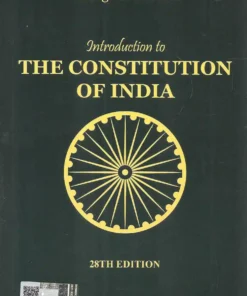
Introduction to the Constitution of India | DD Basu (28th Ed. 2026)
Master the foundational legal framework of the world's largest democracy with Introduction to the Constitution of India by legendary jurist Durga Das Basu. Published by LexisNexis, this 28th Edition (2026) remains the most incisive and pioneering work on the subject.
-
✔ Historical & Modern Context: Traces India’s constitutional evolution since the Government of India Act, 1858, right through to the latest legislative amendments.
-
✔ Recent Landmark Judgments: Fully updated with pivotal Supreme Court decisions, including Surendra Koli v State of Uttar Pradesh and Dr Tanvi Behl v Shrey Goel.
-
✔ Exam-Ready Structure: Features an analytical table of contents, marginal notes, and reference tables, making it indispensable for LL.B., LL.M., and UPSC/PSC candidates.
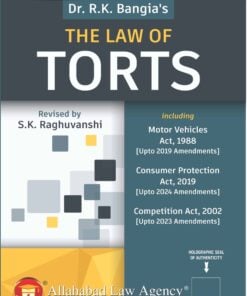
Law of Torts by R.K. Bangia (27th Edition, 2026) | ALA
Begin your legal journey with the most widely prescribed torts textbook in Indian legal education: The Law of Torts by Dr. R.K. Bangia. Published by the Allahabad Law Agency (ALA), this 27th Edition Reprint (2026) is revised by S.K. Raghuvanshi to meet modern syllabus demands.
-
✔ Updated Statutory Landscape: Integrates the Motor Vehicles Act, 1988 (amended up to 2019), Consumer Protection Act, 2019 (amended up to 2024), and Competition Act, 2002 (amended up to 2023).
-
✔ Classic Case Laws: Develops foundational concepts through landmark judgments from Rylands v. Fletcher to M.C. Mehta.
-
✔ Authentic Edition: Includes the ALA holographic authenticity seal on every genuine copy.

R. Cambray’s Land Laws of West Bengal by Babu Sarkar
R. Cambray's Land Laws of West Bengal by Babu Sarkar - 6th Edition 2024. First, this R. Cambray publication provides the exact text on regional property. Specifically, author Babu Sarkar details the strict West Bengal land rules. Furthermore, this sixth edition covers all fundamental 2024 statutory updates perfectly.
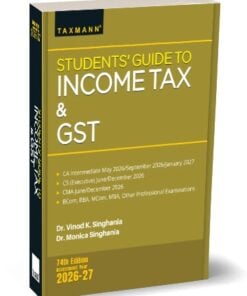
Taxmann’s Students Guide to Income Tax by V.K. Singhania
Taxmann's Students Guide to Income Tax Including GST (74th Edition 2026-27) (CA Inter) (New Syllabus) by Vinod K Singhania - January 2026. First, this Taxmann publication provides a complete guide to income tax and GST. Specifically, it details the exact rules for the 2026-2027 assessment year. Furthermore, this 74th Edition 2026 includes all CA Inter new syllabus updates perfectly.


Reviews
There are no reviews yet.