
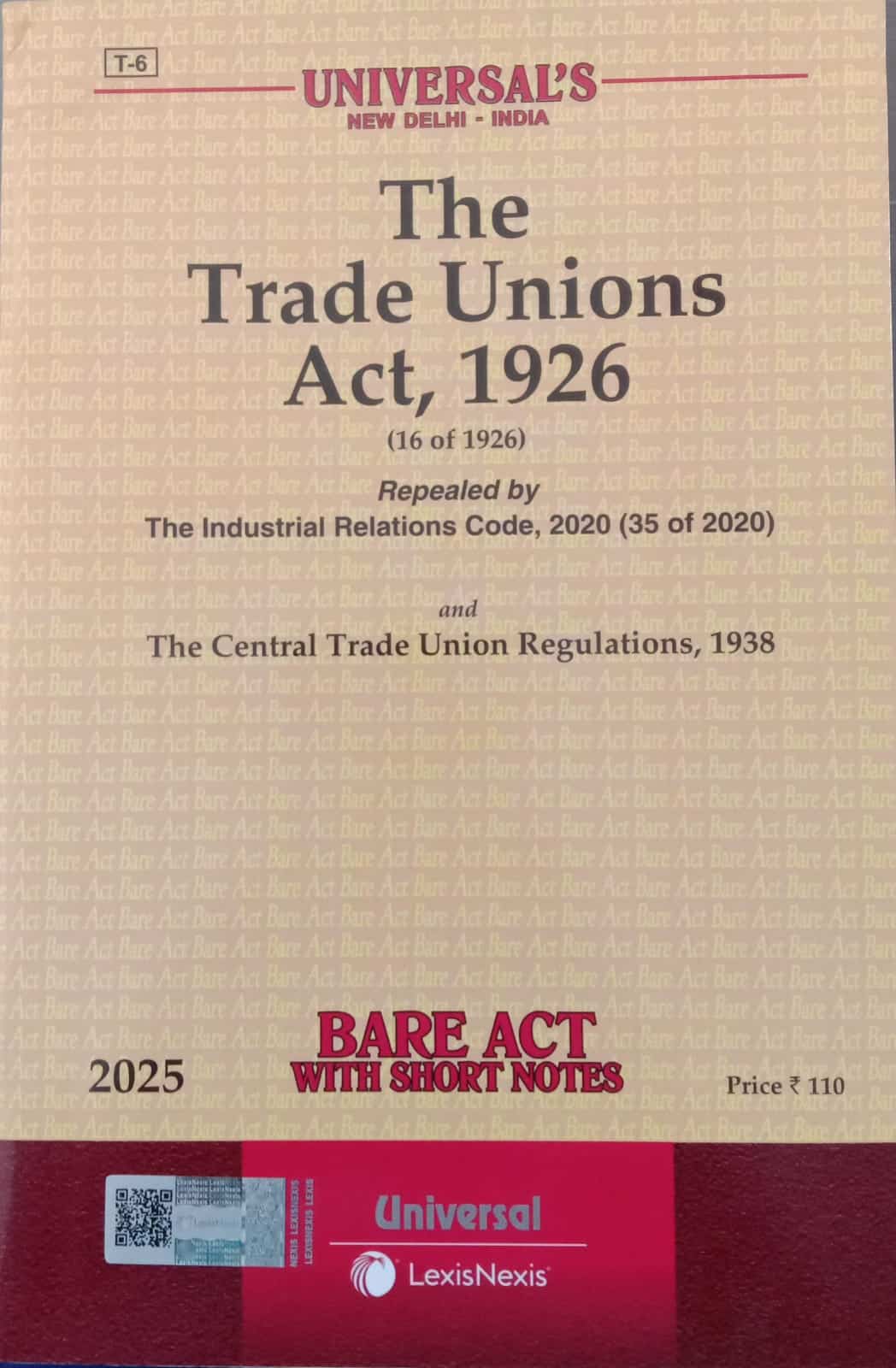


Lexis Nexis’s The Trade Union Act, 1926 (Bare Act) – 2025 Edition
₹110.00
Lexis Nexis’s The Trade Union Act, 1926 (Bare Act) – 2025 Edition.
30 in stock
Lexis Nexis’s The Trade Union Act, 1926 (Bare Act) – 2025 Edition.
Lexis Nexis’s The Trade Union Act, 1926 (Bare Act) – 2025 Edition.
Description:
The Trade Union Act of 1926 is a labor law in India that provides for the registration and regulation of trade unions. It grants registered unions and their members certain immunities and protections to facilitate their work, such as in collective bargaining and trade disputes.
Objectives
The primary objectives of the Act are to:
- Provide legal status: Give legal recognition to trade unions, which allows them to operate as legal entities.
- Protect workers’ rights: Safeguard the interests and welfare of workers, ensuring fair wages, better working conditions, and security of tenure.
- Regulate union activities: Establish a clear legal framework for the formation, registration, and functioning of trade unions to ensure they operate responsibly.
- Promote collective bargaining: Facilitate the process of collective bargaining between unions and employers to settle disputes and improve employment terms.
- Grant immunities: Protect registered trade unions and their members from civil and criminal liability for actions taken in pursuit of legitimate trade union activities.
Key provisions
Registration of trade unions
- Mode of registration: Any seven or more members of a trade union can apply for registration with the Registrar of Trade Unions.
- Minimum membership: As per the 2001 amendment, a union can only be registered if at least 10% or 100 of the workmen, whichever is less (with a minimum of seven), are members at the time of application.
- Certificate of registration: Once the registrar is satisfied that all provisions have been met, they issue a certificate of registration, which serves as conclusive proof that the union is legally registered.
- Cancellation: The registrar has the power to cancel or withdraw a union’s registration for reasons such as fraud, ceasing to exist, or willful contravention of the Act’s provisions.
Rights and liabilities
A registered trade union becomes a body corporate with perpetual succession and a common seal, allowing it to acquire property, enter into contracts, and sue or be sued. Section 15 specifies the purposes for which a union’s general funds can be used, including administrative costs and compensating members during trade disputes. Unions can also set up a separate voluntary fund for political purposes. Members and office-bearers of a registered union are protected from criminal conspiracy charges in trade disputes if no offense is committed, and from civil suits for actions taken during a trade dispute. Agreements between members of a registered union are not considered void solely because they restrict trade.
Membership and administration
Individuals aged 15 and over can be union members and enjoy full membership rights. Those under 18 or convicted of certain crimes with imprisonment are disqualified from being office-bearers. Registered unions must submit annual financial statements to the registrar. The Act also outlines the process for union dissolution.
Evolution and context
The Act was established in response to labor unrest and the lack of legal protection for unions before 1926 in British India. While India’s labor laws have evolved, with efforts like the Industrial Relations Code, 2020, the 1926 Act remains significant for defining union rights and providing a framework for collective bargaining.
Details
- Binding : Softcover
- Publisher : Lexis Nexis
- Author : Universal
- Edition : 2025
- Language : English
- ISBN-10 : 9999999999T06
- ISBN-13 : 9999999999T06
| Publisher | Lexis Nexis |
|---|---|
| Author | Universal |
| Language | English |
Only logged in customers who have purchased this product may leave a review.
Related products
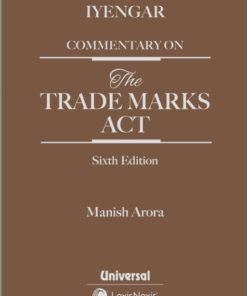
Lexis Nexis’s Commentary on Trade Marks Act by T.R.S. Iyengar
Navigate the complex intersection of intellectual property law and commercial strategy with Iyengar's Commentary on The Trade Marks Act. Published by LexisNexis, this comprehensively updated 6th Edition (2025) remains the ultimate courtroom and boardroom authority on brand protection.
-
✔ Integrated Business Approach: Approaches trademark law not just as a rigid statute, but as an active tool for business trading, brand protection, and corporate strategy.
-
✔ Global & Domestic Jurisprudence: Features an exhaustive compilation of landmark and recent case laws from both Indian courts and international jurisdictions.
-
✔ Complete Statutory Framework: Incorporates all recent legislative developments, Rules, Notifications, and critical international Treaties (including the Madrid Protocol).

Lexis Nexis’s Interfaces of Intellectual Property Law by Sreenivasulu N S
Go beyond the basics with Interfaces of Intellectual Property Law. Authored by distinguished NUJS Professor Sreenivasulu N S and published by LexisNexis, this 1st Edition (2025) explores how IP rights intersect with today’s most critical legal domains.
-
✔ Cross-Disciplinary Approach: Delves into the coexistence of IP law with constitutional law, human rights, environmental law, and technology law.
-
✔ Comprehensive Scope: Reviews the evolution of IP laws from 19th-century conventions through to the complex post-TRIPS era.
-
✔ Latest Developments: Fully updated with important judicial developments and recent legislative changes shaping the public domain and competition law.




Reviews
There are no reviews yet.