


Taxmann’s Derivatives & Risk Management by R.P. Rustagi – Reprint Edition 2022
Original price was: ₹795.00.₹676.00Current price is: ₹676.00.
Taxmann’s Derivatives & Risk Management by R.P. Rustagi – Reprint Edition 2022. This book has been written with the primary objective that the reader should be acquainted with the theory and the practice of different types of derivatives with special reference to the Indian Market and the relevant regulatory and structural position of derivatives therein. Each of the chapters starts with a description of relevant theoretical concepts. Graphs, Charts, Figures, Tables and Exhibits have been incorporated to clarify the relevant text. Short numerical examples (together with solutions) have been inserted wherever required. Integrated throughout the text are numerous solved illustrations which are designed to provide numerical exposure to the concepts explained.
10 in stock
Taxmann’s Derivatives & Risk Management by R.P. Rustagi – Reprint Edition 2022.
Taxmann’s Derivatives & Risk Management by R.P. Rustagi – Reprint Edition 2022.
Description
The present text attempts to take a systematic, analytical and verifying approach towards discussion on the concept and practice of derivatives, with special reference to Indian Market and at a global level. The objectives of this book are three-fold:
- First, to explain the concept of derivatives
- Second, to provide a theoretical framework for the valuation of these derivatives
- Third, to use these derivatives for hedging the financial risk, in particular
A distinguishing feature of the present book is that great care has been taken in the use of mathematics, and to the extent possible, non-essential algebra has been eliminated. Derivatives concepts involving mathematics that are likely to be new but desirable for the readers have been carefully explained and analysed with the help of appropriate quantitative examples and illustrations.
This book can be used as the basis for practical in-house training programmes and the Post-graduate programmes in Commerce and Management such as M.Com, MBA, PGDM, CFA, MFC or other courses in Applied Finance such as Financial Engineering. It is also suitable for risk managers who want to know how derivatives can be used as a hedging tool. As the mathematical level of the book has been kept at a manageable level, it can well be used as core study material for a course on derivatives.
The Present Publication is the Reprint 2022 Edition, authored by Dr R.P. Rustagi, with the following noteworthy features:
- [Simple, Systematic & Comprehensive Explaination] The subject matter is presented in a simple, systematic method. It provides a comprehensive explanation of the concept, procedures and practices of Derivatives
- [Student-Oriented Book] This book has been developed keeping in mind the following factors:
- Interaction of the author/teacher with their students in the classroom
- Shaped by the author/teacher’s experience of teaching the subject matter at different levels for more than three decades
- Reactions and responses of students have also been incorporated at different places in the book
- [Detailed Exposition of the Latest Developments] taking place in the Indian Derivatives Market and at the Global Level
- [Synopsis] at the beginning of every Chapter to present a concise view of the contents of the Chapters
- [Summaries/Points to Remember] is given at the end of every chapter to recapitulate the contents of the chapter
- [Numerous Examples & Solved ‘Graded’ Illustrations] are provided in the book
- [Questions asked in different Examinations] have been incorporated at appropriate places
- [Multiple Choice Questions (MCQs)] with answers are provided in the form of a Question Bank
- [Concept Check; Test Yourself] are given at appropriate places allowing the readers’ to self-check their level of understanding of the relevant concept
- [Actual Cases & Episodes from the Derivatives Market] across the globe are given in the ‘Finance Box’; wherever necessary
- [Integration of Theoretical Knowledge with the Practice; Caselets] in the form of a Classroom Project is given at different places to help the readers’
The structure of the book is as follows:
- [Synopsis] Each chapter begins with the ‘Synopsis’, i.e., the Chapter Plan. It provides the readers with the contents map of that chapter
- [Main Body] Different concepts, procedures and regulatory provisions relating to the chapter’s topic have been examined and explained in a well-knit manner. Sufficient numerical examples have been provided for a better grasp
- [Points to Remember] An overview and important points of the Chapter have been provided in terms of ‘Points to Remember’ at the end of the ‘Main Body’
- [Graded Illustrations] After ‘Points to Remember’, numerous numerical questions, including those which have appeared at different examinations, have been given (with solutions) in terms of ‘Graded Illustrations’
- [Questions for Discussion & Problems] To help the readers in the evaluation of their level of understanding’ Questions for Discussion’ containing short notes questions as well as descriptive essay-type questions are given at the end of every chapter
o Numerical unsolved questions have also been provided (with answers) so that readers gain sufficient confidence by solving these questions in the examination like environment
This book has been organised into seventeen chapters placed in six parts
- [Part I/ Chapter 1; Broad Overview and Framework of Derivatives] presents a summary of the Indian Market and Global Market where different types of derivatives are traded
- [Part II/Chapters 2-3; Forwards and Futures] explains the valuation of futures, use of futures for speculation, arbitrage and hedging
- [Part III/Chapters 4-8; Options] The discussion starts with the introduction to options, their payoffs and various types of strategies that can be built by using options
o It is followed by the analysis of factors determining option premium
o Black and Scholes Model and Binomial Model for determination of option premium have been enquired into, together with limits on options pricing and the put-call parity
o Limited exposition of Exotic and Real Options is also provided
- [Part IV/Chapters 9-13; Other Types of Derivatives] such as Swaps, Credit Derivatives, Interest Rate Derivatives, Currency Derivatives, Structured Debts have been discussed
- [Part V/Chapters 14-15; Non-Financial Derivatives] such as Commodities Derivatives, Energy Derivatives, Weather Derivatives, etc. have been explained
- [Part VI/Chapters 16-17; Risk Management through Derivatives] Analysis of the basics of Risk and Risk Management and Foreign Exchange Risk Management through derivatives is presented in the book
Details
- Binding : Paperback
- Publisher : Taxmann
- Author : R.P. Rustagi
- Edition : Reprint Edition 2022
- Language : English
- ISBN-10 : 9789356221482
- ISBN-13 : 9789356221482
| Publisher | Taxmann |
|---|---|
| Author | R.P Rustagi |
| Language | English |
Only logged in customers who have purchased this product may leave a review.
Related products
Bharat’s Financial Statements of Non-Corporate Entities by CA. Kamal Garg
Bharat's Financial Statements of Non-Corporate Entities by CA. Kamal Garg - 2nd Edition 2026. First, this Bharat publication provides the exact, practice-ready text on reporting guidelines, ledger disclosures, and accounting formats for un-incorporated setups in India. Specifically, written by CA. Kamal Garg, this manual outlines the strict rules of preparing books for non-corporate setups. Furthermore, this 2nd edition incorporates all active disclosure parameters and structural compliance revisions running flawlessly through 2026.

Taxmann’s MSME Digest By Mukesh Mohan Gupta
Taxmann's MSME Digest By Mukesh Mohan Gupta - 1st Edition 2026. First, the MSME Digest serves as a comprehensive legal guide. Specifically, it consolidates the evolving laws governing India's Micro, Small, and Medium Enterprises (MSME) sector. Furthermore, this practice-ready reference brings together landmark decisions from the Supreme Court and various High Courts.
Taxmann’s Income Tax Act – As Amended by Finance Act 2025
Taxmann's Income Tax Act - As Amended by Finance Act 2025 - 70th Edition 2025. This book seamlessly integrates all amendments from the Finance Act 2025 into a single authoritative text. It offers extensive annotations, cross-references, and legislative history, catering to practitioners, academics, and libraries. Separate divisions also cover the Finance Act 2025, STT, CTT, and the now-ended Equalisation Levy, ensuring a holistic overview of direct tax laws. A user-friendly layout—with marginal notes, footnotes, and a comprehensive subject index—enables efficient navigation. Backed by meticulous editorial accuracy, this volume remains a definitive guide to direct tax legislation.
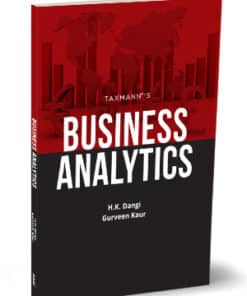
Taxmann’s Business Analytics by H.K. Dangi – 1st Edition 2024
Taxmann's Business Analytics by H.K. Dangi - 1st Edition 2024. This book underscores the pivotal role of data in the contemporary business landscape, blending theoretical knowledge with practical application to prepare students and professionals for data analysis and strategic implementation. It aligns with the UGCF 2022 syllabus under the National Education Policy of the University of Delhi. Covering a wide array of topics from data preparation to ethics in business analytics, it integrates tools like MS Excel, Tableau, and R for comprehensive learning in business analytics.
Taxmann’s Guide to Minimum Alternate Tax (MAT) & Alternate Minimum Tax (AMT) – 2nd Edition 2022
Taxmann's Guide to Minimum Alternate Tax (MAT) & Alternate Minimum Tax (AMT) - 2nd Edition 2022. This book provides a comprehensive analysis of Minimum Alternate Tax (MAT) & Alternate Minimum Tax (AMT). The analysis is done in light of the Income-tax Act 1961, Income-tax Rules 1962, and Relevant Case Laws. This book is amended by the Finance Act 2022.
Reviews
There are no reviews yet.