
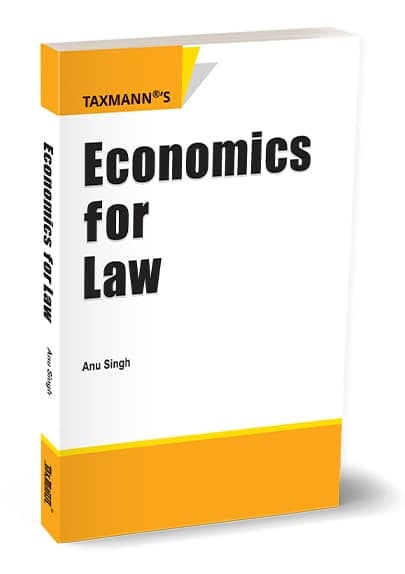


Taxmann’s Economics for Law By Anu Singh
Original price was: ₹375.00.₹330.00Current price is: ₹330.00.
Taxmann’s Economics for Law By Anu Singh – 1st Edition September 2025. Economics for Law offers a clear and rigorous introduction to microeconomic reasoning, specifically tailored for law students. Authored by Dr Anu Singh, this work explains how economic analysis shapes the framing, interpretation, and enforcement of legal rules, focusing on essential concepts such as incentives, efficiency, elasticity, and market structures. Through practical examples and stories—such as the Polluter Pays Principle and the Coase Theorem—the book makes abstract ideas concrete and relevant for legal contexts. Structured in eight chapters with learning objectives, summaries, and diagrams, it is an indispensable resource for LL.B. students, teachers, policymakers, and young legal professionals.
30 in stock
Taxmann’s Economics for Law By Anu Singh – 1st Edition September 2025.
Taxmann’s Economics for Law By Anu Singh – 1st Edition September 2025.
Description
Economics for Law offers a rigorous, law-centred introduction to microeconomic reasoning and demonstrates how economic analysis informs the design, interpretation and enforcement of legal rules. The text is written specifically for law students and focuses on the motivations behind legal rules, the consequences of legal decisions and the efficiency of alternative legal regimes. The author employs economic tools to analyse legal issues and restricts coverage to the concepts that first-year LL.B. students actually need, presenting them in eight carefully selected chapters. To make the material concrete, the book uses practical examples and short ‘stories,’ showing, for instance, how the Polluter Pays Principle (Pigou) and private bargaining (Coase) map to pollution taxes and out-of-court settlements.
This book is intended for the following audience:
- LL.B. Students (especially first year) seeking a rigorous yet accessible introduction to economic reasoning in law
- Law Teachers & Tutors who want a structured, story-led way to embed economic tools in doctrinal teaching
- Policy & Regulatory Professionals (competition/antitrust, consumer, environment) who need a compact microeconomics refresher attuned to legal problems
- Early-career Litigators & Transactional Lawyers looking to sharpen arguments with efficiency analysis, incentive design, and evidence from elasticity or market structure
The Present Publication is the Latest Edition, authored by Dr Anu Singh, with the following noteworthy features:
- [Law-first Orientation] Each topic is developed for legal use-cases rather than abstract economics
- [Accessible Pedagogy] Chapters open with Learning Objectives and close with a concise Summary to aid revision
- [Direct Legal Linkages] Dedicated sub-sections connect core results to doctrine, including ‘Market in legal context,’ ‘Legal implications of demand elasticity,’ ‘Relevance for lawyers and policymakers,’ and ‘Significance for lawyers’
- [Worked Examples & Diagrams] Graphical representations (e.g., demand–supply, revenue effects, tax incidence) are used where they clarify ideas
- [Comprehensive Back-of-book Aids] A subject index supports quick reference and exam preparation
The coverage of the book is as follows:
- Chapter 1 – Introduction to Economics for Law
- The chapter explains why economics is indispensable to understanding legal systems, contrasts microeconomics and macroeconomics, and outlines the scope of the subject with references to incentive-based and efficiency-based analysis
- Chapter 2 – Basic Economic Concepts Relevant to Law
- The chapter covers scarcity and choice, trade-offs and opportunity cost, incentives, rationality and marginal analysis, exchange-generated surplus, equilibrium and efficiency, the three fundamental economic problems in relation to the legal system, and economic systems
- It includes learning objectives that emphasise policy effectiveness (Pareto and Kaldor-Hicks), the PPF, and the circular flow
- Chapter 3 – Market Mechanism
- The chapter develops demand and supply, determinants, market equilibrium and shocks, and consumer/producer surplus, with a focused section on markets in a legal context
- Chapter 4 – Elasticity of Demand and Supply
- The chapter explains types and interpretation of elasticity and applies them to revenue, tax incidence, and evidentiary issues in cartel and merger matters, with supporting diagrams
- Chapter 5 – Consumer Choice Theory
- The chapter covers utility (cardinal and ordinal), indifference analysis, behavioural economics, and the rationale for law students to understand consumer behaviour
- Chapter 6 – Theory of Production and Cost
- The chapter distinguishes short-run and long-run perspectives, surveys cost concepts, and highlights relevance for lawyers and policymakers
- Chapter 7 – Theory of the Firm | Highly Competitive Markets
- The chapter introduces firms, analyses behaviour across competitive structures, and states the significance for lawyers
- Chapter 8 – Theory of the Firm | Highly Concentrated Markets
- The chapter analyses oligopoly and monopoly, market power, and strategic conduct in concentrated industries
The structure of the book is as follows:
- Chapter-wise Organisation – Eight logically sequenced chapters starting from basic principles to firm behaviour in different markets
- Consistent Learning Flow – Each chapter follows Learning Objectives → Exposition with Examples and Stories → Diagrams/Formulae → End-of-chapter Summary
- Pedagogical Emphasis – The book commits to plain language, relatable stories, and law-specific illustrations to maintain accessibility without sacrificing rigour.
Details :
Only logged in customers who have purchased this product may leave a review.
Related products

Lexis Nexis’s Interfaces of Intellectual Property Law by Sreenivasulu N S
Go beyond the basics with Interfaces of Intellectual Property Law. Authored by distinguished NUJS Professor Sreenivasulu N S and published by LexisNexis, this 1st Edition (2025) explores how IP rights intersect with today’s most critical legal domains.
-
✔ Cross-Disciplinary Approach: Delves into the coexistence of IP law with constitutional law, human rights, environmental law, and technology law.
-
✔ Comprehensive Scope: Reviews the evolution of IP laws from 19th-century conventions through to the complex post-TRIPS era.
-
✔ Latest Developments: Fully updated with important judicial developments and recent legislative changes shaping the public domain and competition law.

R. Cambray’s Land Laws of West Bengal by Babu Sarkar
R. Cambray's Land Laws of West Bengal by Babu Sarkar - 6th Edition 2024. First, this R. Cambray publication provides the exact text on regional property. Specifically, author Babu Sarkar details the strict West Bengal land rules. Furthermore, this sixth edition covers all fundamental 2024 statutory updates perfectly.





Reviews
There are no reviews yet.