



Taxmann’s Financial Management by R.P Rustagi – 7th Edition 2024
Original price was: ₹1,095.00.₹931.00Current price is: ₹931.00.
Taxmann’s Financial Management by R.P Rustagi – 7th Edition 2024. This book is a self-sufficient treatise presenting concepts & theories underlying financial management in a systematic, precise & analytical manner. Maximising shareholders’ wealth within the firm’s risk-return set-up is the textbook’s unifying concept. The objective of this book is first to present the concepts, models, and theories of finance in a simple, comprehensive and lucid form. Second, to help practising managers apply these concepts in operational situations.
10 in stock
Taxmann’s Financial Management by R.P Rustagi – 7th Edition 2024.
Taxmann’s Financial Management by R.P Rustagi – 7th Edition 2024.
Description
This book is an authoritative and comprehensive guide exploring the multifaceted financial management field. This seminal work discusses the intricate decisions that individuals and business firms make, which carry financial implications. This book evaluates financial decisions to maximise firm value and shareholder wealth, as indicated by share market prices.
This book aims to fulfil the requirement of students preparing for professional exams conducted by ICAI, ICSI, ICWAI & students of post-graduate courses in commerce and management. This book will also be helpful for financial executives in updating their knowledge about current thinking and developments taking place in financial management.
The Present Publication is the 7th Edition, authored by Dr. R.P. Rustagi, with the following noteworthy features:
- [Highlights of the 7th Edition] are as follows:
- Introduction of chapter summaries and points to remember
- Inclusion of Objective Type Questions, Multiple Choice Questions (MCQs), and updates to chapters with recent developments in financial management
- Additional discussions on Treasury Management, Portfolio Evaluation, Valuation of Futures and Swaps, Capital Structure theories, Foreign Capital Sources, and Risk Management Techniques
- Updated with the latest examination questions, examples, and graded illustrations
- Addition of ten case studies on Working Capital Management to expose students to real-life financial management problems, with selected hints for analytical approaches
- [Simple, Systematic & Comprehensive Explanation] The subject matter is presented using a simple, systematic method that comprehensively explains financial management concepts and theories. The book tries to explain the subject matter through realistic and practical examples.
- [Student-Oriented Book] This book has been developed keeping in mind the following factors:
- Interaction of the author/teacher with their students in the classroom
- Shaped by the author/teacher’s experience of teaching the subject matter at different levels for more than three decades
- Reactions and responses of students have also been incorporated at different places in the book
- [Practical Solutions] The problems the financial managers may face and the decisions they must make have been explained in terms of this objective and the risk-return trade-off
- [Indian Capital Market in a Capsuled Form] Analysis & discussion on the changing structure of Indian Capital Markets
- [Highlights & Summaries] of every chapter have been provided in the form of Points to Remember
- [Financial Decision Making through EXCEL] is explained with the help of several numerical examples from different topics
The book is structured into 32 chapters across ten parts, each focusing on a specific area of financial management, with a special emphasis on the Indian Capital Market
- Points to Remember
- Graded Illustrations
- Object Type Questions (True/False)
- Multiple Choice Questions
- Assignments
- Problems (Unsolved Questions with Answers)
Contents of this book are as follows:
- [Part I – Background] The book comprehensively covers the field of finance, starting with the basics of financial markets, assets, and intermediaries, before discussing the mathematics of finance, highlighting the importance of concepts such as compounding, discounting, and the time value of money (TVM). It includes student activities, multiple-choice questions, assignments, and problems to reinforce learning
- [Part II – Valuation and Risk Management] This part focuses on valuation and risk management, introducing the valuation of securities, including bonds, convertible debentures, and equity shares. It covers the risk-return dimension, share valuation, and financial decision-making, supplemented by student activities and problems for practical understanding. The discussion on risk and return, portfolio management, the Capital Asset Pricing Model (CAPM), and the theory of portfolio selection deepen the reader’s understanding of investment strategies and risk management. It includes graded illustrations, objective questions, and assignments for a comprehensive learning experience
- [Part III – Long-Term Investment Decisions: Capital Budgeting] This part shifts to long-term investment decisions, discussing capital budgeting from cash flow estimation to evaluation techniques, addressing issues like inflation, capital rationing, and the impact of risk and uncertainty. Each chapter includes points to remember, illustrations, and questions to test understanding. Financial derivatives, including futures, options, swaps, and credit derivatives, are introduced, and their valuation models and strategies are explained. This section aims to equip readers with the knowledge to navigate the complex world of financial derivatives effectively
- [Part IV – Financing Decision] The book covers the cost of capital, leverage analysis, EBIT-EPS analysis, and the interplay between leverage, cost of capital, and firm value. These chapters are designed to provide a solid foundation in financial structuring and decision-making
- [Part V – Divided Decision] Dividend decision-making and the valuation of the firm are analysed, discussing the relevance and irrelevance theories of dividend policy and determinants of dividend policy, offering a nuanced understanding of how dividend decisions affect firm value
- [Part VI – Management of Current Assets] mainly working capital, cash, receivables, and inventory, is thoroughly analysed, presenting techniques for efficient management and financing of working capital
- [Part VII – Long-Term Finance and Financial Services] This part focuses on Long-Term Finance and Financial Services, addressing various sources of long-term financing domestically and internationally. It explores domestic sources like debt and equity, long-term debt securities, private equity, foreign capital, Euro issues, and external commercial borrowings. This section emphasises the importance of understanding the diverse options available for long-term financing and their implications for corporate strategy. The discussion extends to lease financing, including types of lease arrangements, treatment of transactions, and the critical evaluation of lease versus buy decisions, supported by the Bower-Herringer-Williamson (BHW) model. Financial services covered include the roles and regulatory frameworks of non-banking finance companies, merchant bankers, venture capital financing, portfolio management, credit rating, securitisation, and reverse mortgages. Student activities such as objective-type questions and assignments are provided to reinforce learning
- [Part VIII – Financial Analysis and Planning] This part analyses financial statements, financial planning, and forecasting fundamentals. It covers preparing and analysing balance sheets, income statements, and cash flow statements, utilising techniques like ratio analysis, comparative and common size statements, and trend percentage analysis. The section underscores the significance of financial analysis for strategic planning, investment decisions, and evaluating financial health. Financial planning is explored in depth, covering long-term and short-term perspectives, budgeting, capital and operating budgets, and the necessity of external funds requirement (EFR) calculations. This part aims to equip readers with the skills to conduct comprehensive financial analyses and develop robust financial plans
- [Part IX – Miscellaneous Topics] This part focuses on mergers, acquisitions, and financial reconstruction. It outlines the types and styles of mergers, the financial evaluation of merger proposals, the benefits and costs associated with mergers, and considerations for financing them. Acquisition is discussed as a capital budgeting decision, and the section also covers corporate restructuring and the specifics of mergers and takeovers within the Indian context. This part provides insights into the strategic considerations behind corporate restructuring and the financial implications of mergers and acquisitions
- [Part X – Indian Capital Market] This part concentrates on the Indian Capital Market, providing an overview of its structure and efficiency, the role of various exchanges like the National Stock Exchange (NSE) and the Over The Counter Exchange of India (OTCEI), and the impact of capital market reforms and the Securities and Exchange Board of India (SEBI). Emerging trends within the Indian capital market, such as securities trading, investor protection, unfair trade practices, insider trading, mutual funds, hedge funds, depositories and scripless trading mechanisms, are discussed. This section aims to provide a comprehensive understanding of the complexities and dynamics of the Indian capital market, its regulatory environment, and its evolving trends.
Details :
- Publisher: Taxmann
- Author : R.P Rustagi
- Edition : 7th Edition 2024
- ISBN-13 : 9789357780834
- ISBN-10 : 9789357780834
- Language : English
- Binding : Paperback
| Author | R.P Rustagi |
|---|---|
| Language | English |
| Publisher | Taxmann |
Only logged in customers who have purchased this product may leave a review.
Related products
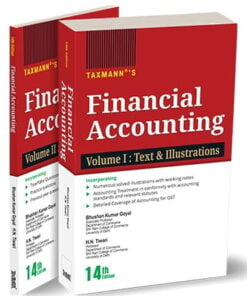
Taxmann’s Financial Accounting by Bhushan Kumar Goyal – 14th Edition 2026
Taxmann's Financial Accounting by Bhushan Kumar Goyal - 14th Edition June 2026. First, this Taxmann publication provides the exact text on fundamental bookkeeping principles and corporate reporting formats for university students. Specifically, authored by Bhushan Kumar Goyal and Dr. H.N. Tiwari, this comprehensive two-volume work details the strict rules of financial data compilation. Furthermore, this fourteenth edition updates all material to fit the newest NEP and UGCF academic structures perfectly.
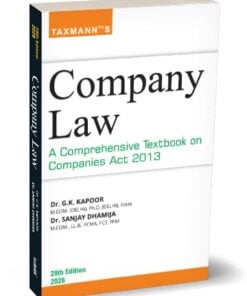
Taxmann’s Company Law (University Edition) by G K Kapoor
Taxmann's Company Law (University Edition) - A Comprehensive Text Book on Companies Act 2013 by G K Kapoor - 28th Edition 2026. Company Law – A Comprehensive Textbook on the Companies Act 2013 is an authoritative, concept-driven textbook that explains Indian company law as an integrated legal system governing the entire corporate lifecycle—from incorporation and governance to regulation, restructuring, and dissolution. This Edition seamlessly blends statutory provisions with judicial interpretation, regulatory developments, and practical application. The book is structured for effective learning and examination readiness, with chapter summaries, review questions, practical problem guidance, and specimen drafting support. It serves as a reliable, syllabus-aligned resource for UG/PG students, CA/CS/CMA aspirants, law students, and academicians seeking clarity, depth, and contemporary relevance in Company Law.
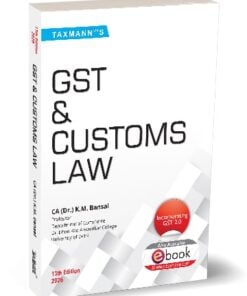
Taxmann’s GST & Customs Law (University Edition) by K.M Bansal
Taxmann's GST & Customs Law (University Edition) by K.M Bansal - 13th Edition January 2026. GST & Customs Law (Incorporating GST 2.0) is a comprehensive, statute-based textbook that presents GST and Customs Law as a unified indirect tax and compliance framework. Fully updated with amendments up to 31st December 2025, the 13th Edition integrates the GST 2.0 reforms (September 2025), capturing the shift towards structural correction, rate rationalisation, and simplified, trust-based compliance. The book follows a concept-first, illustration-driven pedagogy, explaining each topic through statutory provisions, rule mechanics, numerical illustrations, and exam-oriented practice. Designed for commerce students, CA aspirants, faculty, and tax professionals, it serves as both a strong foundational text and a practical reference for execution.

Taxmann’s Company Law | UGCF by Anil Kumar
Taxmann's Company Law | UGCF by Anil Kumar - 15th Edition 2026. Company Law is a thoroughly updated and academically robust textbook that presents the law governing companies in India with clarity, structure, and a strong student-centric approach. Anchored in the Companies Act 2013, the 15th Edition (2026) incorporates all major legislative amendments, allied Rules, and relevant provisions of the Insolvency and Bankruptcy Code 2016. Going beyond a mere reproduction of statutory text, the book explains core concepts, procedures, and practical implications through judicial reasoning, illustrations, and flowcharts. Designed in line with the National Education Policy (NEP), it emphasises outcome-based learning, analytical understanding, and exam preparedness. The book is ideally suited for undergraduate commerce and management students, professional learners, and academic institutions seeking a reliable and comprehensive Company Law resource.

Taxmann’s International Business by Neeta Tripathi
Taxmann's International Business by Neeta Tripathi - 1st Edition 2025. International Business is a NEP-aligned, academically robust textbook tailored to the DSC–4.3 syllabus of B.Com. (Hons) and B.Com. Semester IV at the University of Delhi. It integrates theory with real-world application through opening cases, chapter outcomes, visual aids, and comprehensive practice exercises. Covering globalisation, trade theories, FDI, exchange rates, regional integration, WTO–IMF–World Bank frameworks, and India's global engagement, the book offers complete conceptual and practical clarity. Designed for students, educators, researchers, and competitive exam aspirants, it provides a structured, contemporary, and exam-ready understanding of international business. With its strong pedagogy and up-to-date global insights, it equips learners to navigate today's international business landscape confidently.
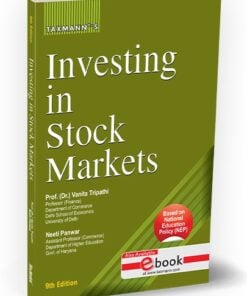
Taxmann’s Investing in Stock Markets by Vanita Tripathi – 9th Edition 2025
Taxmann's Investing in Stock Markets by Vanita Tripathi - 9th Edition 2025. Investing in Stock Markets by Prof. (Dr) Vanita Tripathi & Neeti Panwar is a comprehensive, NEP-aligned resource covering everything from basic concepts to advanced analytical tools. It merges theory with application through a project-based approach, making complex financial topics accessible to students, educators, and enthusiasts. Updated data, new technical indicators, and a clear chapter structure with learning outcomes guide effective learning. Hands-on assignments, illustrations, and references to recent university question papers enhance practical understanding and exam readiness.

Taxmann’s Environmental Science | Theory into Practice (I & II) by Sanjay Kumar Batra – 2nd Edition 2025
Taxmann's Environmental Science | Theory into Practice (I & II) by Sanjay Kumar Batra - 2nd Edition 2025. पर्यावरण विज्ञान – सिद्धांत एवं व्यवहार NEP और UGCF के अनुरूप है, जो दिल्ली विश्वविद्यालय, NCWEB और SOL जैसे संस्थानों के प्रथम एवं द्वितीय वर्ष के पर्यावरण विज्ञान पाठ्यक्रम को कवर करता है। डॉ. संजय कुमार बत्रा, डॉ. कंचन बत्रा और प्रो. हरप्रीत कौर द्वारा लिखित इस पुस्तक में बिंदुवार व्याख्या, नीतिगत अद्यतन (जैसे G20 शिखर सम्मेलन) और व्यावहारिक अभ्यास शामिल हैं। इसके मुख्य विषयों में पारिस्थितिकी तंत्र, प्राकृतिक संसाधन, प्रदूषण, जैव विविधता, जलवायु परिवर्तन और संरक्षण पर धार्मिक दृष्टिकोण शामिल हैं। प्रत्येक इकाई के अंत में समीक्षा प्रश्न, वस्तुनिष्ठ प्रश्न, पूर्व परीक्षा पत्र और अनुभवात्मक अभ्यास दिए गए हैं। यह पुस्तक स्नातक छात्रों, शिक्षकों, परीक्षा अभ्यर्थियों और पर्यावरण विज्ञान में रुचि रखने वाले पाठकों के लिए आदर्श है। इसमें व्यावहारिक उदाहरणों और आलोचनात्मक सोच के माध्यम से सहभागी और समावेशी शिक्षण को बढ़ावा दिया गया है।
Taxmann’s Business Mathematics by S.R. Arora – Reprint 2021
Taxmann's Business Mathematics by S.R. Arora - Reprint 2021. Business Mathematics presents an integrated view of theory & application of the basic concepts of mathematics in a simple, systematic & comprehensive manner with multiple illustrations & examples. It also includes a variety of self-practice (examination-type) problems with hints & answers.
Reviews
There are no reviews yet.