
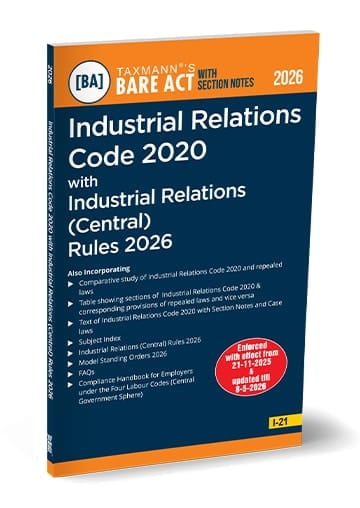

Taxmann’s Industrial Relations Code 2020 with Industrial Relations (Central) Rules 2026 – Bare Act with Section Notes
Original price was: ₹395.00.₹316.00Current price is: ₹316.00.
Taxmann’s Industrial Relations Code 2020 with Industrial Relations (Central) Rules 2026 – Bare Act with Section Notes – Edition 2026. First, this Taxmann publication provides the exact consolidated text of India’s unified collective bargaining and dispute resolution frameworks. Specifically, compiled by Taxmann’s Editorial Board, it details the strict rules of the master statutory code alongside its newly finalized central enforcement rules. Furthermore, this 2026 edition states the law as amended and updated through May 2026, capturing the fully operational post-enforcement parameters perfectly.
99 in stock
Taxmann’s Industrial Relations Code 2020 with Industrial Relations (Central) Rules 2026 – Bare Act with Section Notes – Edition 2026.
Main Description / Overview
Undeniably, this specialized single-volume Bare Act compendium makes complex trade union, standing order, and industrial conflict regulations very clear. For instance, the book features a highly disciplined Section Notes layout where the primary legislative provisions are paired with exhaustive legal annotations, enforcement thresholds, and historical context seamlessly.
Consequently, readers easily grasp the exact statutory modes of confirming enterprise compliance without searching through unedited gazette sheets. Ultimately, it logically organizes the massive labor law overhaul—which consolidated three legacy central acts including the Industrial Disputes Act, Trade Unions Act, and Industrial Employment (Standing Orders) Act—into a highly practical, streamlined reference framework.
Furthermore, it covers everything from the statutory strike notice matrices to the modern administrative guidelines for the newly established multi-member industrial tribunals. Therefore, it acts as an essential daily desk reference for handling routine compliance mappings and minimizing structural legal liabilities.
Target Audience
Clearly, this practice-oriented reference volume serves corporate personnel heads and specialized labor advisors directly. Therefore, it gives direct help to these specific users.
-
First, it supports human resource directors and factory managers executing updated company standing orders and worker grievance mechanisms.
-
Second, it helps practicing chartered accountants and corporate secretaries conducting strict workplace compliance audits.
-
Third, it guides labor law practitioners and trade union counsels cross-checking exact statutory section text during tribunal or conciliation filings.
Key Features of the 2026 Edition
Significantly, the research team updated this foundational labor resource perfectly. As a result, it offers several highly useful tools for readers.
-
First, it integrates the full, unedited statutory text of the Industrial Relations Code 2020 seamlessly.
-
Furthermore, it incorporates the complete text of the newly notified Industrial Relations (Central) Rules 2026 completely.
-
Specifically, it provides detailed, paragraph-by-paragraph Section Notes to clarify hidden statutory layers and structural legal shifts.
-
Moreover, it tracks all central notification milestones and enforcement thresholds updated up to May 2026 clearly.
-
Additionally, it incorporates standard, ready-to-use compliance forms, electronic registers, and reporting templates cleanly.
Detailed Chapter Breakdown
Structurally, the work covers the complete workplace relations and dispute resolution spectrum across clear, navigable statutory parts. Initially, it maps the foundational legal framework of primary relationship definitions perfectly.
-
First, it clearly outlines the core principles of the revised worker and industrial establishment definitions under the unified structure.
-
Next, it fully details the exact duties of employers regarding the composition and operation of Bi-partite Grievance Redressal Committees.
-
Furthermore, it perfectly outlines the strict regulations governing the registration, dissolution, and recognition parameters of trade unions as sole negotiating councils.
-
Moreover, it tackles the complex operational rules governing factory standing orders, highlighting the revised 300-worker applicability threshold.
-
Finally, it details the strict statutory approaches towards strikes, lockouts, retrenchments, closures, and the newly established Worker Re-Skilling Fund parameters.
Details
Only logged in customers who have purchased this product may leave a review.
Related products
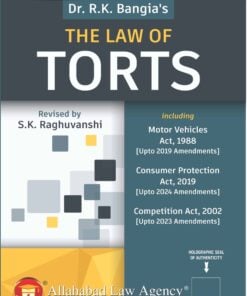
Law of Torts by R.K. Bangia (27th Edition, 2026) | ALA
Begin your legal journey with the most widely prescribed torts textbook in Indian legal education: The Law of Torts by Dr. R.K. Bangia. Published by the Allahabad Law Agency (ALA), this 27th Edition Reprint (2026) is revised by S.K. Raghuvanshi to meet modern syllabus demands.
-
✔ Updated Statutory Landscape: Integrates the Motor Vehicles Act, 1988 (amended up to 2019), Consumer Protection Act, 2019 (amended up to 2024), and Competition Act, 2002 (amended up to 2023).
-
✔ Classic Case Laws: Develops foundational concepts through landmark judgments from Rylands v. Fletcher to M.C. Mehta.
-
✔ Authentic Edition: Includes the ALA holographic authenticity seal on every genuine copy.



Reviews
There are no reviews yet.