


Taxmann’s Interpretation of Taxing Statutes by K.N. Chaturvedi – 2nd Edition 2024
Original price was: ₹895.00.₹716.00Current price is: ₹716.00.
Taxmann’s Interpretation of Taxing Statutes by K.N. Chaturvedi – 2nd Edition 2024. This book analyses the complex realm of statutory interpretation, focusing on taxation laws, illustrating the challenges judges face with legislative language and the importance of understanding legislative intent through various interpretation approaches. The second edition brings to light recent developments in tax policy, including the GST regime in India, and offers a comparative analysis of statutory interpretation practices across common law countries. This book is a comprehensive treatise on the evolving principles of judicial interpretation and the structure of tax law, making it essential for those involved in the legal, academic, and practical aspects of taxation.
9 in stock
Taxmann’s Interpretation of Taxing Statutes by K.N. Chaturvedi – 2nd Edition 2024.
Taxmann’s Interpretation of Taxing Statutes by K.N. Chaturvedi – 2nd Edition 2024.
Description
This book enables the reader to understand the complex world of statutory interpretation, especially in the context of taxation laws. This book analyses the intricate relationship between legislation and its interpretation by the judiciary, underscoring the critical role that statutory law plays in contemporary society. It highlights the challenges judges face in deciphering the often opaque language used in statutes. The book stresses the importance of understanding legislative intent and the various approaches to interpretation, such as the literal rule, golden rule, and mischief rule, while also introducing the reader to more modern methodologies like the plain meaning approach and purposive approach.
This book is tailored for a broad audience, including tax practitioners, lawyers, judges, academicians, and policymakers. Its comprehensive coverage of both foundational principles and contemporary developments in tax law interpretation makes it an invaluable resource for those engaged in the legal, academic, and practical aspects of taxation.
The Present Publication is the 2nd Edition, authored by Dr. K.N. Chaturvedi, with the following noteworthy features:
- [Highlights of the 2nd Edition] are as follows:
- [Updates] Discusses the developments in tax policy and interpretation since 2008, including the implementation of the GST regime in India and global tax law alignments like GAAR and MLI
- [Judicial Decisions] Discusses recent Supreme Court decisions on key aspects of the Income-tax Act, 1961, and analyses the judicial stance on tax exemptions and deductions
- [New Content] Introduces chapters on Tax exemptions and DTAA, updates on customs tariff classifications, and discussions on the simplification and rationalization of direct taxes
- [Legislative Changes] Notes the enactment of the Provisional Collection of Taxes Act, 2023, which updates the 1931 Act, reflecting ongoing legislative evolution
- [Judicial Scrutiny and the Art of Drafting] It presents examples from judicial pronouncements that critique legislative drafting, illustrating this with case laws, and discusses the resulting judicial efforts to interpret ambiguous statutes
- [Legislative Language and Public Understanding] The debate on whether laws should be written in plain English is addressed, with opinions suggesting that simplifying legal language may not necessarily benefit the general public due to the complexities of legal interpretation and context
- [Evolving Principles of Judicial Interpretation] The book notes a shift from traditional rules of statutory interpretation (literal, golden, and mischief rules) towards more nuanced approaches like plain meaning, contextual, and purposive interpretations, reflecting a broader and more flexible understanding of legislative texts
- [Comparative Analysis of Statutory Interpretation] This book discusses interpretation practices across common law countries (the United Kingdom, Canada, Australia, the United States, and India), highlighting differences and commonalities in approaches
- [Structural Overview of Tax Law] Early chapters provide an in-depth look at India’s tax system, the constitutional framework of taxation, the legislative process for tax statutes, and the structural anatomy of an Act, laying a foundation for understanding statutory interpretation in the context of taxation
The detailed contents of the book are as follows:
- Tax System in India
- The book begins with an exploration of the principles of rule of law and governance as they relate to taxation
- It discusses the complexities of statutory interpretation, specifically within the realm of taxation laws
- An in-depth look at the various tax systems in India, including service tax, income tax, and other significant taxes
- Attention is given to state taxes and the introduction of new tax laws, illustrating the evolving nature of tax legislation
- Constitutional Provisions Relating to Taxation
- Delivers a foundational understanding of what constitutes a tax and the necessity of legal authority for its levy and collection
- Examines constitutional remedies in tax matters and differentiates between tax, fee, and cess
- Details the distribution of legislative powers between Parliament and State Legislature, including competence to tax and specific taxes like income tax, sales tax, and excise duty on liquor
- Addresses the interpretation of legislative entries, the concept of pith and substance, and the limits of taxing power, including instances where statutes have been held constitutional or unconstitutional
- Various Stages of Law-Making and Their Relevance as an Aid to Interpretation
- Offers insight into the law-making process, the relationship between policy and drafting, and the introduction and types of bills
- Discusses the significance of presidential recommendations, accompanying documents for taxation bills, and various memorandums and notes that provide clarity to legislative intent
- Explores how statutory interpretation is influenced by law commission reports, taxation committees, parliamentary committees, and speeches by legislators
- Structure of a Taxing Statute
- Provides a comprehensive guide to drafting taxing statutes, including the importance of the title, preamble, and definition clauses
- Explains the roles of legal fiction, headings, marginal notes, explanations, provisos, schedules, and the power to remove difficulties in tax legislation
- Tax Interpretation of Exemption Provisions
- Discusses the preliminary aspects, constitutional provisions, and complexity of tax exemption provisions
- Emphasizes procedural safeguards, judicial review, flexibility in designing exemption provisions, and interpretation of these provisions
- Covers tax incentives and the concept of legitimate expectation in tax law
- DTAA and International Taxation
- Introduces Double Taxation Avoidance Agreements (DTAA) and their role in international taxation, including Supreme Court rulings on the matter
- Details the new scheme of international taxation, amendments to the Income-tax Act, and specific sections pertinent to international agreements
- Explores the interpretation of DTAA and the Multilateral Instrument (MLI), as well as significant judgments related to international tax law
- Different Approaches to Interpretation
- Expounds on the basic principles of statutory interpretation and compares the approaches taken by various jurisdictions, including the United Kingdom, Australia, Canada, and India
- Tax Evasion, Tax Avoidance, and Tax Mitigation
- Addresses the distinctions between tax evasion, tax avoidance, and tax mitigation
- Details the statutory framework on tax avoidance, including General Anti-Avoidance Rules (GAAR) and transfer pricing provisions
- Aids to Interpretation
- Discusses general, internal, and external aids to the interpretation of tax statutes
- Outlines general presumptions relevant to the interpretation of tax laws, including presumptions about constitutionality, retrospective effect, exemption provisions, and implied repeal
- Includes a discussion on the use of Latin maxims and the significance of popular, ordinary, and technical meanings in statutory interpretation
- Simplification and Rationalisation of Direct Taxes
- Covers efforts towards simplifying and rationalizing direct taxes, including the roles of various committees, commissions, and reports from the Comptroller and Auditor General (CAG) and Public Accounts Committee (PAC)
- Reviews the Direct Tax Code Bill 2010 and outlines key concepts for the future of tax law simplification
Details
- Binding : Hardcover
- Publisher : Taxmann
- Author : K.N. Chaturvedi
- Edition : 2nd Edition 2024
- Language : English
- ISBN-10 : 9789357786034
- ISBN-13 : 9789357786034
| Publisher | Taxmann |
|---|---|
| Language | English |
| Author | K.N. Chaturvedi |
Only logged in customers who have purchased this product may leave a review.
Related products
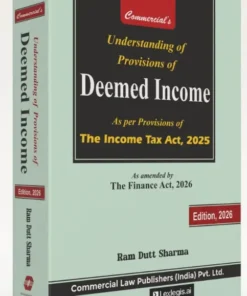
Commercial’s Understanding of Provisions of Deemed Income by Ram Dutt Sharma
Master the complex legal fictions that turn undisclosed financial transactions into massive tax liabilities. Commercial's Understanding of Provisions of Deemed Income (1st Edition, 2026) is a highly focused reference manual authored by former Income Tax Officer Ram Dutt Sharma.
-
✔ The Finance Act 2026 Updates: Fully aligned with the Income Tax Act 2025, detailing the latest statutory treatments of income deemed to accrue or arise in India.
-
✔ Unexplained Wealth: Deep, operational analysis of deemed income arising from unexplained cash, investments, expenditure, and assets (Sections 68, 69, 69A-D).
-
✔ Insider Strategy: Written by a 35-year veteran of the Income Tax Department, providing unparalleled clarity for defending against scrutiny assessments and reassessments.
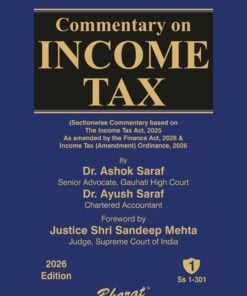
Commentary on Income Tax (Set of 2 Vols) | Ashok Saraf 2026
Navigate the sweeping changes of India's new direct tax regime with Bharat's Commentary on Income Tax (Set of 2 Volumes). Authored by Senior Advocate Dr. Ashok Saraf and CA Dr. Ayush Saraf, this 1st Edition (2026) provides an authoritative, section-by-section analysis of the newly enacted Income-tax Act 2025.
-
✔ Complete Statutory Transition: Exhaustive commentary on the new Income-tax Act 2025, amended by the Finance Act 2026.
-
✔ Corporate & Business Focus: Deep-dive analysis into the computation of business profits, depreciation, and capital gains.
-
✔ Expert Authorship: Blends decades of constitutional litigation experience with modern corporate accounting (Ind AS) expertise.
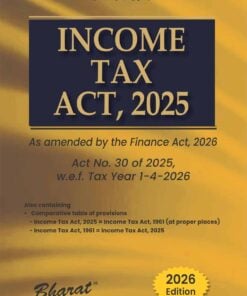
Bharat’s Income Tax Act, 2025 (Pocket Edn.) – 39th Edition 2026
Bharat's Income Tax Act, 2025 (Pocket Edn.) - 39th Edition 2026. First, this Bharat publication provides the exact pocket-sized legal text on direct tax laws for professionals in India. Specifically, compiled by Bharat Law House, this compact reference book details the statutory rules of the newly active Income Tax Act, 2025. Furthermore, this 39th edition includes highly useful comments and cross-reference tables updated for easy use on the go.
Taxmann’s GST on Works Contract & Other Construction/EPC Contracts by Sudipta Bhattacharjee
Taxmann's GST on Works Contract & Other Construction/EPC Contracts by Sudipta Bhattacharjee, Rishabh Prasad, Abhishek Garg - 12th Edition 2026. First, this Taxmann publication provides the exact text on engineering agreements. Specifically, the authors detail the strict rules for infrastructure taxation. Furthermore, this twelfth edition covers all fundamental 2026 legal updates perfectly.

Taxmann’s Direct Taxes Ready Reckoner by Vinod K Singhania
Taxmann's Direct Taxes Ready Reckoner by Vinod K Singhania - 50th Edition March 2026 (A.Y. 2026-27) & (Tax Year 2026-27). First, this Taxmann publication provides the exact tax rates. Specifically, author Vinod K Singhania details strict tax planning. Furthermore, this 50th Edition covers all fundamental assessment year updates perfectly.



Reviews
There are no reviews yet.