
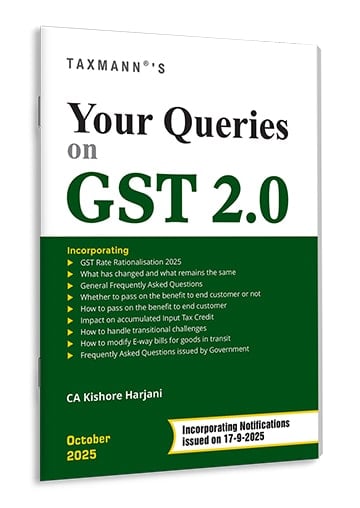

Taxmann’s Your Queries on GST 2.0 by Kishore Harjani – 1st Edition October 2025
₹395.00
Taxmann’s Your Queries on GST 2.0 by Kishore Harjani – 1st Edition October 2025. Your Queries on GST 2.0 is a hands-on guide to the 2025 GST rate rationalisation and compliance reset. Written in an FAQ style, it distils the 56th GST Council decisions into practical steps on pricing, documentation, ITC, transitions, and consumer obligations. The book explains the shift to a two-tier structure, with rates of 5% and 18%, and a special 40% slab for demerit goods/services. It illustrates the sectoral impact, ranging from FMCG and healthcare to autos, e-commerce, and gaming. Combining statutes, case law, circulars, and worked examples, it helps professionals move seamlessly from ‘what changed’ to ‘how to implement.’
30 in stock
Taxmann’s Your Queries on GST 2.0 by Kishore Harjani – 1st Edition October 2025.
Taxmann’s Your Queries on GST 2.0 by Kishore Harjani – 1st Edition October 2025.
Description
Your Queries on GST 2.0 is a practitioner’s manual for the 2025 rate rationalisation and compliance reset. Framed entirely as answers to practical queries, it translates the 56th GST Council decisions (September 2025) into actionable steps for pricing, documentation, credits, transitions, and consumer-facing obligations. The book explains the shift from the earlier four-tier system (5/12/18/28%) to a streamlined two-tier structure (5% and 18%), alongside a special 40% slab for demerit/luxury goods and specific services, and shows how this plays out across food, education, health, textiles, automobiles, energy, construction, electronics, local delivery and gaming/casinos. Each chapter combines statutes, rules, judicial precedents, circulars/press notes, and worked illustrations, allowing readers to transition from ‘what changed’ to ‘how to implement today’.
This book is intended for the following audience:
- Indirect Tax Consultants & Litigation Teams needing sector-wise rate maps, anti-profiteering positions and transition treatments
- CFOs/Tax Heads & In-house GST Teams who must recast MRPs, pass on benefits, re-paper contracts, adjust credits, and cleanly handle returns/re-invoicing
- Accountants & CA/CMA/CS preparing returns, audits and reconciliations where time-of-supply and credit rules intersect with rate change
- Sector Stakeholders in FMCG, pharma/medical, education, textiles, auto, electronics, logistics/GTA, hotels, e-commerce, local delivery/ECO and entertainment
- Consumer-facing Brands & Legal/Metrology Teams implementing MRP changes and disclosures under Legal Metrology and NPPA directions
The Present Publication is the October 2025 Edition, incorporating Notifications issued on 17-09-2025. It is authored by CA. Kishore Harjani, with the following noteworthy features:
- [Sector-wise Impact Mapped with HSN-wise Tables] Crisp ‘What changed/What remains the same’ tables for goods and services—so teams can re-tag SKUs and services quickly
- [Anti-profiteering & Consumer-law Alignment] How to evidence ‘commensurate reduction’, what survives via CPA/CCI, and how to handle grammage vs. price in low-price packs
- [MRP under Legal Metrology & NPPA] Revised price stickers, unit-price rounding, sector exceptions (scheduled drugs), and communication duties down the chain
- [Credit & Cash-flow Clarity] When to reverse ITC on exemption (Sec. 18(4)/Rule 44), why refund of accumulated ITC is limited after mere rate cuts, and how inverted duty refunds work
- [Transition ‘Edge Cases’] Pre/post-change supplies, advances, returns, credit notes vs. financial credit notes (when recipient hasn’t reversed ITC), re-invoicing, long-term fixed-price contracts
- [E-way Bill Continuity] Confirms no re-issue needed for goods already in transit; validity unaffected by rate change
- [Official FAQs, Worked Examples & Matrices] Consolidated Government clarifications across insurance, hotels/beauty services (5% without ITC), job work (5%/18%), multimodal transport, ECO/local delivery, automobiles, beverages, textiles and renewables
- [Annexures] CBIC price-tracking format; Legal Metrology permissions/waivers; NPPA instructions for drugs/devices; extended packaging-material usage timelines
- [Author Credibility] CA. Kishore Harjani brings two decades of indirect-tax practice across multiple sectors, Big-4 engagements, government trainings, and prior authorship on classification, tariff and FTP—assuring both depth and practicality
- [Use Cases] Ideal as a desk-companion for price-reset programmes, statutory audits, consumer-law exposure reviews, and Board-level briefings on GST 2.0’s commercial impact
The coverage of the book is as follows:
- Chapter 1 – Introduction
- Places GST 2.0 in context, recaps the July 2017 rollout, and explains the 56th Council Meeting (3 Sept 2025) that drove rationalisation; includes the ‘7 Pillars’ visual
- Chapter 2 – What has Changed/What Remains the Same
- The heart of the book’s HSN‑linked rate tables. Examples:
- Automobiles – Most passenger vehicles/items shifted 28%→18%, but certain cars/motorcycles now 40%; EVs remain at 5%
- Common Household & Personal‑care Items – Tooth powder, feeding bottles, umbrellas, utensils (iron/copper/aluminium), bicycles & parts, napkins/diapers, toothbrushes—many moved 12/18%→5%
- Services – Specified gaming/actionable‑claim categories now at 40% with ITC; cultural/religious/public‑convenience services unchanged.
- The heart of the book’s HSN‑linked rate tables. Examples:
- Chapter 3 – General FAQs
- Explains why 12%/28% were removed, the new 5/18/40 structure, timelines (22 Sept 2025 effective date; treatment of tobacco while cess accounts are settled), and macro intent (inflation/demand)
- Chapter 4 – Whether To Pass on The Benefit
- Maps Section 171 principles to CPA 2019 and clarifies the CCI’s empowerment (Dec 2022–Sept 2024) to examine profiteering when NAA wound down—plus what this means post‑April 2025
- Chapter 5 – How To Pass on The Benefit
- Mechanics—price revision, credit notes, discounts, MRP declaration—and how to talk about it (e.g., avoid implying it’s merely ‘voluntary compliance’). Includes e‑commerce platform liability if old MRPs remain online
- Chapter 6 – Impact on Accumulated ITC
- No ITC reversal merely because output rate falls; Rule 44 doesn’t cover simple rate reductions—illustrated with a numeric example.
- IDS refunds—what Section 54(3) allows, how CBIC circulars evolved, and how courts read them (BMG Informatics; Baker Hughes; Shivaco; Micro Systems)
- Chapter 7 – Handling Transitional Challenges
- Section 14 clarified with tables for goods/services when supply, invoice, and payment fall on either side of 22‑09‑2025; detailed credit‑note treatment when returns/adjustments occur post‑change; fixed‑price contract nuances and AAR/HC case law (e.g., Universal MEP Projects)
- Chapter 8 – Modifying E‑way Bills for Goods in Transit
- Explains Rule 138 parts A/B, how systems auto‑populate rates by HSN, and—critically—that existing e‑way bills aren’t invalidated and validity isn’t affected by a rate change; cancellation/re‑generation isn’t triggered solely by revised rates
- Chapter 9 – FAQs Issued by Government
- Conspectus of official clarifications—e.g., NPPA OMs confirm no recall/re‑labelling for medicines already released; just price‑list updates and retailer‑level compliance. Also includes job‑work rates (pharma/leather to 5% with ITC; residuary job‑work 18%; E&P offshore works contracts 18%)
The structure of the book is as follows:
- Each FAQ presents the issue → legal position (Act/Rules/Notifications/Circulars) → practical approach → documentation & evidence → worked example
- Cross-references to Council decisions, Legal Metrology, NPPA/DoP OMs, and CBIC instructions are embedded for implementation
- Sector-wise Rate Tables provide quick look-ups; matrices simplify time-of-supply during transition; illustrations cover MRP rounding and SKU-level benefit passing.
Details
- Binding : Paperback
- Publisher : Taxmann
- Author : Kishore Harjani
- Edition : 1st Edition October 2025
- Language : English
- ISBN-10 : 9789371263450
- ISBN-13 : 9789371263450
| Publisher | Taxmann |
|---|---|
| Language | English |
| Author | Kishore Harjani |
Only logged in customers who have purchased this product may leave a review.
Related products
Commercial’s Understanding of Provisions of Deemed Income by Ram Dutt Sharma
Master the complex legal fictions that turn undisclosed financial transactions into massive tax liabilities. Commercial's Understanding of Provisions of Deemed Income (1st Edition, 2026) is a highly focused reference manual authored by former Income Tax Officer Ram Dutt Sharma.
-
✔ The Finance Act 2026 Updates: Fully aligned with the Income Tax Act 2025, detailing the latest statutory treatments of income deemed to accrue or arise in India.
-
✔ Unexplained Wealth: Deep, operational analysis of deemed income arising from unexplained cash, investments, expenditure, and assets (Sections 68, 69, 69A-D).
-
✔ Insider Strategy: Written by a 35-year veteran of the Income Tax Department, providing unparalleled clarity for defending against scrutiny assessments and reassessments.
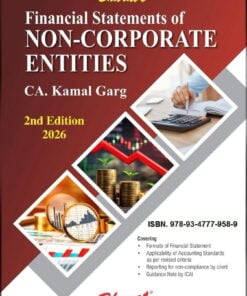
Bharat’s Financial Statements of Non-Corporate Entities by CA. Kamal Garg
Bharat's Financial Statements of Non-Corporate Entities by CA. Kamal Garg - 2nd Edition 2026. First, this Bharat publication provides the exact, practice-ready text on reporting guidelines, ledger disclosures, and accounting formats for un-incorporated setups in India. Specifically, written by CA. Kamal Garg, this manual outlines the strict rules of preparing books for non-corporate setups. Furthermore, this 2nd edition incorporates all active disclosure parameters and structural compliance revisions running flawlessly through 2026.
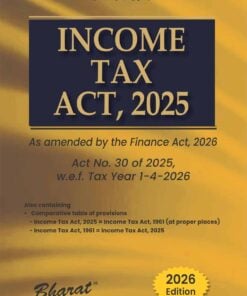
Bharat’s Income Tax Act, 2025 (Pocket Edn.) – 39th Edition 2026
Bharat's Income Tax Act, 2025 (Pocket Edn.) - 39th Edition 2026. First, this Bharat publication provides the exact pocket-sized legal text on direct tax laws for professionals in India. Specifically, compiled by Bharat Law House, this compact reference book details the statutory rules of the newly active Income Tax Act, 2025. Furthermore, this 39th edition includes highly useful comments and cross-reference tables updated for easy use on the go.
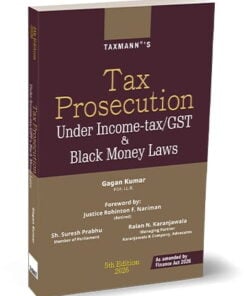
Taxmann’s Tax Prosecution under Income-tax/GST & Black Money Laws by Gagan Kumar
Taxmann's Tax Prosecution under Income-tax/GST & Black Money Laws by Gagan Kumar - 5th Edition 2026. First, this Taxmann publication provides the exact text on criminal tax liabilities. Specifically, author Gagan Kumar details the strict rules for tax prosecution. Furthermore, this fifth edition covers all fundamental 2026 statutory frameworks perfectly.
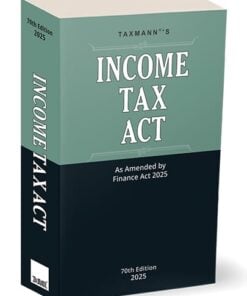
Taxmann’s Income Tax Act – As Amended by Finance Act 2025
Taxmann's Income Tax Act - As Amended by Finance Act 2025 - 70th Edition 2025. This book seamlessly integrates all amendments from the Finance Act 2025 into a single authoritative text. It offers extensive annotations, cross-references, and legislative history, catering to practitioners, academics, and libraries. Separate divisions also cover the Finance Act 2025, STT, CTT, and the now-ended Equalisation Levy, ensuring a holistic overview of direct tax laws. A user-friendly layout—with marginal notes, footnotes, and a comprehensive subject index—enables efficient navigation. Backed by meticulous editorial accuracy, this volume remains a definitive guide to direct tax legislation.


Taxmann’s Guide to Minimum Alternate Tax (MAT) & Alternate Minimum Tax (AMT) – 2nd Edition 2022
Taxmann's Guide to Minimum Alternate Tax (MAT) & Alternate Minimum Tax (AMT) - 2nd Edition 2022. This book provides a comprehensive analysis of Minimum Alternate Tax (MAT) & Alternate Minimum Tax (AMT). The analysis is done in light of the Income-tax Act 1961, Income-tax Rules 1962, and Relevant Case Laws. This book is amended by the Finance Act 2022.
Reviews
There are no reviews yet.