
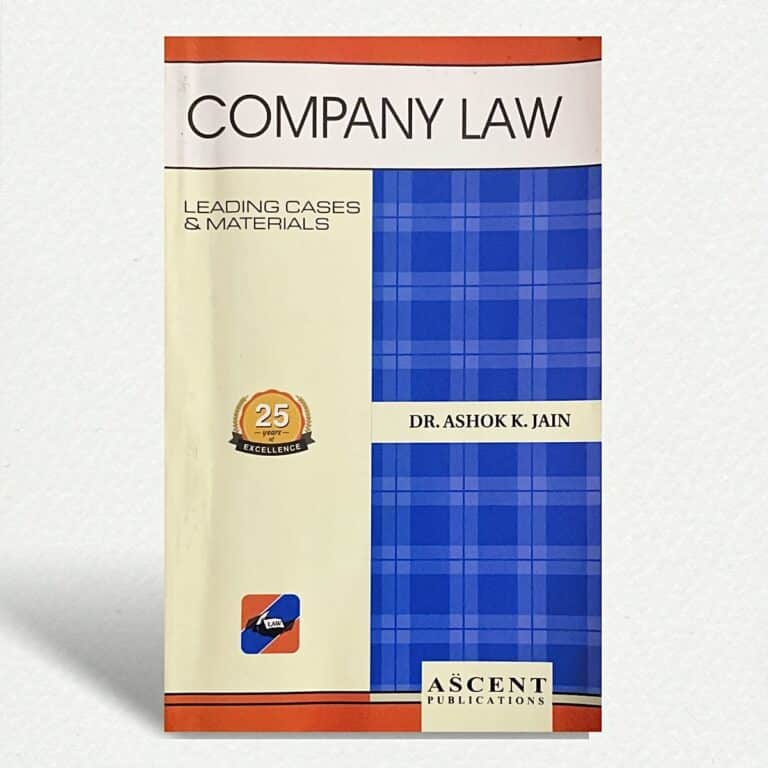


Ascent’s Company law by Dr. Ashok Kumar Jain
Original price was: ₹310.00.₹264.00Current price is: ₹264.00.
Ascent’s Company law by Dr. Ashok Kumar Jain.
10 in stock
Ascent’s Company law by Dr. Ashok Kumar Jain.
Ascent’s Company law by Dr. Ashok Kumar Jain.
Description:
Company law is the body of law that governs the rights, relations, and conduct of corporations, companies, organizations, and businesses. In India, the primary legislation is the Companies Act, 2013 (which superseded the Companies Act, 1956), along with associated rules, regulations, and judicial decisions.
Key Principles and Characteristics
Company law is founded on several key principles:
- Separate Legal Personality: A company is a separate legal entity distinct from its members (shareholders). It can own property, incur debt, sue, and be sued in its own name.
- Limited Liability: The financial liability of shareholders is generally limited to the amount unpaid on their shares or the amount they have guaranteed, protecting their personal assets from the company’s debts.
- Perpetual Succession: The company’s existence is permanent and continues regardless of changes in its members (e.g., death, insolvency, or transfer of shares), ceasing only through a formal winding-up process.
- Delegated Management: Day-to-day management is delegated to a Board of Directors elected by the members.
Main Aspects Covered by Company Law
Company law regulates the entire lifecycle of a company, including:
- Incorporation and Formation: It outlines the process for legally registering a company with the Registrar of Companies (ROC), which involves submitting key documents like the Memorandum of Association (MoA) and Articles of Association (AoA).
- Types of Companies: The Act provides for various company structures to suit different business needs, such as:
- Private Limited Company: Maximum 200 members, restricts share transfers, and cannot invite the public to subscribe to its securities.
- Public Limited Company: Minimum of seven members, no restriction on share transfers, and can list its securities on a stock exchange.
- One Person Company (OPC): Allows a single individual to form a company with limited liability.
- Section 8 Company: Non-profit companies formed for charitable objects (e.g., education, social welfare, environment protection).
- Corporate Governance and Management: The law sets rules for the appointment, qualifications, remuneration, and duties of directors and key managerial personnel (KMP). It mandates requirements for board meetings, shareholder meetings, and the maintenance of accounts and records to ensure accountability and transparency.
- Corporate Finance: It regulates how companies raise capital, through the issuance of shares (equity financing) or borrowing (debt financing), and outlines rules for prospectuses, allotments, and buy-backs.
- Mergers and Acquisitions: The law provides a framework for corporate restructuring, including mergers, amalgamations, and takeovers, and involves regulatory scrutiny, often by the National Company Law Tribunal (NCLT).
- Winding Up and Dissolution: It details the formal process of closing a company, which involves liquidating assets, paying off creditors, distributing any remaining surplus to shareholders, and finally removing the company’s name from the official register.
Key Legislation
The primary regulatory framework is the Companies Act, 2013, administered by the Ministry of Corporate Affairs (MCA). Other relevant laws include the Insolvency and Bankruptcy Code, 2016 (which now governs insolvency-related winding-up) and the SEBI Act, 1992 (for listed companies).
Details :
- Publisher : Ascent publications
- Author : Dr. Ashok Kumar Jain
- Edition : 4th Edition
- ISBN-13 : 9789387286191
- ISBN-10 : 9789387286191
- Language : English
- Binding : Paperback
| Author | Dr. Ashok Kumar Jain |
|---|---|
| Language | English |
| Publisher | Ascent Publication |
Only logged in customers who have purchased this product may leave a review.




Reviews
There are no reviews yet.