
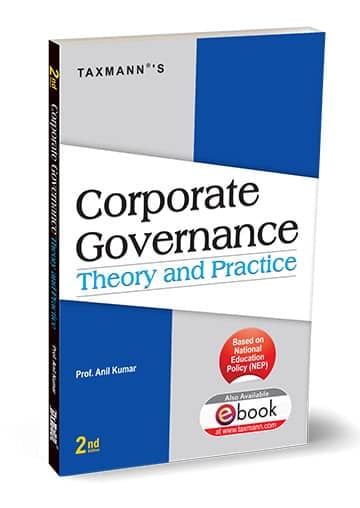

Taxmann’s Corporate Governance – Theory and Practice – UGCF | NEP by Anil Kumar
Original price was: ₹375.00.₹319.00Current price is: ₹319.00.
Taxmann’s Corporate Governance – Theory and Practice – UGCF | NEP by Anil Kumar – 2nd Edition 2025. Corporate Governance – Theory and Practice offers a clear, contemporary introduction to how corporations are governed across ethical, structural, strategic, and legal dimensions. Drawing on over 35 years of experience, the author integrates foundational theories with real-world cases, regulatory developments, and major governance failures. Updated for the NEP curriculum, the book emphasises case-based learning, global comparisons, and practical assignments to build analytical and professional competence. It explains not only how governance mechanisms work but why they matter in boardrooms, markets, and crises. This Edition serves as a comprehensive resource for students, faculty, practitioners, and researchers seeking a practical understanding of modern corporate governance.
10 in stock
Taxmann’s Corporate Governance – Theory and Practice – UGCF | NEP by Anil Kumar – 2nd Edition 2025.
Taxmann’s Corporate Governance – Theory and Practice – UGCF | NEP by Anil Kumar – 2nd Edition 2025.
Description
Corporate Governance – Theory and Practice is a comprehensive, pedagogy-driven textbook that examines how corporations are governed—structurally, ethically, strategically, and legally. The author, drawing on over 35 years of teaching and research experience, delivers a rigorous and contemporary treatment of corporate governance that balances conceptual foundations with deep practical insight. This Edition reflects India’s evolving regulatory ecosystem, global developments, and the expanding expectations of stakeholders. It equips students to understand not only what governance mechanisms are, but why they exist and how they operate in real business settings—including boardrooms, capital markets, and crises. Updated to align with the NEP curriculum, the book integrates case-based learning, practical exercises, global comparisons, and assignments aligned with outcome-based education. It is rooted in both theoretical frameworks and corporate failures, illustrating how governance lapses trigger systemic risk, erode shareholder wealth, and provoke regulatory reform worldwide.
This book is intended for the following audience:
- Undergraduate Students of B.Com. (Hons.), B.Com., BBA, BMS and similar programmes
- Postgraduate & MBA Students seeking a structured, case-based understanding of governance issues
- Faculty Members teaching Corporate Governance, Business Ethics, Company Law, Strategic Management, or related papers
- Practitioners & Policymakers who require a consolidated reference combining theory, law, and real corporate events
- Researchers exploring governance failures, regulatory reforms, and global best practices
The Present Publication is the 2nd Edition, authored by Prof. Anil Kumar, with the following noteworthy features:
- [Integrated Theory–Practice Framework] The book blends classical governance theories (Agency, Stewardship, Stakeholder, Managerial Hegemony, Resource Dependency) with practical illustrations from companies in India and abroad. Each concept is supported by empirical examples, regulatory emphasis, and case-based reasoning
- [Rich Comparative Governance Models] Students gain a nuanced understanding of:
- Anglo-Saxon (American) model
- German two-tier board model
- Japanese keiretsu model
- Family-based models prevalent in Asia
- Comparative governance patterns across jurisdictions help learners appreciate structural diversity and cultural influences
- [Comprehensive Coverage of Board Governance] Detailed coverage of:
- Types of directors (executive, independent, nominee, etc.)
- Board roles and responsibilities
- Board structures in global contexts
- Key committees (Audit, Nomination, Remuneration, CSR, and more)
- Director independence, diversity, and performance evaluation
- This enables readers to understand boardroom dynamics and decision-making frameworks
- [Governance Challenges in the Modern Corporate World] Includes full discussions on:
- Insider trading
- Whistleblowing mechanisms
- Shareholder activism
- Class action suits
- Institutional investor influence
- Gandhian Trusteeship & CSR linkages
- ESG and ethical leadership dimensions
- [Deep Analysis of Global Corporate Failures] The book includes detailed explorations of global collapses, such as:
- Enron
- WorldCom
- Lehman Brothers
- BCCI (UK)
- Maxwell Communications
- Vivendi (France)
- Each case is analysed for root governance failures, signalling effects, board-level oversight breakdowns, and regulatory responses (SOX, OECD codes, Cadbury reforms)
- [Indian Regulatory Landscape Mapped Thoroughly] This Edition incorporates:
- Companies Act 2013 provisions related to governance
- SEBI (LODR) Regulations 2015
- Reports of the Kumar Mangalam Birla, Narayana Murthy, and Uday Kotak Committees
- CSR obligations and governance integration
- Disclosure norms, risk management, audit independence, and compliance mechanisms
- [Forensic Study of Indian Corporate Scandals] A distinguishing hallmark of this Edition is the detailed analysis of major Indian failures:
- Satyam Computer Services scandal
- IL&FS crisis
- Punjab National Bank (Nirav Modi) fraud
- Yes Bank collapse
- ICICI–Videocon conflict-of-interest case
- Kingfisher Airlines governance breakdown
- Each scandal is examined in relation to governance mechanisms that failed, red flags missed, and systemic weaknesses exposed
- [Pedagogically Strong NEP-aligned Structure] The book incorporates:
- Review questions
- Practical assignments
- Cross-industry governance comparisons
- Case analysis tasks
- Exercises promoting critical thinking (e.g., examining public reports of listed companies, analysing whistleblowing cases)
- This ensures hands-on learning and professional readiness
The detailed coverage of the book is as follows:
- Conceptual Framework of Corporate Governance
- Covers meaning, significance, evolution, governance vs. management, pillars of governance, theories, global models, and insights from Kautilya’s Arthashastra—one of the book’s unique differentiators
- Includes conceptual diagrams, models, and case-based illustrations
- Board Structure and Directors
- This chapter explores:
- Types of directors globally
- Role, composition, and functioning of the board
- Executive vs. non-executive dynamics
- Audit, Nomination, Remuneration, and specialised committees
- Case illustrations relating to board oversight failures
- This chapter explains how modern boards actually work
- This chapter explores:
- Issues & Challenges in Contemporary Governance
- This chapter is a bridge between theory and practice, addressing:
- Insider trading regulatory structure
- Whistle-blower protection design
- Shareholder activism scenarios
- Institutional investor influence
- Class action suits in India
- CSR as part of governance
- Gandhian Trusteeship as an ethical framework
- This chapter is a bridge between theory and practice, addressing:
- Global Corporate Failures & International Governance Codes
- Includes forensic analyses of failures like:
- Enron
- WorldCom
- Lehman Brothers
- BCCI
- Maxwell
- And explains how they shaped:
- Cadbury Committee recommendations
- Sarbanes–Oxley Act (SOX) reforms
- OECD governance principles
- This helps students link global crises with regulatory strengthening
- Includes forensic analyses of failures like:
- Corporate Governance Regulatory Framework in India
- A granular examination of:
- Corporate laws
- Governance committees
- SEBI regulations
- Disclosure & transparency norms
- Audit and risk management requirements
- Responsibilities of promoters, directors, and KMPs
- A granular examination of:
- Corporate Failures and Scams in India
- One of the most detailed sections in the book, covering:
- Satyam
- PNB scam
- IL&FS crisis
- Yes Bank collapse
- ICICI conflict-of-interest case
- Kingfisher Airlines’ governance lapses
- Each case is broken into:
- Background
- Governance failures
- Roles of directors, auditors, and regulators
- Red flags
- Post-crisis regulatory tightening
- One of the most detailed sections in the book, covering:
The textbook adopts a progressive learning architecture:
- Foundational Concepts → Models & Theories → Board Structure → Contemporary Issues → Global Failures → 6. Indian Regulatory Framework → Indian Scandals → Practical Exercises
- Each chapter includes:
- Clear learning objectives
- Definitions & illustrations
- Case studies
- Questions and problem-based assignments
- Real corporate disclosures and governance analysis tasks
- This design mirrors NEP’s focus on experiential and analytical learning
Anil Kumar
Prof. Anil Kumar, PhD, is a distinguished academician and seasoned governance expert with over thirty-five years of experience in teaching, research, training, and consultancy. He is a Professor in the Department of Commerce at the Delhi School of Economics, University of Delhi, and previously served for more than 3 decades as a Professor at the Shri Ram College of Commerce (SRCC).
He is also the Chief Executive Officer (CEO) of the University of Delhi Foundation, a Section 8 company of the University. An alumnus of SRCC and Harvard Business School, he completed his postgraduate studies at the Delhi School of Economics. He earned his PhD in Corporate Governance from the University of Delhi.
Prof. Kumar serves as an Independent Director on the Board of the Life Insurance Corporation (LIC) of India and is the Chairperson of its Nomination and Remuneration Committee. He is a regular panellist on national news platforms, including DD News, DD India, ABP News, and Times Now.
He has authored over 10 books on corporate governance and corporate law, published numerous research papers in leading national and international journals, presented his work globally, and conducted executive development programmes for government officials, corporate leaders, and board members.
Details
- Binding : Paperback
- Publisher : Taxmann
- Author : Anil Kumar
- Edition : 2nd Edition 2025
- Language : English
- ISBN-10 : 9789375617891
- ISBN-13 : 9789375617891
| Publisher | Taxmann |
|---|---|
| Language | English |
| Author | Anil Kumar |
Only logged in customers who have purchased this product may leave a review.
Related products
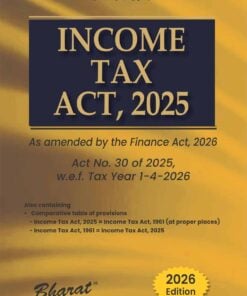
Bharat’s Income Tax Act, 2025 (Pocket Edn.) – 39th Edition 2026
Bharat's Income Tax Act, 2025 (Pocket Edn.) - 39th Edition 2026. First, this Bharat publication provides the exact pocket-sized legal text on direct tax laws for professionals in India. Specifically, compiled by Bharat Law House, this compact reference book details the statutory rules of the newly active Income Tax Act, 2025. Furthermore, this 39th edition includes highly useful comments and cross-reference tables updated for easy use on the go.
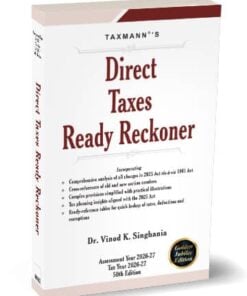
Taxmann’s Direct Taxes Ready Reckoner by Vinod K Singhania
Taxmann's Direct Taxes Ready Reckoner by Vinod K Singhania - 50th Edition March 2026 (A.Y. 2026-27) & (Tax Year 2026-27). First, this Taxmann publication provides the exact tax rates. Specifically, author Vinod K Singhania details strict tax planning. Furthermore, this 50th Edition covers all fundamental assessment year updates perfectly.
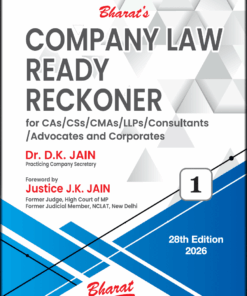
Bharat’s Company law Ready Reckoner (2 Vols) by Dr. D.K. Jain
Bharat's Company law Ready Reckoner (2 Volumes) by Dr. D.K. Jain - 28th Edition 2026. First, this Bharat publication provides a complete guide to company law. Specifically, it details the exact rules for corporate compliance perfectly. Furthermore, this 28th Edition 2026 covers all statutory amendments across two massive volumes.
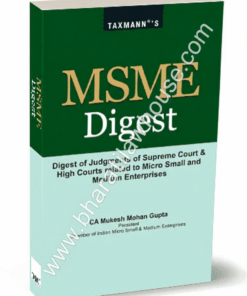
Taxmann’s MSME Digest By Mukesh Mohan Gupta
Taxmann's MSME Digest By Mukesh Mohan Gupta - 1st Edition 2026. First, the MSME Digest serves as a comprehensive legal guide. Specifically, it consolidates the evolving laws governing India's Micro, Small, and Medium Enterprises (MSME) sector. Furthermore, this practice-ready reference brings together landmark decisions from the Supreme Court and various High Courts.
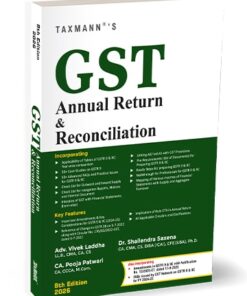
Taxmann’s GST Annual Return & Reconciliation by Vivek Laddha
Taxmann's GST Annual Return & Reconciliation by Vivek Laddha - 8th Edition 2026. GST Annual Return & Reconciliation (8th Edition | 2026) is an all-inclusive professional handbook for preparing and filing GSTR-9 and GSTR-9C under India's GST regime. Updated as per Notification No. 13/2025-CT dated 17th September 2025, it offers a 360° integration of law, accounting, audit, and procedural practices, ensuring accuracy, compliance, and audit readiness. Authored by Adv. Vivek Laddha, Dr Shailendra Saxena, and CA. Pooja Patwari, the book features amendment-driven analysis, 30+ case studies, 50+ FAQs, and practical checklists, supported by detailed financial linkages and stepwise filing guidance. It stands as an indispensable reference for GST professionals, corporates, and academicians seeking structured, error-free annual compliance.
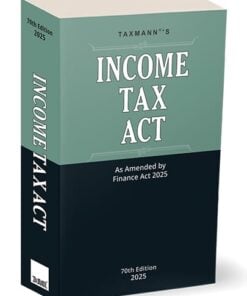
Taxmann’s Income Tax Act – As Amended by Finance Act 2025
Taxmann's Income Tax Act - As Amended by Finance Act 2025 - 70th Edition 2025. This book seamlessly integrates all amendments from the Finance Act 2025 into a single authoritative text. It offers extensive annotations, cross-references, and legislative history, catering to practitioners, academics, and libraries. Separate divisions also cover the Finance Act 2025, STT, CTT, and the now-ended Equalisation Levy, ensuring a holistic overview of direct tax laws. A user-friendly layout—with marginal notes, footnotes, and a comprehensive subject index—enables efficient navigation. Backed by meticulous editorial accuracy, this volume remains a definitive guide to direct tax legislation.
Reviews
There are no reviews yet.