
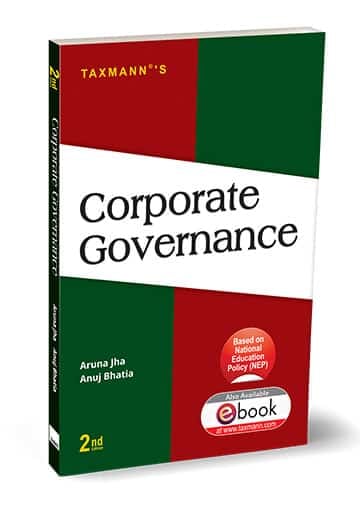


Taxmann’s Corporate Governance – UGCF | NEP by Aruna Jha
Original price was: ₹295.00.₹251.00Current price is: ₹251.00.
Taxmann’s Corporate Governance – UGCF | NEP by Aruna Jha – 2nd Edition 2025. Corporate Governance is a thoroughly revised, syllabus-driven textbook that blends theory, law, ethics, and case studies to offer a holistic understanding of governance in both Indian and global contexts. This 2nd Edition integrates the latest updates to the Companies Act 2013, SEBI LODR 2015, and post-Kotak reforms, reflecting contemporary expectations of board effectiveness and transparency. Tailored to the NEP-aligned B.Com. curriculum, the book provides clear learning objectives, structured pedagogy, and extensive assessment support. Through its rich theoretical frameworks, comparative models, and analyses of major corporate failures, it serves as an indispensable resource for students, educators, and governance professionals.
10 in stock
Taxmann’s Corporate Governance – UGCF | NEP by Aruna Jha – 2nd Edition 2025.
Taxmann’s Corporate Governance – UGCF | NEP by Aruna Jha – 2nd Edition 2025.
Description
Corporate Governance is a comprehensive, syllabus-based textbook that treats corporate governance as an integrated discipline—combining theory, law, practice, ethics, and case studies across Indian and global contexts. This Edition has been thoroughly revised to incorporate:
- Recent amendments to the Companies Act 2013
- Updates to SEBI (Listing Obligations and Disclosure Requirements) Regulations 2015
- Post-Kotak Committee reforms and evolving expectations around Board effectiveness, disclosure, and stewardship
The authors position corporate governance as a defining pillar of sustainable business, ethical leadership, and stakeholder trust, rather than as a peripheral compliance topic.
This book is intended for the following audience:
- B.Com. (Hons.) and B.Com. Students – Aligns exactly with DSC-6.2: Corporate Governance under the NEP-based Undergraduate Curriculum Framework 2022
- Faculty Members & Academic Institutions – Designed as a plug-and-teach text for a semester-long paper with integrated teaching devices—unit-wise structuring, clear sequencing, and assessment aids
- Corporate Professionals & Compliance Officers – Ideal for company secretaries, compliance officers, board members, analysts, auditors, and legal professionals who need clarity on board processes, regulatory requirements, and governance risks
- Researchers, Policymakers & CSR/ESG Professionals – Rich in comparative frameworks, theoretical models, and case studies, offering robust material for policy evaluation, governance analytics, and academic inquiry
The Present Publication is the 2nd Edition, authored by Prof. (Dr) Aruna Jha and Anuj Bhatia, with the following noteworthy features:
- [Learning Objectives & Outcomes] Each chapter starts with bullet-point learning objectives (e.g., understanding origins of corporate governance, appreciating its necessity, exploring governance–management relationship)
- [Integrated Theory–Law–Practice Approach] The text consistently moves from concept → theory → models → law → practice → case study → exam application (Test Your Knowledge and Practical Exercises)
- [Case-embedded Treatment]
- Global Failures – BCCI, Maxwell, Enron, WorldCom, Vivendi, Lehman Brothers
- Indian Failures – Satyam, Kingfisher Airlines, PNB Heist, IL&FS Group Crisis, ICICI Bank scandal, Yes Bank crisis, and a synthesis of “common governance problems
- [Board-centric Governance Focus] A whole chapter on Board and Board Committees – The Epicentre of Governance, covering legal provisions for directors, independent directors, board powers, and mandatory committees (Audit, NRC, Stakeholders Relationship, CSR)
- [Regulatory Deep-dive] A dedicated chapter on Corporate Governance Reforms in India consolidating: Birla Committee, Naresh Chandra Committee, Narayana Murthy Committee, SEBI’s Clause 49, Companies Act 2013, SEBI LODR 2015, Kotak Committee 2017, and post-2018 LODR amendments
- [Ancient Indian Thought & Ethics] Integration of Kautilya’s Arthashastra, Gandhian Trusteeship, Rajarshi model of leadership, Mandala theory, and Yogakshema-based CSR—anchoring modern governance in Indian civilisational ideas
- [Assessment Support] University question papers (B.Com. (Hons.) and B.Com., May 2025, Sem VI) are included, mapped to chapters and units, with marks distribution and options
The coverage of the book is as follows:
- Introduction to Corporate Governance
- Explores the historical evolution from Berle & Means (1932) and Bob Tricker (1984) to contemporary scandals that triggered regulatory reforms. Introduces:
- Narrow and broader definitions (Cadbury, OECD 2023, ICSI)
- Need/benefits (value creation, stakeholder protection, global capital, ESG, sustainable growth)
- Four Pillars – Accountability, fairness, transparency, independence—illustrated via a simple diagrammatic table
- Governance vs management, with a structured comparison table and a figure showing shareholders–Board–management hierarchy
- Explores the historical evolution from Berle & Means (1932) and Bob Tricker (1984) to contemporary scandals that triggered regulatory reforms. Introduces:
- Theoretical Framework of Corporate Governance
- A complete theory chapter covering:
- Agency/Shareholder Theory – Principal–agent conflict, information asymmetry, agency costs, monitoring mechanisms, ownership patterns
- Stewardship Theory – Trust-based, intrinsic motivation, CEO–Chairman unity, reduced monitoring costs
- Stakeholder Theory – Primary vs secondary stakeholders, shared value creation, CSR linkages (Nestlé example), board diversification for stakeholder representation.
- Resource Dependency Theory – Board as a resource-linking mechanism; interlocking directorships; external networks
- Managerial Hegemony Theory – Dominance of management, symbolic boards, passive shareholders, ideology of managerialism (Enron, Volkswagen examples)
- Comparative tables clearly differentiate Agency vs Stewardship and Agency vs Stakeholder perspectives
- A complete theory chapter covering:
- Models of Corporate Governance
- Compares four broad models:
- Anglo-Saxon (outsider) Model – Dispersed shareholding, unitary boards, strong capital markets, activist investors, tight disclosure regime
- German Model – Two-tier boards, co-determination, bank-centric finance, cross-shareholding, stakeholder orientation, emphasis on supervisory board and employee representation
- Japanese Model – Keiretsu structure, main bank system, large insider boards, government influence, reforms post-Companies Act 2015 and Corporate Governance Code 2021
- Indian Model (modern) – Concentrated promoter ownership, rising institutional ownership, mandatory CSR and BRSR, key governance issues (family control, independent director shortages)
- Indian Model (ancient) – Kautilya’s rajadharma, dharma–artha–kama, Rajarshi leadership, Mandala theory, Yogakshema and CSR, whistle-blowing analogues in Arthashastra
- Compares four broad models:
- Board and Board Committees – The Epicentre of Governance
- Detailed treatment of:
- Legal position of directors; composition norms (minimum/maximum numbers, women director, resident director, independent director thresholds, small shareholder director)
- Duties under Section 166 (good faith, due care, conflict avoidance, no undue gain, non-assignment of office)
- Board powers under Section 179, statutory duties, KMP appointments, and risk management
- Mandatory committees (as per Companies Act):
- Audit Committee – Composition, powers, terms of reference, role in financial reporting and internal control
- Nomination & Remuneration Committee – Board & KMP appointments, performance evaluation, remuneration policies
- Stakeholders Relationship Committee – Grievance redressal for investors
- CSR Committee – Applicability thresholds, composition, 2% CSR spending and monitoring
- Detailed treatment of:
- Insider Trading & Whistle Blowing – Quirky Governance
- Explains:
- SEBI (Prohibition of Insider Trading) Regulations 2015 – Definition of insider, UPSI, trading plans, structured digital database, enhanced whistle-blower incentives
- Whistle-blowing – Internal vs external, open vs anonymous, pros/cons, organisational whistle-blower policies, Companies Act vigil mechanism and SEBI framework, Whistle Blowers Protection Act 2014
- Explains:
- Shareholder Activism, Institutional Investors & Class Action Suits
- Covers:
- Shareholder Activism—forms, advantages, disadvantages, Indian trends (Eicher Motors, Siemens, Godfrey Phillips, etc.)
- Class Action Suits—concept, advantages, disadvantages, Section 245 Companies Act, admissibility thresholds, IL&FS/Jindal/ICICI Securities ongoing suits
- Institutional Investors—types, ownership statistics (with NSE data), mechanisms of participation (voting, engagement, public statements, coalition building), SEBI’s 2019 Stewardship Code
- Covers:
- CSR & Corporate Governance
- From Bowen and WBCSD definitions to Indian CSR:
- Business case for CSR (reputation, employee retention, cost savings, risk mitigation, community licence to operate)
- Critiques of CSR
- Gandhian Trusteeship as a normative base; Sarvodaya and ‘bahujana sukhaya, bahujana hitaya’ shaping redistribution and modern CSR
- From Bowen and WBCSD definitions to Indian CSR:
- Corporate Failures – Global & Indian
- Two major blocks:
- Global Failures – BCCI, Maxwell, Enron, WorldCom, Vivendi, Lehman Brothers, with each case structured as background → crisis → governance issues → aftermath
- Indian Failures – Satyam, Kingfisher, PNB Heist, IL&FS, ICICI–Videocon, Yes Bank; followed by a synthetic chapter on Common Governance Problems in Corporate Failures (financial manipulation, auditor failure, board passivity, CEO duality, weak risk management, regulatory gaps)
- Two major blocks:
- Corporate Governance Reforms in India
- Brings together:
- Evolution from CII’s 1998 voluntary code, Clause 49, Birla Committee, Naresh Chandra, Narayana Murthy
- Companies Act 2013 – Independent directors, CSR, vigil mechanism, class action suits, SFIO, e-governance
- SEBI LODR 2015 – Board composition, quorum, independent woman director, Board evaluation, RMC, enhanced RPT and disclosure norms
- Kotak Committee 2017 – Larger board size, skill matrix disclosure, strengthened committees, improved RPT norms, and how these have been folded into LODR
- Brings together:
The structure of the book is as follows:
- Each chapter includes:
- Learning Objectives
- Conceptual exposition enriched with diagrams and tables
- Legal provisions with illustrations
- Case-based analysis
- Test Your Knowledge questions
- Practical Exercises for application
- Web resources and further reading
- Visual and Analytical Aids – The book includes:
- Shareholding pattern charts (e.g., NSE category-wise ownership)
- Board structure diagrams
- Theory comparison tables
- Governance–management relationship models
- Assessment-oriented Design – Past DU exam papers are strategically aligned with chapter topics, enabling students to map content with expected exam pathways.
Aruna Jha
Prof. (Dr) Aruna Jha is a senior faculty member in the Department of Commerce at the prestigious Shri Ram College of Commerce (SRCC), University of Delhi. With nearly three decades of distinguished teaching and research experience, she has established herself as an authority in Auditing and Corporate Governance.
Dr Jha has authored several well-regarded books and has contributed extensively to academia through her research publications in reputed, peer-reviewed journals indexed in Scopus, Web of Science, and UGC. She is an active participant in national and international conferences, where she regularly presents her work and engages with the global academic community.
Her expertise extends beyond academia; she has been associated with multiple projects funded by government bodies and prominent research agencies, and has conducted CSR Impact Assessments for leading corporations. Through her scholarship, consultancy, and continuous engagement with emerging trends, Dr Jha has made a significant contribution to advancing knowledge and practice in her discipline.
Details
- Binding : Softcover
- Publisher : Taxmann
- Author : Aruna Jha
- Edition : 2nd Edition 2025
- Language : English
- ISBN-10 : 9789375618430
- ISBN-13 : 9789375618430
Only logged in customers who have purchased this product may leave a review.
Related products

Taxmann’s Business Mathematics by S.K. Sharma
Master quantitative techniques without the intimidation. Taxmann’s Business Mathematics, authored by Dr. S.K. Sharma and Prof. (Dr) Gurmeet Kaur, is an application-driven textbook built specifically for B.Com. students under the UGCF-NEP 2020 framework.
-
✔ Learn It, Then Do It: Features a unique matched-pair design. Every one of the 493 fully solved examples is shadowed by a same-numbered exercise posing the identical task on fresh data.
-
✔ Real University Exams: Integrates 294 past-paper questions from 45 years of Delhi University sittings (1981–2026).
-
✔ Spreadsheet Practicals: Includes a dedicated 43-page unit mastering Excel financial functions, matrices, and Solver for Linear Programming.
Principles of Marketing | Kavita Sharma (5th Ed. 2026) | Taxmann
Master the full landscape of modern marketing with Taxmann's Principles of Marketing. Authored by Sr. Prof. Kavita Sharma and Dr. Swati Aggarwal from the University of Delhi, this 5th Edition (July 2026) is designed specifically for Indian graduate and postgraduate learners.
-
✔ Real Indian Case Studies: Move beyond rote learning with cases featuring recognizable brands like Britannia, Apollo Hospitals, Patanjali, and Starbucks.
-
✔ NEP-Aligned Practical Exercises: Every chapter closes with application-oriented exercises that encourage critical analysis and debate.
-
✔ Visually Engaging: Concepts are brought to life through richly illustrated product advertisements, figures, and flow charts.
Taxmann’s Cracker – Environmental Social & Governance (ESG) by Ankush Bansal
Taxmann's Cracker - Environmental Social & Governance (ESG) | Principles & Practice (CS-Professional) (New Syllabus) by Ankush Bansal for Dec 2026 Exams - 6th Edition June 2026. First, this Taxmann publication provides the exact, exam-ready question bank for corporate governance and sustainability candidates at the professional level in India. Specifically, compiled by CS Ankush Bansal, this book details the past examination trends for the CS-Professional qualification. Furthermore, this 6th edition is fully updated for the Dec 2026 Exams and incorporates the newest regulatory mandates.
Taxmann’s Auditing and Corporate Governance by Anil Kumar – 7th Edition 2024
Taxmann's Auditing and Corporate Governance by Anil Kumar under CBCS - 7th Edition 2024. A UGC-recommended, comprehensive & authentic textbook or concepts of auditing, corporate governance, CSR, etc. This book covers the entire syllabus for undergraduate students of B.Com. (Hons.), B.Com. (Programme), BBA, BMS of Delhi University and other Universities.
Taxmann’s Business Laws | B.Com. (Prog.) | UGCF by Sushma Arora – 8th Edition 2022
Taxmann's Business Laws | B.Com. (Prog.) | UGCF by Sushma Arora - 8th Edition 2022. Most updated, amended & comprehensive student-oriented book on Business Laws such as the Indian Contract Act, Sale of Goods Act, & Limited Liability Partnership Act. This book features various examples & case studies from Landmark Rulings.
Reviews
There are no reviews yet.