
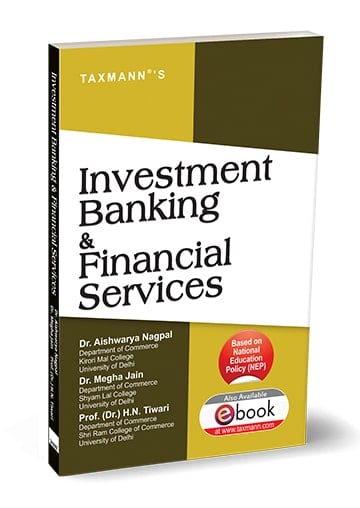



Taxmann’s Investment Banking & Financial Services – UGCF by Aishwarya Nagpal
Original price was: ₹775.00.₹659.00Current price is: ₹659.00.
Taxmann’s Investment Banking & Financial Services – UGCF by Aishwarya Nagpal – 1st Edition 2026. Investment Banking & Financial Services is a comprehensive, NEP-aligned textbook that offers a clear, contemporary, and practice-oriented understanding of the investment banking and financial services ecosystem. It blends core principles with emerging areas such as fintech, ESG and sustainable finance, digital assets, algorithmic trading, and AI-driven analytics. With integrated coverage of regulatory frameworks, Indian and global market practices, and realistic case studies, the book strengthens analytical capability and application skills. Designed for undergraduate learners, faculty, and early-career professionals, it effectively bridges academic learning with industry relevance and career readiness.
10 in stock
Taxmann’s Investment Banking & Financial Services – UGCF by Aishwarya Nagpal – 1st Edition 2026.
Taxmann’s Investment Banking & Financial Services – UGCF by Aishwarya Nagpal – 1st Edition 2026.
Description
Investment Banking & Financial Services is an in-depth, contemporary, and pedagogically robust textbook that offers a comprehensive exploration of the financial intermediation ecosystem. Responding to the rapid transformation of global and Indian financial markets, driven by technological innovation, regulatory reforms, expanding capital markets, and the increasing sophistication of corporate finance, the book provides a multidimensional understanding of how modern investment banks operate, advise, innovate, and create value. The text balances foundational principles with advanced and emerging topics. It systematically builds conceptual clarity on investment banking structures, capital-raising mechanisms, advisory functions, trading and market-making operations, and research capabilities, while also positioning these within the wider financial system. Throughout, it integrates discussions on fintech innovations, digital assets, ESG finance, algorithmic trading, sustainable investment mechanisms, and AI-driven analytics, enabling learners to appreciate the evolving nature of global finance. Designed to nurture analytical thinking and practical readiness, the book brings together theory, regulatory insight, institutional context, numerical illustrations, and case-driven application. It equips students not only to understand investment banking but to navigate and contribute meaningfully to the dynamic financial services landscape.
This book is intended for the following audience:
- Undergraduate Students (B.Com., B.Com. Hons., BBA – NEP) – The content aligns precisely with NEP-prescribed syllabi and provides students with the conceptual grounding and analytical tools required for examinations, internships, and advanced study
- Faculty & Academic Institutions – With its structured learning objectives, diagrams, cases, and review architecture, the book is ideal for course adoption, curriculum planning, and outcome-based teaching
- Career Aspirants in Finance – Students seeking roles in investment banking, equity research, financial advisory, portfolio management, capital markets, corporate finance, fintech, and consulting will find practical insights and industry-oriented examples that mirror practical challenges
- Early-Career Professionals – Ideal as a reference for young analysts, interns, and professionals who need clarity on institutional finance, regulatory frameworks, issue management, and the broader capital market landscape
The Present Publication is the Latest Edition, authored by Dr Aishwarya Nagpal, Dr Megha Jain, and Prof. (Dr) H.N. Tiwari, with the following noteworthy features:
- [NEP-aligned, Outcome-Based Structure] Each chapter begins with learning objectives and closes with summaries, review questions, and application-based exercises, fostering structured, measurable learning
- [Comprehensive Coverage of Regulatory Frameworks] The book incorporates the latest norms issued by SEBI, RBI, and other capital market regulators. It explains disclosure requirements, merchant banking regulations, issue management guidelines, investor protection norms, and due diligence frameworks
- [Integration of Modern and Emerging Themes] Fintech platforms, digital securities, algorithmic trading, tokenisation, ESG finance, AI-driven analytics, sustainable investment products, and DeFi models are woven into the conceptual narrative—not as add-ons, but as essential elements of contemporary financial services
- [Indian and Global Contextualisation] Examples from India’s capital markets, such as mega IPOs, REITs, green bonds, sovereign disinvestment programmes, and startup financing, appear alongside global practices, giving learners a dual contextual perspective
- [Rich Case-study Architecture] Realistic case studies simulate investment banking decision-making, including:
- Selecting between debt and equity for project finance
- Managing IPO preparation, pricing, compliance, and book building
- Executing M&A transactions, conducting valuations, managing due diligence, and sequencing approvals
- [Academic Depth with Practical Orientation] Students gain a deep conceptual foundation while continually engaging with industry applications, making the book suitable for both academic mastery and employability
The coverage of the book is as follows:
- Investment Banking Architecture
- A detailed introduction to the purpose, scope, and structure of investment banking, including differences between commercial and investment banks, global evolution, Indian institutional roles, and the broader financial intermediation ecosystem. Visual diagrams illustrate organisational layers such as front office, middle office, back office, and functional divisions including underwriting, advisory, research, trading, and issue management
- Capital Raising, Issue Management, and Underwriting | Step-by-step coverage of public and private capital-raising processes:
- IPOs, FPOs, rights issues, private placements
- Book building, pricing mechanisms, syndication, and underwriting
- Pre-issue, issue, and post-issue responsibilities of merchant bankers
- SEBI’s regulatory and compliance environment
- Investor grievance redressal and disclosure requirements
- Numerical illustrations and procedural diagrams enhance comprehension
- Corporate Finance and Mergers & Acquisitions | Comprehensive coverage of:
- Corporate restructuring methods
- Debt vs equity structuring
- Valuation methodologies (DCF, multiples, comparables, transaction analysis)
- Due diligence frameworks—financial, legal, operational, and technical
- Strategic and regulatory considerations in buy-side and sell-side M&A
- Case studies mirror advisory assignments, encouraging strategic evaluation and decision-making skills
- Trading, Market Making, and Research | Insights into:
- Market microstructure
- Proprietary trading, brokerage functions, and liquidity creation
- Risk modelling and hedging tools
- Research methodologies, report writing, financial modelling, and analytics
- Integration of AI and algorithmic systems into trading ecosystems
- Students gain a functional understanding of how markets operate and how investment banks support liquidity, pricing efficiency, and information flow
- Regulated Financial Environment | An in-depth view of India’s regulatory architecture governing capital markets and financial intermediaries, covering:
- SEBI framework for merchant banks, research analysts, and intermediaries
- Insider trading norms
- KYC/AML compliance
- Corporate governance standards
- Investor protection legislation
- Oversight mechanisms of RBI and stock exchanges
- This gives learners a firm grounding in statutory and compliance-based dimensions of financial services
- Indian Capital Market Dynamics | The text provides a rich portrayal of the Indian financial landscape, including:
- Liberalisation and market deepening
- Growth of investment banking institutions
- Role of PSU and private sector investment banks
- Evolution of public fundraising practices
- Rise of sustainable and digital finance instruments
- Financing of the startup ecosystem and the MSME sector
- These insights help position students within India’s fast-evolving financial architecture
- Emerging and Future Trends | Forward-looking sections analyse:
- ESG integration into corporate finance
- AI and ML applications in valuation, risk assessment, and portfolio strategies
- Algorithmic and high-frequency trading
- Digital public infrastructure (UPI, AA framework, ONDC)
- DeFi and tokenised asset markets
- Green finance, transition finance, and climate-aligned investment structures
- Such themes prepare students for the future trajectory of investment banking and financial innovation
The book employs a carefully planned instructional approach:
- Learning Objectives – Clarify expectations and guide study
- Conceptual Exposition – Supported by diagrams, tables, and illustrations
- Practical Insights – Examples from Indian and global markets interwoven with theory
- Case Studies – Simulate actual transactions and advisory scenarios
- Summaries – Consolidate the key ideas of each chapter
- Review Questions – Ranging from conceptual checks to analytical and application-oriented tasks
- Progressive Design – Topics build in complexity, enabling cumulative understanding
- This structure supports incremental learning, examination preparedness, and professional application.
Aishwarya Nagpal
Dr Aishwarya Nagpal is an Assistant Professor at Kirori Mal College, University of Delhi. She earned her PhD from the Faculty of Management Studies (FMS), University of Delhi, in 2023, with a specialisation in the integrated domains of International Finance and Corporate Finance. She completed her Bachelor of Commerce from Shri Ram College of Commerce (SRCC), University of Delhi, in 2011, followed by a Master of Commerce from Hansraj College, University of Delhi, in 2013.
Dr Nagpal has an accomplished academic record, marked by numerous meritorious distinctions and accolades. Prior to her current appointment, she served as an Assistant Professor in the Department of Commerce at Daulat Ram College and at Shri Ram College of Commerce, both at the University of Delhi. Her research contributions include several publications in reputed Scopus-indexed and ABDC-listed journals. She has presented her work at prominent national and international conferences hosted by institutions such as the IITs, IIMs, IIFT, IGIDR, and the Indian Econometric Society. She has received multiple Best Paper Awards at prestigious academic forums. She has also completed an ICSSR-sponsored research project focusing on informal manufacturing in India.
Beyond academic journals, Dr Nagpal regularly contributes opinion articles to leading national newspapers, including The Financial Express, Hindu BusinessLine, and The Economic Times, offering analytical perspectives on contemporary issues in finance and the broader economy.
Her academic and research interests encompass Financial Modelling, Corporate Restructuring, Corporate Finance, Climate Finance, International Finance, Investment Banking, and Investment Management. She remains deeply committed to advancing rigorous research, high-quality teaching, and policy-relevant scholarship in finance.
Details
- Binding : Softcover
- Publisher : Taxmann
- Author : Aishwarya Nagpal, Megha Jain, H.N. Tiwari
- Edition : 1st Edition 2025
- Language : English
- ISBN-10 : 9789375615101
- ISBN-13 : 9789375615101
| Publisher | Taxmann |
|---|---|
| Author | Aishwarya Nagpal |
| Language | English |
Only logged in customers who have purchased this product may leave a review.
Related products

Taxmann’s International Trade Finance By IIBF – Edition February 2025
Taxmann's International Trade Finance By IIBF - Edition February 2025. International Trade Finance presents a complete overview of cross-border trade, integrating foundational theories with the latest developments. Guided by seasoned bankers and subject-matter experts, it covers ICC rules (UCP 600, URC, URDG), regulatory directives (RBI, DGFT, Customs), and the transition from LIBOR to ARRs. Readers gain practical insights on risk management, sanctions compliance, TBML, and maritime fraud, supported by practical case studies and MCQs. Digitisation, including blockchain and eUCP, is thoroughly explained alongside supply chain financing and compliance guidelines. Ideal for bankers, exporters/importers, students, and corporate/legal professionals, this authoritative resource ensures alignment with global best practices.

Taxmann’s Small Finance Banks by IIBF
Taxmann's Small Finance Banks by IIBF. Small Finance Banks offers a thorough examination of the evolving role and operational nuances of Small Finance Banks in India, emphasising their impact on financial inclusion and economic growth. Aligned with the Indian Institute of Banking & Finance's (IIBF) Certificate Examination syllabus, it covers regulatory frameworks, daily banking functions, risk management, and advanced topics like foreign exchange and technological innovations. Enhanced by practical examples and case studies, the text blends theoretical clarity with valuable insights. The 2025 Edition, published by Taxmann, ensures authoritative content. Structured modules, clear learning objectives, and progress checks make it indispensable for finance professionals, students, policymakers, and entrepreneurs.

Taxmann’s Bankers’ Handbook on Accounting By IIBF
Taxmann's Bankers' Handbook on Accounting By IIBF. This book offers an in-depth understanding of banking accounting, from basic principles to advanced standards. It provides detailed insights into the preparation and analysis of bank financial statements. It is an invaluable resource for gaining a thorough understanding of the complex world of banking finance.


Reviews
There are no reviews yet.