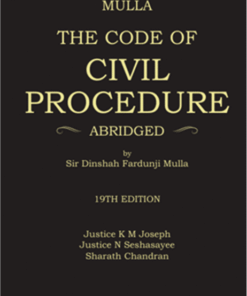
Mulla’s The Code of Civil Procedure (Abridged) | 19th Ed. 2026
Equip your legal practice with the ultimate courtroom classic. Mulla's The Code of Civil Procedure (Abridged), published by LexisNexis, is an indispensable tool for judges, lawyers, and academicians. This 19th Edition (2026) continues a century-old legacy of precision and critical analysis.
-
✔ Latest Legislative Updates: Fully incorporates recent statutory developments, including the sweeping changes introduced by the Mediation Act, 2023.
-
✔ Contemporary Jurisprudence: Critically analyzes recent landmark judgments such as LK Prabhu v KT Mathew and Kumud Lall v Suresh Chandra Roy.
-
✔ Comprehensive yet Concise: Delivers a lucid, highly readable presentation that perfectly balances depth of knowledge with quick courtroom referencing.

KLH’s Civil Rules and Orders of the High Court of Calcutta by C.R. Datta
KLH's Civil Rules and Orders of the High Court of Calcutta by C.R. Datta - 6th Edition Reprint 2024. First, this KLH publication provides the exact text on regional civil procedures. Specifically, author C.R. Datta details the strict rules for the Calcutta High Court. Furthermore, this 2024 reprint covers all fundamental judicial updates perfectly.


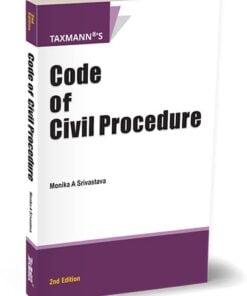
Taxmann’s Code of Civil Procedure by Monika A. Srivastava – 2nd Edition September 2025
Taxmann's Code of Civil Procedure by Monika A. Srivastava - 2nd Edition September 2025. The Code of Civil Procedure offers a rigorous, student-oriented journey through the entire civil action lifecycle—institution and pleadings, interlocutory stages, trial, decree, and execution—grounded in updated Supreme Court and leading High Court rulings. Designed for LL.B./LL.M. students, Judicial Services/AIBE aspirants, early-career civil litigators, and faculty, it blends precise exposition with courtroom relevance. The key features include a chronological 'suit-to-execution' architecture, doctrinal clarity with a practical focus, and interfaces with the Limitation Act, Evidence Act, Commercial Courts Act, and Section 89 of the CPC (mediation). Pedagogy emphasises illustrations, flowcharts, checklists, 'common pitfalls,' specimen-pleading cues, viva prompts, and quick-revise tables—plus curated student queries and hypotheticals that map rules to outcomes.