
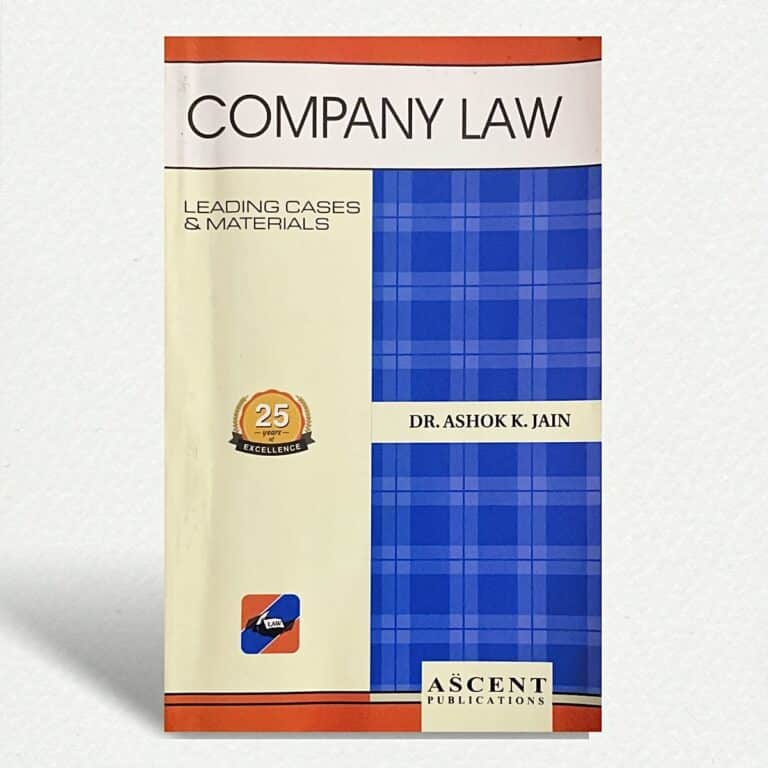
Ascent’s Company law by Dr. Ashok Kumar Jain
Original price was: ₹310.00.₹264.00Current price is: ₹264.00.
Ascent’s Company law by Dr. Ashok Kumar Jain.
10 in stock
Ascent’s Company law by Dr. Ashok Kumar Jain.
Ascent’s Company law by Dr. Ashok Kumar Jain.
Description:
Company law is the body of law that governs the rights, relations, and conduct of corporations, companies, organizations, and businesses. In India, the primary legislation is the Companies Act, 2013 (which superseded the Companies Act, 1956), along with associated rules, regulations, and judicial decisions.
Key Principles and Characteristics
Company law is founded on several key principles:
- Separate Legal Personality: A company is a separate legal entity distinct from its members (shareholders). It can own property, incur debt, sue, and be sued in its own name.
- Limited Liability: The financial liability of shareholders is generally limited to the amount unpaid on their shares or the amount they have guaranteed, protecting their personal assets from the company’s debts.
- Perpetual Succession: The company’s existence is permanent and continues regardless of changes in its members (e.g., death, insolvency, or transfer of shares), ceasing only through a formal winding-up process.
- Delegated Management: Day-to-day management is delegated to a Board of Directors elected by the members.
Main Aspects Covered by Company Law
Company law regulates the entire lifecycle of a company, including:
- Incorporation and Formation: It outlines the process for legally registering a company with the Registrar of Companies (ROC), which involves submitting key documents like the Memorandum of Association (MoA) and Articles of Association (AoA).
- Types of Companies: The Act provides for various company structures to suit different business needs, such as:
- Private Limited Company: Maximum 200 members, restricts share transfers, and cannot invite the public to subscribe to its securities.
- Public Limited Company: Minimum of seven members, no restriction on share transfers, and can list its securities on a stock exchange.
- One Person Company (OPC): Allows a single individual to form a company with limited liability.
- Section 8 Company: Non-profit companies formed for charitable objects (e.g., education, social welfare, environment protection).
- Corporate Governance and Management: The law sets rules for the appointment, qualifications, remuneration, and duties of directors and key managerial personnel (KMP). It mandates requirements for board meetings, shareholder meetings, and the maintenance of accounts and records to ensure accountability and transparency.
- Corporate Finance: It regulates how companies raise capital, through the issuance of shares (equity financing) or borrowing (debt financing), and outlines rules for prospectuses, allotments, and buy-backs.
- Mergers and Acquisitions: The law provides a framework for corporate restructuring, including mergers, amalgamations, and takeovers, and involves regulatory scrutiny, often by the National Company Law Tribunal (NCLT).
- Winding Up and Dissolution: It details the formal process of closing a company, which involves liquidating assets, paying off creditors, distributing any remaining surplus to shareholders, and finally removing the company’s name from the official register.
Key Legislation
The primary regulatory framework is the Companies Act, 2013, administered by the Ministry of Corporate Affairs (MCA). Other relevant laws include the Insolvency and Bankruptcy Code, 2016 (which now governs insolvency-related winding-up) and the SEBI Act, 1992 (for listed companies).
Details :
- Publisher : Ascent publications
- Author : Dr. Ashok Kumar Jain
- Edition : 4th Edition
- ISBN-13 : 9789387286191
- ISBN-10 : 9789387286191
- Language : English
- Binding : Paperback
| Author | Dr. Ashok Kumar Jain |
|---|---|
| Language | English |
| Publisher | Ascent Publication |
Only logged in customers who have purchased this product may leave a review.
Related products
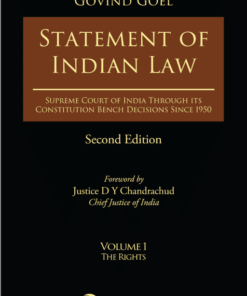
Lexis Nexis’s Statement of Indian Law by Govind Goel
Master the absolute highest level of Indian jurisprudence. LexisNexis's Statement of Indian Law (2nd Edition, 2024) by Govind Goel is a monumental 3-volume compilation tracking every single decision delivered by the Constitution Benches of the Supreme Court of India since 1950.
-
✔ The Ultimate Constitutional Record: The only exhaustive running interpretative commentary on the evolution of law through the Constitutional Benches.
-
✔ Pioneering Judicial Analytics: Features a dedicated chapter mapping the productivity, spread of unanimity, and dissent of Supreme Court judges using graphs, pie charts, and data tables.
-
✔ Recent Historic Addendums: Fully updated with landmark 2023/2024 rulings, including In Re Article 370 of the Constitution of India, Vivek Narayan Sharma v Union of India, and Sita Soren v Union of India.
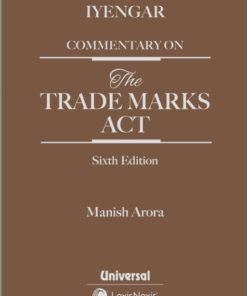
Lexis Nexis’s Commentary on Trade Marks Act by T.R.S. Iyengar
Navigate the complex intersection of intellectual property law and commercial strategy with Iyengar's Commentary on The Trade Marks Act. Published by LexisNexis, this comprehensively updated 6th Edition (2025) remains the ultimate courtroom and boardroom authority on brand protection.
-
✔ Integrated Business Approach: Approaches trademark law not just as a rigid statute, but as an active tool for business trading, brand protection, and corporate strategy.
-
✔ Global & Domestic Jurisprudence: Features an exhaustive compilation of landmark and recent case laws from both Indian courts and international jurisdictions.
-
✔ Complete Statutory Framework: Incorporates all recent legislative developments, Rules, Notifications, and critical international Treaties (including the Madrid Protocol).
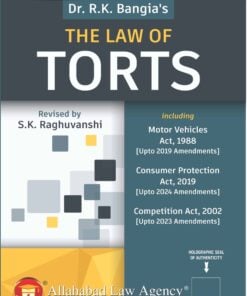
Law of Torts by R.K. Bangia (27th Edition, 2026) | ALA
Begin your legal journey with the most widely prescribed torts textbook in Indian legal education: The Law of Torts by Dr. R.K. Bangia. Published by the Allahabad Law Agency (ALA), this 27th Edition Reprint (2026) is revised by S.K. Raghuvanshi to meet modern syllabus demands.
-
✔ Updated Statutory Landscape: Integrates the Motor Vehicles Act, 1988 (amended up to 2019), Consumer Protection Act, 2019 (amended up to 2024), and Competition Act, 2002 (amended up to 2023).
-
✔ Classic Case Laws: Develops foundational concepts through landmark judgments from Rylands v. Fletcher to M.C. Mehta.
-
✔ Authentic Edition: Includes the ALA holographic authenticity seal on every genuine copy.
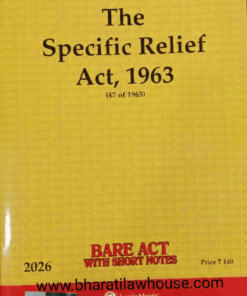
Lexis Nexis’s The Specific Relief Act, 1963 (Bare Act) by Universal
Lexis Nexis’s The Specific Relief Act, 1963 (Bare Act) by Universal - 2026 Edition. First, this LexisNexis publication provides the exact text of civil remedies. Specifically, it details the strict rules for enforcing contracts. Furthermore, this 2026 Edition covers all fundamental statutory updates perfectly.

Reviews
There are no reviews yet.