
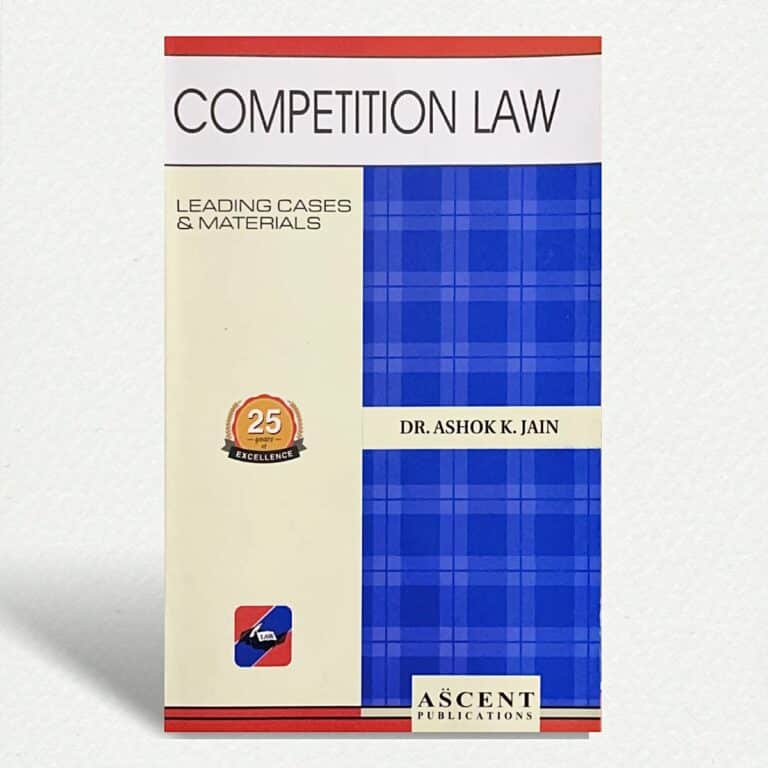
Ascent’s Competition Law by Dr. Ashok Kumar Jain
Original price was: ₹325.00.₹276.00Current price is: ₹276.00.
Ascent’s Competition Law by Dr. Ashok Kumar Jain.
10 in stock
Ascent’s Competition Law by Dr. Ashok Kumar Jain.
Ascent’s Competition Law by Dr. Ashok Kumar Jain.
Description:
Competition law (known as antitrust law in the United States) is a legal framework designed to promote and maintain fair competition in the market and to prevent monopolistic or anti-competitive practices by businesses. Its primary goal is to ensure a level playing field for all enterprises, protect consumer interests, and maximize economic efficiency and innovation.
Core Areas of Regulation
Competition law primarily focuses on three major areas:
- Anti-Competitive Agreements: The law prohibits agreements or practices that restrict free trade and competition. These can be formal contracts or informal “gentlemen’s agreements” (even a “nod or a wink”) and are generally divided into:
- Horizontal Agreements: Between competitors at the same level of the supply chain (e.g., manufacturers agreeing to fix prices, limit production, share markets, or rig bids). These are often presumed illegal.
- Vertical Agreements: Between firms at different levels of the supply chain (e.g., a manufacturer and a distributor agreeing on exclusive supply arrangements, tie-in arrangements, or resale price maintenance). These are examined on a case-by-case basis to determine their actual effect on competition.
- Abuse of Dominant Position: It is not illegal for a company to be dominant in a market; however, it is illegal to abuse that position. Abuse includes practices like:
- Imposing unfair or discriminatory prices or conditions (such as predatory pricing, which is selling below cost to eliminate competitors).
- Limiting production or denying market access to competitors.
- Using a dominant position in one market to gain advantages in another market.
- Regulation of Combinations (Mergers and Acquisitions): The law provides for the scrutiny of large mergers, acquisitions, and amalgamations that could potentially lessen competition significantly in the market. Authorities can prohibit such combinations or approve them subject to conditions (remedies) to maintain competition.
Objectives
The core objectives of competition law include:
- Protecting Consumer Interests: Ensuring consumers have access to a wide variety of goods and services at competitive, fair prices and with better quality.
- Promoting Economic Efficiency: Encouraging businesses to innovate, reduce costs, and improve productivity to survive and thrive.
- Ensuring Freedom of Trade: Creating a level playing field for all market participants, including small and medium enterprises, and removing unnecessary barriers to entry.
Enforcement
Competition law is enforced by specialized regulatory bodies. In India, for example, the Competition Commission of India (CCI) is the authority responsible for investigating anti-competitive practices, passing orders, imposing penalties, and promoting awareness about competition law (competition advocacy). Penalties can be severe, including hefty fines and other corrective actions.
Details :
- Publisher : Ascent publications
- Author : Dr. Ashok Kumar Jain
- Edition : 2nd Edition
- ISBN-13 : 9789387286009
- ISBN-10 : 9789387286009
- Language : English
- Binding : Paperback
| Author | Dr. Ashok Kumar Jain |
|---|---|
| Language | English |
| Publisher | Ascent Publication |
Only logged in customers who have purchased this product may leave a review.
Related products
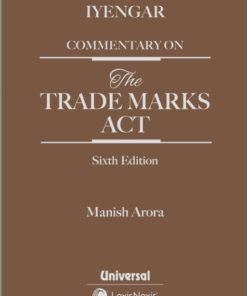
Lexis Nexis’s Commentary on Trade Marks Act by T.R.S. Iyengar
Navigate the complex intersection of intellectual property law and commercial strategy with Iyengar's Commentary on The Trade Marks Act. Published by LexisNexis, this comprehensively updated 6th Edition (2025) remains the ultimate courtroom and boardroom authority on brand protection.
-
✔ Integrated Business Approach: Approaches trademark law not just as a rigid statute, but as an active tool for business trading, brand protection, and corporate strategy.
-
✔ Global & Domestic Jurisprudence: Features an exhaustive compilation of landmark and recent case laws from both Indian courts and international jurisdictions.
-
✔ Complete Statutory Framework: Incorporates all recent legislative developments, Rules, Notifications, and critical international Treaties (including the Madrid Protocol).
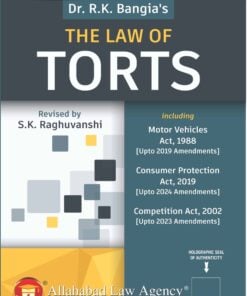
Law of Torts by R.K. Bangia (27th Edition, 2026) | ALA
Begin your legal journey with the most widely prescribed torts textbook in Indian legal education: The Law of Torts by Dr. R.K. Bangia. Published by the Allahabad Law Agency (ALA), this 27th Edition Reprint (2026) is revised by S.K. Raghuvanshi to meet modern syllabus demands.
-
✔ Updated Statutory Landscape: Integrates the Motor Vehicles Act, 1988 (amended up to 2019), Consumer Protection Act, 2019 (amended up to 2024), and Competition Act, 2002 (amended up to 2023).
-
✔ Classic Case Laws: Develops foundational concepts through landmark judgments from Rylands v. Fletcher to M.C. Mehta.
-
✔ Authentic Edition: Includes the ALA holographic authenticity seal on every genuine copy.



Reviews
There are no reviews yet.